44.3% of All Households in Seoul Are Single-Person... Increased by 20% in 5 Years
Gwanak (62.2%), Jung (53%), Jongno (52.4%) Have the Most Single-Person Households
Dedicated Team Established, Various Supports Including Health Checkups and Estate Cleanup Provided
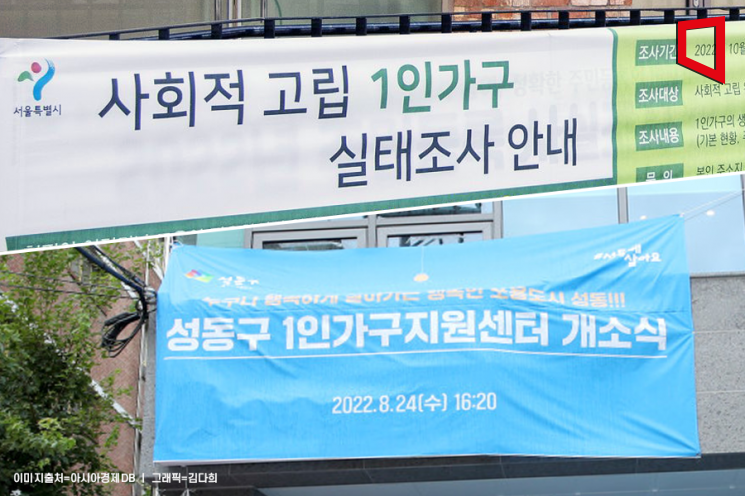
Kim Young-il (48, male), who runs a multi-house rental business in Dongjak-gu, Seoul, rents exclusively to single-person households. A few years ago, there were occasionally tenants living with another person, but nowadays, such cases are no longer seen. Thanks to easier management, Kim also prefers single-person household tenants these days.
Due to changes in population structure and lifestyle, the number of single-person households is increasing significantly. Accordingly, each basic local government in Seoul is competing to introduce support policies for single-person households. The range of support varies widely, from free health checkups and item rentals to monthly rent and caregiving cost support, as well as assistance with organizing belongings of the deceased and special cleaning fees.
For example, Eunpyeong-gu announced the "Plan to Make Eunpyeong Happy for Single-Person Households" last April. They plan to implement 45 detailed projects across five sectors to resolve inconveniences, anxieties, and complaints of single-person households, allocating a budget of 43 billion KRW through 2026. There is a reason why Eunpyeong-gu is investing considerable budget and effort. As of the end of last month, 4 out of 10 households in Eunpyeong-gu are single-person households, an increase of 21% over five years.
According to population statistics from the Ministry of the Interior and Safety on the 20th, as of the end of June this year, the nationwide proportion of single-person households was 41.4%, up 5.3 percentage points from five years ago. The number of single-person households increased by 25.3%. In Seoul, 44.3% of all households are single-person households, meaning 4.4 out of every 10 households live alone. Gwanak-gu has the highest rate of single-person households in Seoul at 62.2%, followed by Jung-gu (53.0%), Jongno-gu (52.4%), Geumcheon-gu (51.7%), Dongdaemun-gu (50.2%), and Yeongdeungpo-gu (50.0%). In 2018, Gwanak-gu was the only district with more than half of households being single-person, but now there are six such districts.
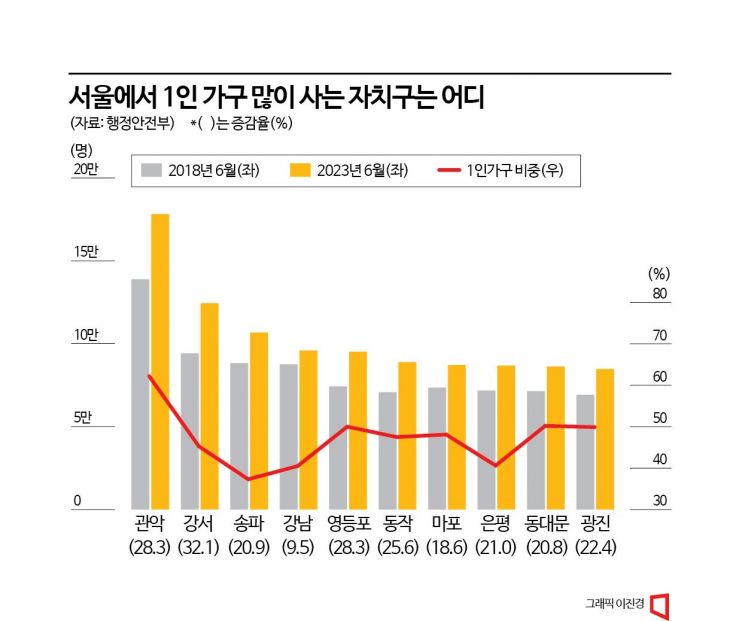
As the proportion of single-person households increases, the policy focus of local districts naturally shifts toward supporting them.
Dongdaemun-gu, Dobong-gu, Seongbuk-gu, and Eunpyeong-gu have mostly established dedicated single-person household support teams this year. Similarly, Gwanak-gu, which operates a dedicated support team, held a policy idea contest to gather ideas for single-person household policies. Gwanak-gu is expanding its safe lease contract service and real estate dispute mediation counseling center to protect tenants from jeonse (key money deposit) fraud. Local certified real estate agents are appointed as housing safety managers to provide lease contract consultations, and similar support measures exist in other districts with many young residents. They also operate a free health checkup system for single-person households aged 19 to 39.
Dobong-gu, which has a high proportion of elderly residents, started the "Dobong-style Full Stop" project this month to assist with organizing belongings of socially isolated single-person households who pass away alone. For eligible single-person households, the district supports up to 1 million KRW for organizing belongings and special cleaning costs. Oh Eun-seok, mayor of Dobong-gu, said, "We will help socially isolated households have a dignified death and properly conclude their lives, and carefully take care of the mental health of neighbors who witness lonely deaths."
Seocho-gu conducted financial and welfare capacity-building training last month for about 40 goshiwon (small lodging house) managers. As lonely deaths among single-person households living in goshiwons have increased, the purpose is to educate managers to detect residents' crises early and provide help. This initiative was inspired by the fact that 11% of the 1,139 lonely deaths in Seoul (based on 2021 data from the Seoul Welfare Foundation) occurred among goshiwon residents.
Eunpyeong-gu supports caregiving costs up to 600,000 KRW annually for single-person households requiring care due to hospital admission, and provides monthly rent support of up to 200,000 KRW for homeless young households. Kim Mi-kyung, mayor of Eunpyeong-gu, said, "Due to the continuous increase in single-person households, support policies reflecting changes in population trends are necessary. We will actively collaborate with related organizations and promote customized safe care policies."
© The Asia Business Daily(www.asiae.co.kr). All rights reserved.
![Clutching a Stolen Dior Bag, Saying "I Hate Being Poor but Real"... The Grotesque Con of a "Human Knockoff" [Slate]](https://cwcontent.asiae.co.kr/asiaresize/183/2026021902243444107_1771435474.jpg)

















