Kim Tae-hyo, 1st Deputy Director of the National Security Office, and Campbell, US NSC Indo-Pacific Coordinator, Jointly Announce
Discuss Information Sharing, Communication Systems, and Training Development
Deputy Director Kim: "Assured Extended Deterrence to Eliminate Need for Nuclear Armament"
Coordinator Campbell: "Clear Expression of Will is Important... US Nuclear Submarine Currently Visiting Busan"
On the 18th, security officials from South Korea and the United States warned, "Any nuclear attack by North Korea against the U.S. and its allies will lead to the end of the North Korean regime, and both South Korea and the U.S. will face immediate, overwhelming, and decisive responses to any nuclear attack on South Korea."
Kim Tae-hyo, First Deputy Director of the National Security Office, stated this during a joint press release following the first Korea-U.S. Nuclear Consultative Group (NSC) meeting held at the Yongsan Presidential Office from the morning. The meeting was attended by Kurt Campbell, White House National Security Council (NSC) Indo-Pacific Coordinator, and Kara Abercrombie, NSC Defense Policy and Arms Control Coordinator from the U.S.
The Korea-U.S. NCG was established following the adoption of the "Washington Declaration" during the Korea-U.S. summit between President Yoon Suk-yeol and President Joe Biden in April. Originally a deputy minister-level meeting, it was elevated to the vice ministerial level to enhance its effectiveness. Both sides plan to hold high-level and working-level NCG meetings alternately on a quarterly basis, totaling four meetings annually.
Deputy Director Kim said, "The U.S. side showed a firm resolve that if North Korea launches a nuclear attack on the Republic of Korea, it will take immediate, overwhelming, and decisive countermeasures, which would lead to the end of the North Korean regime," adding, "We clearly expressed our full trust in the U.S.'s extended deterrence commitment."
Coordinator Campbell also emphasized, "We have nothing clearer in terms of trust and confidence in capability than nuclear deterrence," and stated, "We have acted accordingly so far and will continue to take all necessary measures to fully utilize this capability." He further stressed, "Through this, our partnership will continue to be ironclad, allowing the truly historically great alliance of the Korea-U.S. alliance to expand and reaffirm trust."
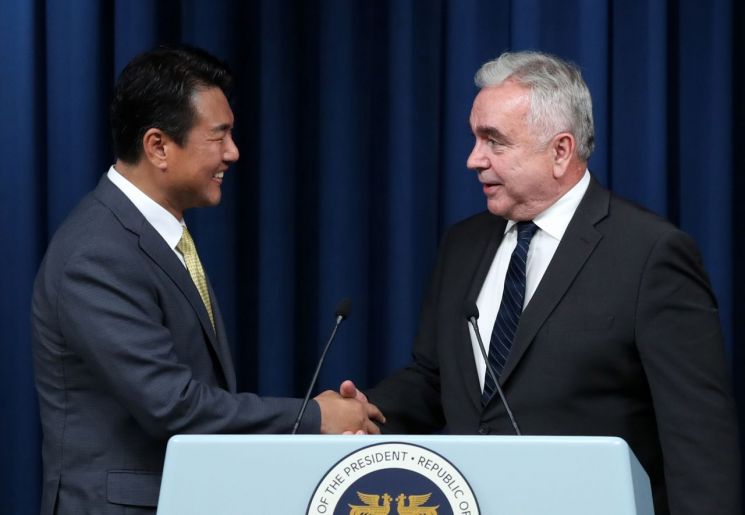 Kim Tae-hyo, First Deputy Director of the National Security Office (left), and Kurt Campbell, U.S. National Security Council (NSC) Indo-Pacific Coordinator, shake hands after concluding a joint press conference related to the launch meeting of the Korea-U.S. Nuclear Consultative Group (NCG) held on the 18th at the Yongsan Presidential Office building in Seoul.
 [Image source=Yonhap News]
They reiterated that the Korea-U.S. NCG will continue to operate as a mechanism to strengthen the Korea-U.S. alliance and enhance combined deterrence and response posture. To this end, the Korea-U.S. NCG plans to establish various operational systems to strengthen nuclear deterrence and response capabilities on the Korean Peninsula, including ▲ development of security and information-sharing procedures ▲ nuclear consultation and communication systems during crises and contingencies ▲ cooperation and development related to planning, operations, exercises, simulations, training, and investment activities.
Specifically, the two countries will exchange and share necessary information through secure networks and concretize plans on how U.S. nuclear assets and South Korea’s non-nuclear assets will actually combine and operate during nuclear operations. Additionally, the U.S. plans to regularly deploy or move nuclear strategic assets to South Korea to periodically send necessary strategic messages. Crisis management plans and plans to reduce crises before, during, and after crises will be established, while simulation exercises, drills, and training for Korean experts will also be conducted.
Regarding this, Deputy Director Kim said, "Both sides agreed to discuss joint responses to the North Korean nuclear threat and to concretize nuclear strategic planning," adding, "They also agreed to expand information sharing on nuclear and conventional forces and to establish systems and procedures that allow agreements between the Korea-U.S. leaders under any nuclear crisis." He emphasized, "Both sides will devise and implement joint planning and execution measures for South Korea’s non-nuclear force support to U.S. nuclear operations, with the NCG playing a central role in coordinating and carrying out various tabletop exercises and simulations related to nuclear matters."
When asked whether the operation of nuclear assets through the Korea-U.S. NCG could alleviate concerns amid growing domestic calls for independent nuclear development, officials from both countries responded with confidence. Deputy Director Kim asserted, "I am confident today that sufficient and reliable Korea-U.S. extended deterrence will be possible to the extent that South Korea does not need to consider separate nuclear armament." Coordinator Campbell emphasized, "The efforts to be undertaken with the launch of this NCG will be comprehensive, whole-of-government efforts and will continue over a long period."
Coordinator Campbell particularly noted, "I believe it is important to visibly realize our clear will and commitment," and revealed, "Currently, for the first time in decades, a U.S. nuclear strategic submarine (SSBN) is docked at Busan Port." The SSBN is a nuclear-powered ballistic missile submarine (Ohio-class) equipped with submarine-launched ballistic missiles (SLBMs) to carry out strategic missions. The last time an SSBN visited South Korea was in March 1981 with the Robert Lee (SSBN 601). The "Washington Declaration" explicitly mentions the "port call of U.S. strategic nuclear submarines in South Korea."
When asked whether the U.S. is willing to use nuclear weapons in the event of a conflict on the Korean Peninsula, Coordinator Campbell responded, "It is not appropriate to answer hypotheticals," but added, "Regarding general U.S. nuclear guidelines, if North Korea uses nuclear weapons, the U.S. will respond overwhelmingly. This is a position that needs no further emphasis or clarification in national policy."
Regarding the possibility of a Korea-U.S.-Japan summit around August, Deputy Director Kim said, "We are preparing to hold the Korea-U.S.-Japan summit in the U.S. around August as President Biden invited," adding, "At that time, comprehensive discussions will be held on trilateral security cooperation, other economic security issues, and exchanges."
Meanwhile, Coordinator Campbell began the press release by expressing, "On behalf of the American people and government, I extend my deepest condolences and sympathy for the many lives lost due to the recent floods," and stated, "The U.S. government will provide any necessary support in any form."
© The Asia Business Daily(www.asiae.co.kr). All rights reserved.

















