Disputes Among Agencies Over Responsibility
State Affairs Coordination Office and Police Launch Related Investigations
As criticism mounts that the flooding of the Cheongju Osong underground passage, which resulted in 14 tragic deaths, was a man-made disaster, a blame game among related agencies is ongoing. It appears that if proper control measures had been implemented at the right time, the tragedy could have been prevented. With growing weight given to the argument that this catastrophe was caused by the negligence of these agencies, attention is focused on the forthcoming investigation results.
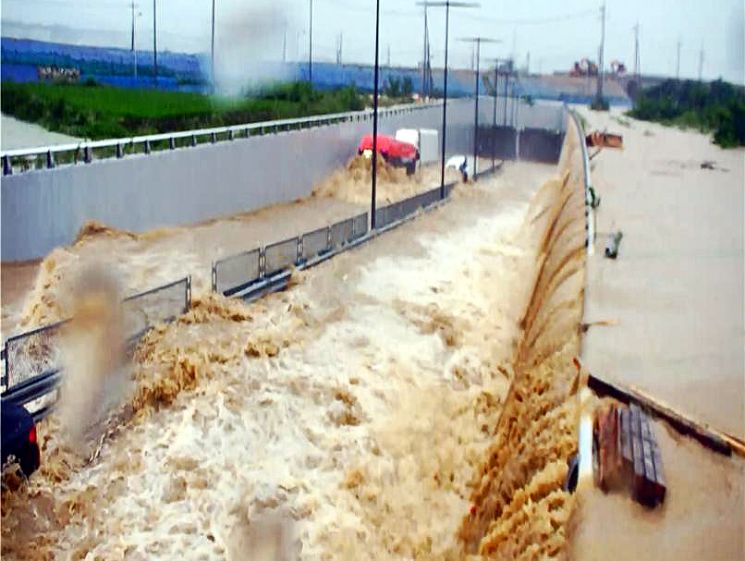 At around 8:40 a.m. on the 15th, muddy water overflowing from the Miho River is flooding the Gungpyeong 2nd Underpass in Osong-eup, Heungdeok-gu, Cheongju-si. Photo by Yonhap News
According to related agencies on the 18th, the Office for Government Policy Coordination began an inspection the previous day to determine the cause of the disaster at the Gungpyeong 2nd underground passage in Osong, Chungbuk. The Chungbuk Provincial Police Agency also formed an investigation headquarters and started a full-scale accident investigation.
The reason the Office for Government Policy Coordination and the police are conducting investigations is that warning signs were detected in advance, but proper measures were not taken in response.
According to the Ministry of Environment, the Geumgang Flood Control Office issued a notification to Heungdeok-gu, Cheongju City, two hours before 8:40 a.m. on the 15th, when the disaster occurred, requesting "traffic control or evacuation measures for residents." Additionally, Cheongju City received a 119 emergency call about 40 minutes before the accident reporting that "the embankment seems to be overflowing," but failed to control the underground passage. However, Heungdeok-gu, which received the warning, only informed Cheongju City and did not notify Chungcheongbuk-do.
This has led to a dispute over responsibility between Cheongju City and Chungbuk Province. According to Article 76 of the Road Act, "If there is a risk of natural disasters such as floods making road traffic dangerous, the road management authority may prohibit or restrict road traffic." Based on this, Cheongju City claims that the responsibility lies with Chungbuk Province. The underground passage where the disaster occurred belongs to Local Road No. 508, which is managed by Chungbuk Province.
Chungbuk Province argues that it did not receive related reports from Cheongju City and therefore could not identify the risk in advance. Each local government is trying to avoid responsibility for the disaster. Furthermore, the police received multiple reports around 7:05 a.m. that the Miho River might overflow, but only notified Heungdeok-gu and did not control the underground passage themselves.
It is also regrettable that the disaster could have been prevented in advance. Roads at risk of flooding should have automatic barriers installed to block traffic in emergencies. These barriers are to be installed on roads classified as level 2 or higher in risk by the Ministry of the Interior and Safety. The Gungpyeong 2nd underground passage is classified as the highest risk, level 3, so automatic barriers should have been installed. A budget was allocated in June this year, with plans to place orders in September.
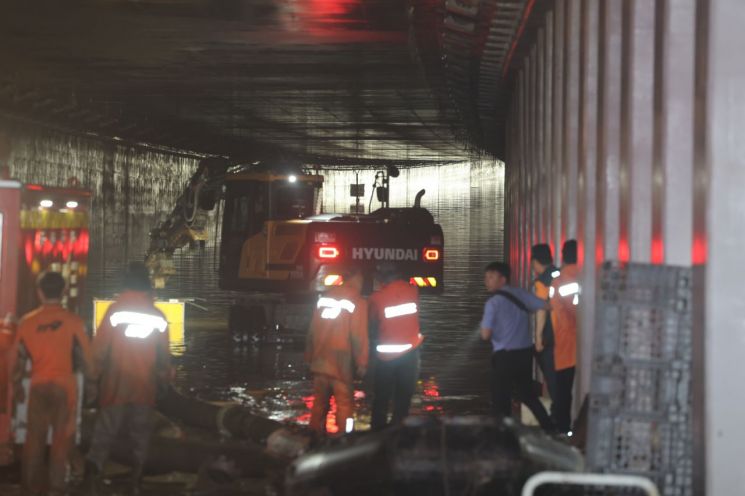 On the night of the 16th, rescue workers including the coast guard conducted a foot search at Gungpyeong 2 Underpass in Osong-eup, Cheongju-si, Chungbuk, which was flooded due to the collapse of the Miho Stream embankment. Photo by Yonhap News
Residents also claim that the embankment of the Miho River, where the underground passage flooding began, was poorly managed. This embankment is a temporary embankment installed by the Administrative City Construction Agency (Haengbokcheong) during the expansion construction of the Mihocheon Bridge.
However, a Haengbokcheong official argued, "The temporary embankment was constructed according to the planned flood level of the Miho River," adding, "The embankment was washed away due to an unprecedented natural disaster with torrential rain exceeding the flood level this time."
Meanwhile, the police plan to conduct an on-site inspection with the National Forensic Service to determine responsibility. The Office for Government Policy Coordination also plans to promptly and transparently inform the public once the inspection results are available.
© The Asia Business Daily(www.asiae.co.kr). All rights reserved.


















