Article 469 of the Civil Act 'Refusal of Third-Party Payment by Parties' Intent'... New Judgment Needed
Government Allows Objections to Deposit 'Appeal and Re-Appeal'... May Reach the Supreme Court
The conflict over compensation payments is intensifying as district courts repeatedly reject the government's 'third-party payment deposit' aimed at forced labor victims or their bereaved families. The government attempted to intervene in the compensation process involving Japanese war crime companies for forced labor victims to find a way forward, but the situation has instead become more tangled.
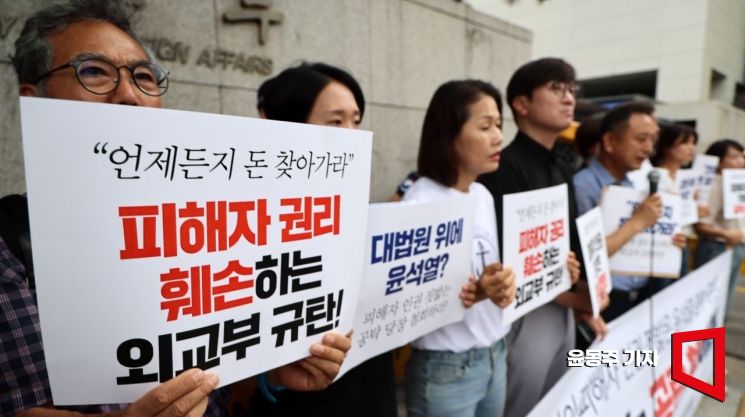 Members of civic groups participating in the "Joint Action for Historical Justice and Peaceful Korea-Japan Relations" held an urgent press conference on the 4th in front of the Ministry of Foreign Affairs building in Jongno-gu, Seoul, condemning the Ministry's announcement to initiate a deposit procedure concerning the victims and bereaved families of forced labor under Japanese colonial rule, who have opposed the "third-party payment." Photo by Yoon Dong-ju doso7@
According to the legal community on the 19th, the government is trying to resolve the compensation issue for forced labor victims through 'third-party payment deposits,' but courts hold the position that deposits cannot be accepted without the consent of the parties involved. Therefore, it is expected that the legality of the government's third-party payment deposit will be determined through a trial.
A third-party payment deposit occurs when a third party with an interest attempts to repay a debt, but the creditor refuses or is unable to receive it, so the money is temporarily entrusted to the court. The reason the government chose such a complex method as third-party payment deposit stems from a Supreme Court ruling in October 2018 ordering Japanese companies to pay damages in lawsuits filed by victims who were forcibly taken to work at Shinnippon Steel (now Nippon Steel & Sumitomo Metal) during the Japanese colonial period but did not receive wages.
Our courts ruled that Japanese war crime companies bear liability for forced labor compensation, but from the Japanese companies' perspective, paying damages to victims would mean acknowledging forced labor. At that time, Japan was in a strained relationship with our government and had no justification to comply with the compensation ruling. However, with the inauguration of the Yoon Suk-yeol administration last year, a favorable breeze blew in Korea-Japan relations, and President Yoon, aiming to resolve past issues such as colonial rule, brought out the third-party payment card, accelerating the compensation issue.
Our government established the 'Forced Labor Victims Support Foundation' under the Ministry of the Interior and Safety as a third party to first pay compensation to forced labor victims or their bereaved families, then planned to claim reimbursement from the debtor Japanese companies. However, the plan is falling apart as frontline courts refuse to accept the government's compensation deposits.
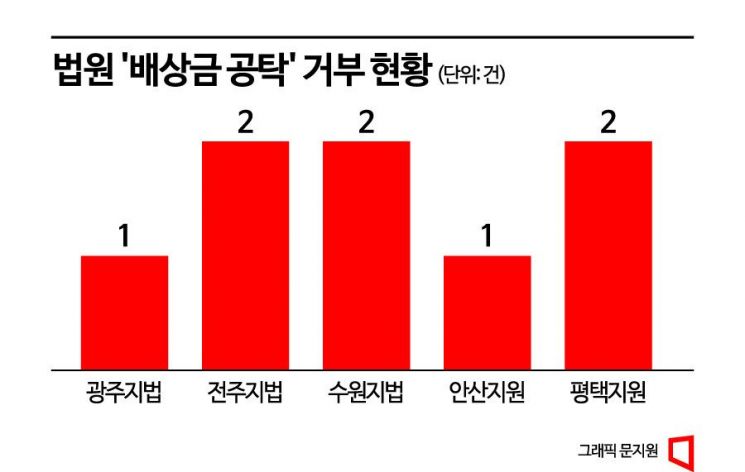
As of this day, courts including Gwangju District Court, Suwon District Court, Suwon District Court Pyeongtaek Branch and Ansan Branch, and Jeonju District Court have rejected 8 out of 10 deposit applications submitted by the government. The reason is that forced labor victims or their bereaved families have refused to accept the third-party payment deposits. The government filed objections with the courts, but the courts again ruled that "there is no reason for the objection."
When victims or their bereaved families express opposition to third-party payment of forced labor compensation, courts are unlikely to accept the government's deposit applications or objections. Therefore, the issue of the government's third-party payment deposit is expected to be resolved through formal litigation.
The government argues that court deposits are necessary since forced labor victims or their bereaved families directly refuse payment, while the courts counter that deposits cannot be accepted because the parties clearly reject third-party deposits.
The problem is that courts have never provided legal interpretation or judgment on the Civil Code provisions related to third-party debt repayment. Ultimately, the trial will focus on whether third-party repayment can be refused by the parties' expression of intent, and whether our government, as a third party, has the right to pay compensation to victims on behalf of Japanese war crime companies who should directly pay the victims.
A current senior judge said, "The Civil Code states that a third party cannot repay if not permitted by the parties' expression of intent, but whether the creditor's refusal of payment due to damages from an unlawful act falls under this case requires judicial determination."
© The Asia Business Daily(www.asiae.co.kr). All rights reserved.


















