70th Anniversary of the Armistice... Veterans' Countries and South-North Youth Gathered
Walking the Central Frontline, Commemorating the Fallen at Each Historic Site
Taiwanese Youths from the Republic of China Overseas Chinese Community Also Came to Raise Awareness of Their Participation
On the 70th anniversary of the armistice, university students from countries that participated in the Korean War and young people from South Korea and North Korean defectors are walking the front lines to commemorate the victims. Although not officially recorded as a participant country, Taiwanese youths have made a surprise appearance, following in the footsteps of the Republic of China’s overseas Chinese who played a role as a "hidden foreign legion."
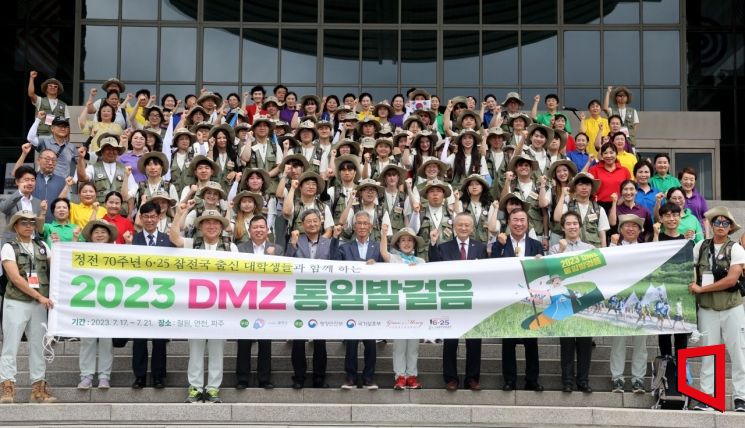 The launch ceremony of the '2023 DMZ Unification Steps,' commemorating the 70th anniversary of the armistice and involving university students from countries that participated in the Korean War, was held on the 17th at the War Memorial of Korea. Participating students and guests are shouting "Fighting" while taking a commemorative photo. Photo by Younghan Heo younghan@
On the morning of the 17th at around 10 a.m., the nonprofit organization Mulmangcho held the launch ceremony for the "DMZ Unification Steps" at the Peace Plaza of the War Memorial in Yongsan-gu, Seoul. About 100 young people, dressed uniformly in olive-brown vests and safari hats, will visit 11 war sites including the Demilitarized Zone (DMZ) over four nights and five days to honor the sacrifices of fallen soldiers from various countries. Starting from the Belgian and Luxembourg War Memorials located in Dongducheon, Gyeonggi Province, they will walk the central front lines through Pocheon, Cheorwon, Yeoncheon, and Paju, braving the rain until they reach Imjingak.
Although this event has been held for ten years, this year is special. For the first time, university students from 16 countries that participated in the Korean War on the anti-communist side, along with young people from South Korea and North Korean defectors, have gathered. There are also surprise guests: two female university students from Taiwan, including Yang Jeong-un. They said, "During the Korean War, overseas Chinese from the Republic of China who were on the Korean Peninsula united to fight against North Korea. We will also share the stories of those who were forcibly conscripted into the Chinese Communist forces, captured as prisoners of war, and after being released as 'anti-communist POWs,' settled in Taiwan."
"We will publicize the Taiwanese veterans who fought for Korea without recognition"
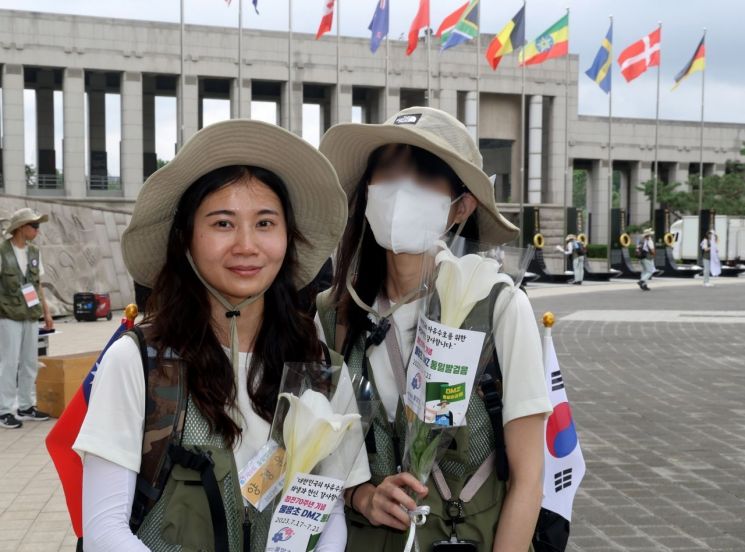 Two Taiwanese university students, including Yang Jeong-woon (left), participating in the '2023 DMZ Unification Steps' event with university students from countries that participated in the Korean War, commemorating the 70th anniversary of the armistice. Photo by Younghan Heo younghan@
Taiwan is not officially recorded as a participant country, but the overseas Chinese who were on the Korean Peninsula fought for Korea. This was greatly influenced by the civil war that took place in China before North Korea’s invasion. At that time, Mao Zedong, who won the civil war, proclaimed the founding of the People’s Republic of China in Beijing in October 1949, while the Nationalist government relocated its base to Taipei, Taiwan. From then on, the Communist Party on the mainland and the Republic of China (Nationalist government) in Taiwan faced off across the Taiwan Strait.
Shortly after the outbreak of the Korean War, Chiang Kai-shek’s Republic of China proposed dispatching three army divisions with about 33,000 troops to South Korea, but the United States rejected the offer due to concerns about Chinese Communist intervention. Ultimately, the overseas Chinese holding Republic of China nationality who were on the Korean Peninsula gathered their own forces to support the South Korean army and participated in the war. At that time, the overseas Chinese formed the Korea-China Anti-Communist Patriotic Youth Corps centered around a figure named Wi Seobang. After the United Nations forces captured Pyongyang in October 1950, they met General Paik Sun-yup, commander of the South Korean 1st Division, and requested to participate in operations, which General Paik accepted.
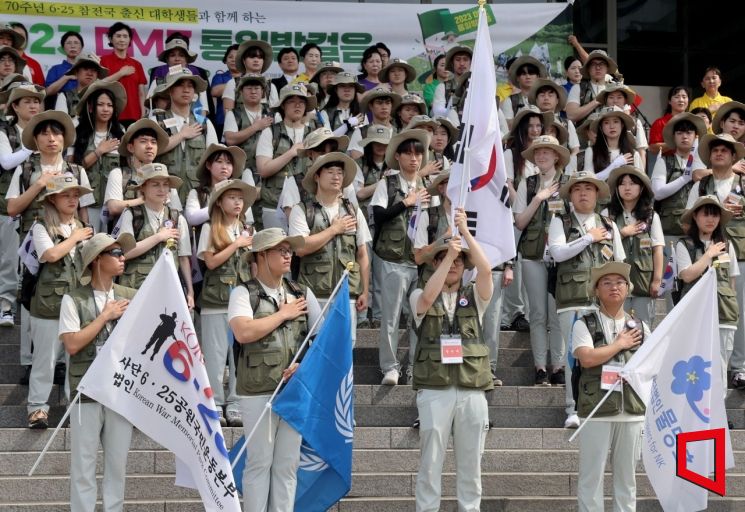 The '2023 DMZ Unification Steps' launch ceremony with university students from countries that participated in the Korean War on the 70th anniversary of the armistice was held on the 17th at the War Memorial of Korea. Participating students are performing the national ceremony. Photo by Heo Younghan younghan@
Although the overseas Chinese considered the Korean Peninsula their second home, they were not assigned ranks or military numbers because they were 'foreigners.' Nevertheless, these overseas Chinese warriors fought in several battles as a "nameless foreign legion," and in March 1951, the SC Unit, an official overseas Chinese unit under the Army Intelligence Unit, was established in Busan. The name SC Unit is said to derive from 'Seoul Chinese,' referring to Korean overseas Chinese. While the unit led by Wi Seobang was a 'volunteer force,' the SC Unit was a special operations unit formed at the government level of South Korea and Taiwan.
Wi Seobang, regarded as a representative figure, later received the Geumseong Hwarang Military Merit Medal and was buried at the Seoul National Cemetery. However, most overseas Chinese veterans, including those in the SC Unit, reportedly did not receive proper recognition from the South Korean government. This was because they were not 'Koreans' and were not officially assigned ranks or military numbers as 'veterans' deployed in combat. Many of them are known to have contributed to Korea even after the armistice by persuading Chinese Communist prisoners of war to defect or by working as psychological warfare agents against North Korea.
Park Seon-young, director of Mulmangcho, said, "The reason for recruiting young people from three groups?16 participant countries, South Koreans, and North Korean defectors?is because we believe that unification is no longer a task that can be achieved by 'our people alone,' but requires solidarity and cooperation from the international community." She added, "We hope this will be a time to reflect on how many countries fought to protect the Korean Peninsula, including the Taiwanese overseas Chinese veterans, to gain a new understanding of the Korean War and to consider how we can move toward unification."
Meanwhile, the head of this event is Cha Dong-gil, chairman of the Mulmangcho War Crimes Investigation Committee (retired Marine Brigadier General), and the deputy head is Jeong Su-han, chairman of the Mulmangcho Korean War POW Repatriation Committee (retired Army Brigadier General). During the four nights and five days, retired generals including Chairman Jeong will give lectures on issues left by the war such as Korean War POWs and abductees, followed by discussions among the young participants.
© The Asia Business Daily(www.asiae.co.kr). All rights reserved.



















