Underpasses and Underground Parking Lots Are 'Giant Sewers'
If Flood Risk Exists, Windows Should Be Opened in Advance
Every year during the rainy season, accidents continue to occur where people get trapped and suffocate in underground spaces or flooded vehicles. On the 15th, a vehicle was submerged and casualties occurred when the Gungpyeong Underpass in Osong-eup, Heungdeok-gu, Cheongju-si, Chungbuk, was flooded due to suddenly rising water.
On the 16th, the Ministry of the Interior and Safety's National Disaster Safety Portal explained personal response guidelines for when underpasses or underground parking lots are flooded.
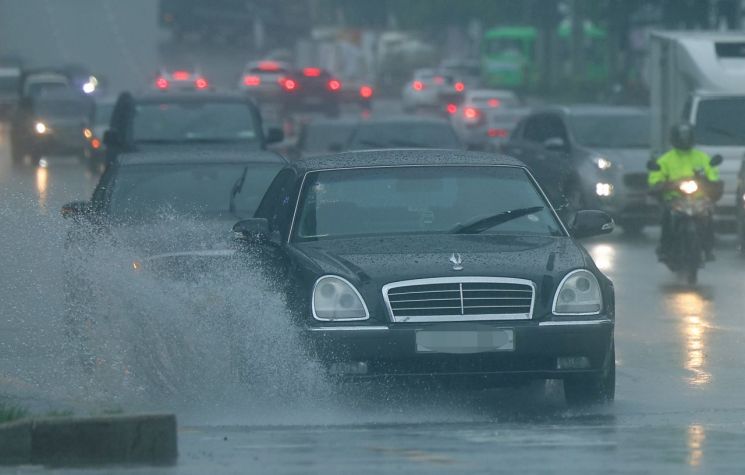 On the 13th, when the full-scale rainy season began with a heavy rain advisory issued across Seoul, vehicles were driving through splashes caused by sudden downpours around the Isu Station intersection in Dongjak-gu, Seoul.
 [Photo by Yonhap News]
The Ministry of the Interior and Safety urges that if you are trapped in a vehicle in a rushing river while driving, you should break the vehicle window with a hard object such as an emergency escape hammer, the support rod of the car seat headrest, or a seatbelt buckle (clip) to escape.
Additionally, experts advise not to enter underpasses during heavy rain or to quickly abandon the vehicle and escape if there is any abnormality.
If there is a possibility of flooding, abandon the 'car' and evacuate quickly
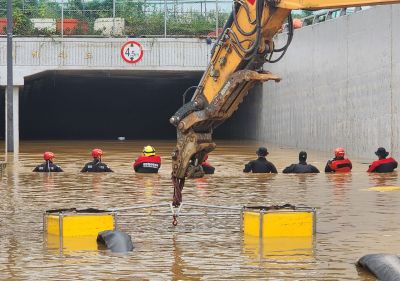 On the morning of the 16th, fire officials are conducting a search operation for people at the Gungpyeong 2 underpass in Osong-eup, Heungdeok-gu, Cheongju City, which was flooded due to heavy rain.
 [Photo by Yonhap News]
According to the website published by the Ministry of the Interior and Safety, it is safer not to enter underpasses where flooding has already begun. At night, when it is difficult to check for flooding or in places with steep road slopes like the Osong underpass, it is best to detour via other roads.
Especially, if a rushing current causes a bridge to be submerged, never enter the river. This is because vehicles can be easily swept away even in shallow water when a rapid current occurs. The same applies to underpasses. If you have entered an underpass where flooding has started, you must abandon the vehicle and evacuate outside quickly.
If you are swept away by a rushing river while driving, you should open the vehicle door on the opposite side of the incoming current and escape.
If the door does not open or you cannot get out, you must break the window with a hard object such as an emergency escape hammer, the support rod of the car seat headrest, or a seatbelt buckle (clip) to escape.
When it rains heavily, you should strike the corner of the vehicle window with force or use your foot rather than the center part to break it. If you slightly lower the window in advance, it is easier to break, so if you feel that a large amount of rain is coming, leaving a gap in the window is also helpful for escape.
If you encounter a rushing current while inside the vehicle, you should open the vehicle door on the opposite side of the incoming current and escape quickly. It is difficult to open the door on the side where water is flowing due to the speed of the water.
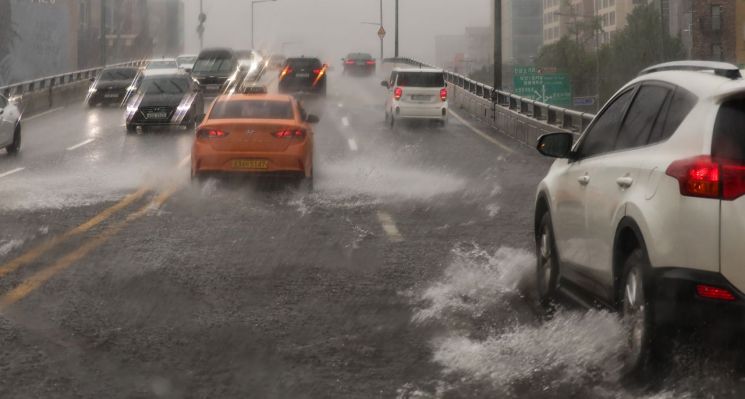 On the afternoon of the 13th, when a heavy rain advisory was issued for the Seoul area due to heavy rain, the southern end of Hannam Overpass near Hannam Five-way Intersection in Yongsan-gu, Seoul, was flooded due to the concentrated rainfall, causing vehicles to drive slowly.
 [Photo by Yonhap News]
After escaping, you should evacuate to the nearest embankment. This is because rushing currents flow so fast that running or walking quickly can cause you to fall. Especially if you fall, there is a risk of being swept away by the current, so you must be very careful.
When roads are flooded, be especially cautious of manholes. Manholes on roads can become dislodged or protrude. Therefore, you should avoid manholes as much as possible while driving. At night, when it is difficult to check the extent of flooding, it is best to refrain from driving and avoid places where water flows rapidly.
If there is a risk of vehicle flooding, for passenger cars, you should move the vehicle to a safe place before the tires are submerged more than two-thirds. If the engine stalls during flooding but it is not an electronic malfunction, you can open the windows or sunroof.
Therefore, do not panic and open the windows and sunroof to create an escape route. In case of emergency, if there is a possibility of flooding, opening the windows or sunroof in advance allows for a quick escape. Also, because the difference in water pressure inside and outside the vehicle may prevent the doors from opening, opening the windows in advance facilitates securing an escape route.
If you could not open the windows in advance, wait until the water level difference between inside and outside the vehicle is less than 30 cm, then escape quickly. A water level difference of about 30 cm can be easily overcome by the strength of an upper-grade elementary school student (grades 5-6) to open the vehicle door.
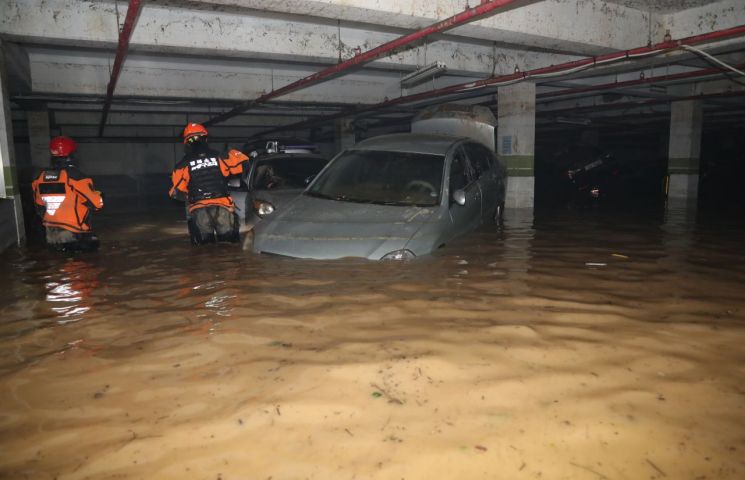 The interior of an underground parking lot in an apartment complex in Pohang-si, Gyeongbuk, where 2 people were rescued and 7 people were confirmed dead last September at 2 p.m.
 [Photo by Yonhap News]
If water starts to rise even slightly in an underground parking lot, abandon the vehicle immediately and escape. If rainwater enters the parking lot, do not move the vehicle outside but evacuate yourself only. When water starts to enter along the slope of the underground parking lot, the vehicle cannot move due to water pressure, so only people should evacuate quickly. Never enter an underground parking lot to check whether a vehicle is submerged.
Also, if water flows into underground stairs to about shin height, it becomes difficult for adults to climb, so evacuate immediately if water starts to flow in even slightly. If water reaches ankle height on stairs, children or the elderly cannot climb, so evacuate immediately if there is any water inflow.
© The Asia Business Daily(www.asiae.co.kr). All rights reserved.



















