Tesla Attempts to Dominate Industry Standard with NACS
Ford, GM, Volvo, Mercedes Join NACS Alliance... Hyundai Cautious
Skepticism Over Speed and Compatibility When Using Tesla Chargers
Concerns Over Sharing Customer Info and Driving/Charging Data
Fears of Losing Tesla EV Leadership and Becoming Dependent on Its Ecosystem
# In the 1980s, Sony Betamax (hereafter Beta) and JVC VHS waged a standards war in the home video market. As everyone knows, the war ended with VHS's victory. In fact, Beta had superior technology compared to VHS. It offered better picture quality and was smaller in size, making it advantageous for device miniaturization. However, Sony maintained a closed licensing policy and kept prices high, ultimately failing to popularize the format. VHS, which was a latecomer with inferior picture quality, instead offered lower prices and longer playback times. Additionally, JVC formed technical alliances by bringing competitors together to overcome its technological disadvantages. VHS, which became the dominant standard, monopolized the home video market until DVDs emerged in the late 20th century.
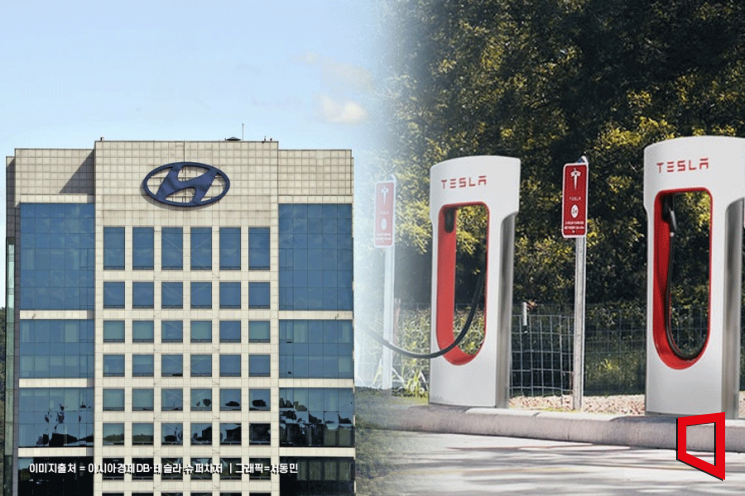
Recently, a fierce standards war is also unfolding in the electric vehicle (EV) charging market. Tesla is redefining the standard for the U.S. EV charging market by leveraging its proprietary fast-charging network, the 'Supercharger.' Tesla's charging method is named the 'North American Charging Standard (NACS).' Tesla's intention is not just to challenge the existing standard, the 'Combined Charging System (CCS),' but to completely replace the industry standard with the NACS method. Ford, General Motors (GM), Rivian, Volvo, Polestar, and Mercedes-Benz have already announced the adoption of the NACS method for their EVs, and Volkswagen and Stellantis are currently negotiating with Tesla on related matters.
On the 13th (local time), Hyundai Motor Group Chairman Chung Eui-sun was asked about joining the Tesla charging alliance at the Ioniq 5N unveiling event held in the UK. He was reserved, saying, "We are discussing internally, but I don't know yet." At the same event, Hyundai Motor President Jang Jae-hoon expressed a cautious stance, stating, "I think it is right to do what benefits customers in terms of charging efficiency, time, and cost," and added, "(From the same perspective) a decision on joining the charging alliance will be made soon."
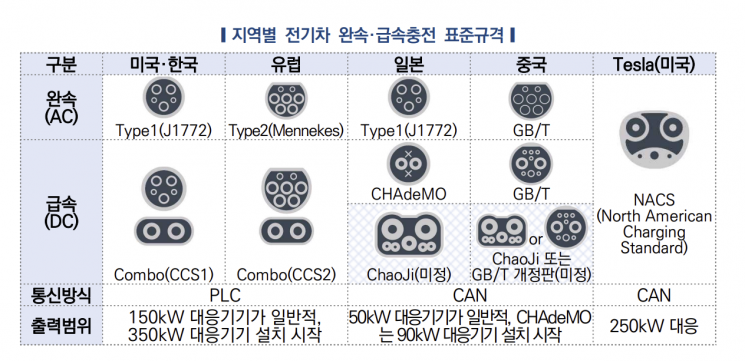
Industry analysts offer various reasons why Hyundai is hesitant to join the 'Tesla charging alliance.' First, there is a technical basis rooted in the fact that using Tesla Superchargers would negate the advantages of Hyundai's 800V ultra-fast charging. The recently released Ioniq 5N is equipped with an 800V battery system capable of charging at up to 350 kW, reaching 80% charge in 18 minutes. In contrast, Superchargers are designed for Tesla vehicles with a 400V system. Even when charging at a maximum of 250 kW, it takes about 30 minutes to reach 80%. Using Superchargers would render Hyundai's high-spec 800V battery system ineffective, potentially resulting in longer charging times than when using the CCS1 method.
The second reason concerns data. Tesla Superchargers do not have separate payment windows or input methods. To use a Supercharger, users must install the Tesla app. Through this process, Tesla can collect personal information and driving and charging data from all third-party customers sharing the chargers. This vast amount of data is a crucial weapon for gaining leadership in the EV market. Tesla has already employed a similar strategy to advance its autonomous driving technology by releasing its Full Self-Driving (FSD) system as a free trial to general customers, thereby collecting autonomous driving data nationwide in the U.S.
The third reason is that Tesla itself has not yet completed compatibility verification for charging other manufacturers' EVs. Hyundai adopting the NACS method for its EVs does not simply mean adding one connector and selling the cars. It requires verification of charging stability and efficiency, including software bug fixes. Many companies that have joined the Tesla charging alliance have announced plans to produce EVs equipped with NACS charging ports starting in 2025. Tesla has also publicly shared connector design structures and suppliers to support this. However, some view the one-and-a-half-year timeframe for compatibility development and verification as too short.
Moreover, all Tesla vehicles have their charging ports located on the left rear side. To open Superchargers to other EVs with charging ports in various locations, the charging cable length must be extended from the current 2 meters to over 3 meters. Even if new models released after 2025 move their charging ports to the left rear to follow Tesla's method, there are challenging issues such as completely rewiring the vehicle's electrical system.
Finally, there is concern that Tesla might dominate the global EV ecosystem starting with the U.S. charging standard. If Tesla's standard does not become the industry norm in the charging market, automakers risk losing leadership not only in EV market share but also in charging service-related businesses and Battery-as-a-Service (BaaS) throughout the EV business. Once dependent on the Tesla system, independent decision-making becomes difficult. As demonstrated by the VHS and Beta case, industry standards are not determined solely by technological superiority. Factors such as price, convenience, compatibility, and the ability to secure international cooperation are also essential. An industry insider commented, "U.S. automakers likely made quick decisions under the judgment that there are clear benefits to using Tesla's charging infrastructure and in coordination with the government. However, automakers like Hyundai and European manufacturers using the CCS1 method will find it difficult to make quick decisions based on short-term benefits."
© The Asia Business Daily(www.asiae.co.kr). All rights reserved.
![Clutching a Stolen Dior Bag, Saying "I Hate Being Poor but Real"... The Grotesque Con of a "Human Knockoff" [Slate]](https://cwcontent.asiae.co.kr/asiaresize/183/2026021902243444107_1771435474.jpg)

















