'Gay Game' Scheduled in Hong Kong in November
Multiple Withdrawals Amid Local National Security Law Concerns
Hong Kong's South China Morning Post (SCMP) reported on the 16th that the 'Gay Games,' a sports festival for sexual minorities (LGBTQ), is being impacted by the Hong Kong National Security Law.
According to the report, some overseas officials and participants have stated they will not attend the Hong Kong 'Gay Games' to avoid violating the Hong Kong National Security Law, causing difficulties for the event organizers.
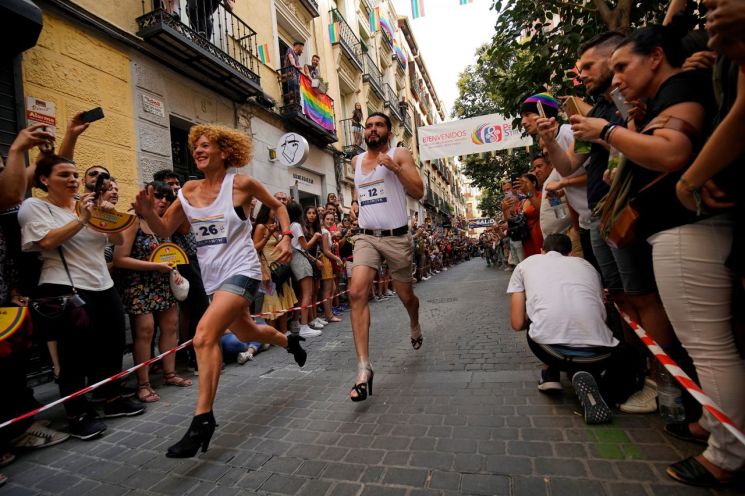
Additionally, some LGBTQ human rights activists in Hong Kong are calling for the cancellation of the event, suggesting that pressure will likely increase.
The 'Gay Games' have been held every four years since their inception in 1982. The previous event took place in Paris in 2018, with 10,000 participants. The Hong Kong event, originally scheduled for last year, was postponed due to COVID-19 and was planned to be held from November 3 to 11 this year.
Shami Kramer, an honorary lifetime member of the International Gay Games Federation from the United States, told SCMP, "There are safety and security issues in Hong Kong," adding, "The U.S. and other governments are warning travelers about the arbitrary law enforcement in Hong Kong that poses risks."
He also revealed that last year he sent a letter to the International Gay Games Federation requesting that Hong Kong not be authorized to host the Gay Games.
He pointed out, "Hong Kong today is not the same city as when it was selected to host the 2016 Gay Games," adding, "The Hong Kong National Security Law means that anyone who has criticized Hong Kong in the past could be at risk upon entering Hong Kong."
LGBTQ human rights activists in Hong Kong agreed with Shami's remarks, stating that anyone who has previously criticized China or Hong Kong faces the risk of immediate arrest upon arrival in Hong Kong.
Kate Roy, who was part of the Sydney Gay Games organizing committee in 2002, said she will not participate in this year's Hong Kong event, citing "enormous security risks."
She asked, "Would Australians be prosecuted if they waved rainbow flags on the streets of Hong Kong?" Earlier in February, a Hong Kong LGBTQ sports group reported that police instructed them to remove rainbow flags during a local marathon. The rainbow colors symbolize sexual minorities.
A spokesperson for the Hong Kong police did not directly answer whether waving rainbow flags could lead to prosecution but told SCMP that comprehensive risk assessments would be conducted on a case-by-case basis for public events.
Enacted on June 30, 2020, the Hong Kong National Security Law allows for the death penalty or life imprisonment for four crimes: secession, subversion of state power, terrorist activities, and collusion with foreign forces. Amid this atmosphere, the Hong Kong Gay Games organizing committee has lowered its target to about 3,000 participants.
The organizing committee stated that they will promote Hong Kong as a safe city with a low crime rate for visitors and added, "At the same time, we will ask participants to comply with local laws as they do in their own countries or regions."
The committee announced that competitions in 18 sports will be held and that as of the 5th of this month, over 1,600 participants have registered.
© The Asia Business Daily(www.asiae.co.kr). All rights reserved.
![Clutching a Stolen Dior Bag, Saying "I Hate Being Poor but Real"... The Grotesque Con of a "Human Knockoff" [Slate]](https://cwcontent.asiae.co.kr/asiaresize/183/2026021902243444107_1771435474.jpg)
















