California Death Valley Expected to Soar to 53 Degrees
Experts Say "This Year Will Be the Hottest Year on Earth"
The record-breaking heatwave that has been ongoing for weeks in the southern United States is expected to peak this weekend. In particular, Death Valley in California, known as one of the hottest places on Earth, is predicted to soar to 128 degrees Fahrenheit (53 degrees Celsius) on the 16th (local time).
The U.S. National Weather Service (NWS) stated in a short-term forecast on the 14th, "Dangerous heat is affecting the West Coast to the Gulf Coast (covering Texas to Florida)," adding, "As of this morning, at least 93 million people are under heat warnings and advisories."
They also warned, "As the suffocating heat continues this weekend, most areas of the West Coast and Southwest will be engulfed in scorching temperatures."
The weather agency further predicted, "A strong high-pressure system over the Southwest will persist throughout the weekend, bringing record-breaking high temperatures." This is expected to cause a 'heat dome' phenomenon, where the strong high pressure traps a mass of hot air.
On Saturday the 15th, the daytime high temperatures are expected to range between 105 and 115 degrees Fahrenheit (41 to 46 degrees Celsius) across California's inland Great Valley region and the southwestern deserts. Additionally, some desert areas in southern California, southern Nevada, and southern Arizona may exceed 120 degrees Fahrenheit (49 degrees Celsius).
Death Valley, notorious for its summer heatwaves, is expected to reach 128 degrees Fahrenheit (53 degrees Celsius) on Sunday the 16th. Last week, a 65-year-old man died from the heat while driving a car with a broken air conditioner in Death Valley.
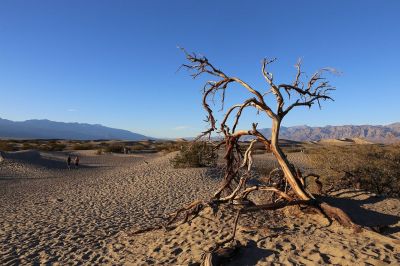 The desert region of Death Valley in California, USA, famous for having the highest temperatures on Earth
Death Valley recorded 56.7 degrees Celsius (134 degrees Fahrenheit) in 1913, which is listed in the Guinness World Records as the highest temperature on Earth. In July last year, an unofficial temperature of 56 degrees Celsius was also recorded.
Texas and Florida, which have been suffering from the heatwave since mid-last month, continue to experience hot and humid weather. The heat index, reflecting the high humidity typical of these regions, is expected to remain around an average of 100 to 110 degrees Fahrenheit (38 to 43 degrees Celsius).
The Maricopa County Department of Public Health, where Phoenix is located, reported recently that "12 people have died from heat-related illnesses as of the 11th of this year." They are also investigating the causes of 55 suspected heat-related illness cases.
The National Weather Service forecasts that the heatwave will continue into early next week, and even after temperatures somewhat subside in most of the southwestern U.S., temperatures are expected to remain above average through the end of this month.
Dr. Daniel Swain, a climatologist at the University of California, Los Angeles (UCLA), recently said on a YouTube channel, "This heatwave will not end in a day or two but will continue over the long term."
Meanwhile, experts agree that "this year will be the hottest year on record for the Earth." The United Nations World Meteorological Organization (WMO) released a report in May warning that the global highest temperature record could soon be broken. This is attributed to the long-term global warming trend caused by human greenhouse gas emissions, compounded by the 'El Ni?o phenomenon' occurring for the first time in four years.
El Ni?o refers to the phenomenon where sea surface temperatures in the equatorial eastern Pacific monitoring area rise by 0.5 degrees Celsius or more and persist for over five months. According to the WMO, as of the 6th, sea surface temperatures in the eastern Pacific have risen about 3 to 4 degrees Celsius above normal.
The U.S. National Oceanic and Atmospheric Administration (NOAA) stated, "La Ni?a, which cools the Earth's temperature, lasted for three years, and the opposite phenomenon, El Ni?o, which began this year, has an 81% chance of peaking between November and January next year." They added, "There is about a one in five chance that this El Ni?o will reach the historic intensity experienced in 1997."
© The Asia Business Daily(www.asiae.co.kr). All rights reserved.

















