Seoul City Announces Rapid Integrated Reconstruction Plan on the 14th
Diverse Skyline Planned Considering Location
Conflict with Commercial Property Owners Remains a Challenge
The 'Seocho Jinhung Apartment,' a 45-year-old building near Gangnam Station on Subway Line 2, will be redeveloped into a 50-story urban complex residential district. Located at the 'gateway to Seoul,' where the Gyeongbu Expressway and Seocho-daero meet, the Seoul Metropolitan Government plans to encourage innovative reconstruction designs to create a diverse skyline.
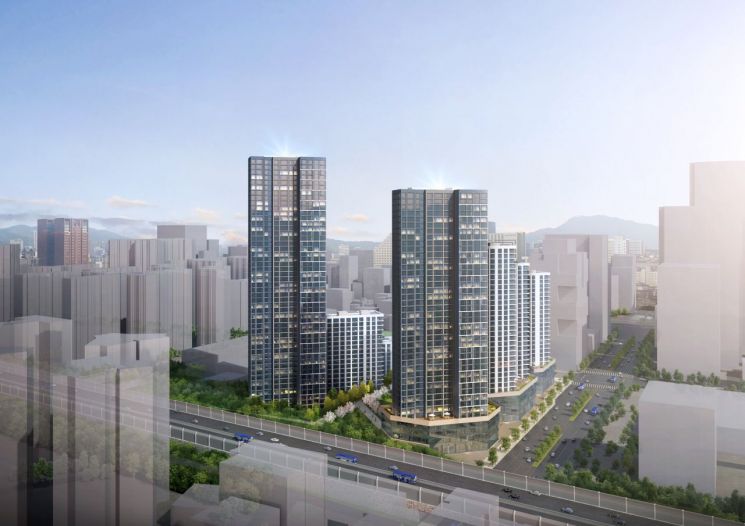 Rapid Integrated Planning Landscape Plan for Jinheung Apartment, Seocho-dong, Seocho-gu, Seoul. Photo by Seoul City
On the 14th, Seoul announced the finalization of the rapid integrated planning proposal for Jinhung Apartment in Seocho-dong, Seocho-gu. Currently consisting of 615 households in buildings up to 10 stories, the apartment will be reborn as approximately 825 households in a 50-story building through reconstruction. It is expected to transform into an urban complex residential district that offers the convenience of living in the Gangnam downtown area, including jobs, leisure, and shopping.
Built in 1979, Jinhung Apartment passed a safety inspection in 2010 but faced ups and downs in project promotion due to conflicts between apartment and commercial unit owners and inconsistencies with higher-level plans such as the Seocho Apartment District Development Basic Plan and Seocho-ro District Unit Plan. Accordingly, Seoul selected this apartment as a target for rapid integrated planning in January last year and has been supporting its reconstruction.
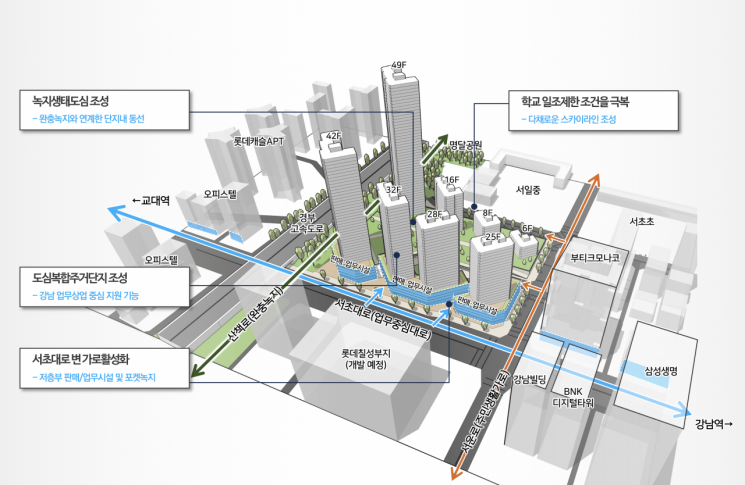 Conceptual plan for the rapid integrated project of Jinheung Apartment, Seocho-dong, Seocho-gu, Seoul. Photo by Seoul City
The core of the Jinhung Apartment rapid integrated planning includes ① development of an urban complex residential district connecting the Gangnam-Seocho business and commercial axis, ② creation of a green ecological urban area linking the Gyeongbu Expressway green space with the complex, and ③ planning a diverse skyline that forms a symbolic landscape of Seoul.
First, considering Gangnam downtown's role as a business and commercial hub, Seoul decided to introduce various mixed functions alongside the existing residential use. To this end, the zoning was changed from a Category 3 residential area to a quasi-residential area, and street-type (four-story scale) commercial and office facilities were planned along Seocho-daero. A Seoul city official explained, "With large-scale developments planned around the site, such as the Lotte Chilsung site and Lion Sewing Machine site, the plan is to respond to future commercial and office demand through mixed-use development of Jinhung Apartment."
In particular, as a public contribution following the upgrade to a quasi-residential area, Seoul plans to install green spaces, a public detention basin (about 20,000 tons) to improve frequent flooding areas, and public rental housing. The plan also includes securing public benefits by introducing urban-type residences (officetels, office facilities), excellent design, and rainwater utilization facilities.
Currently, Gangnam downtown is densely surrounded by buildings on both sides of Seocho-daero and Teheran-ro, lacking resting spaces for pedestrians. Therefore, Seoul has expanded linear green spaces along the Gyeongbu Expressway and established a green ecological urban complex plan that integrates green walking paths and landscaping within the complex. Linked with the 'Gyeongbu Arterial Road Upper Space Park' plan announced on April 3, the current 8-10m wide linear green space will be expanded to 30m, and pedestrian paths will be connected along the green walking paths and landscaping areas to create safe school routes for Seoil Middle School and Seocho Elementary School on the north side of the site.
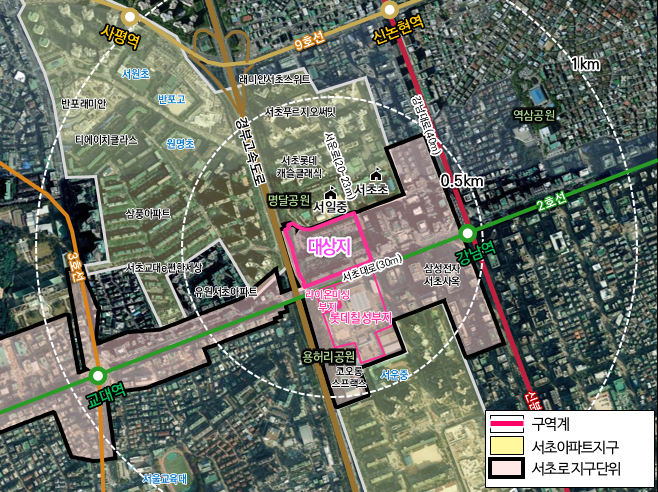 Location map of Jinheung Apartment, Seocho-dong, Seocho-gu, Seoul for Rapid Integrated Planning. Photo by Seoul City
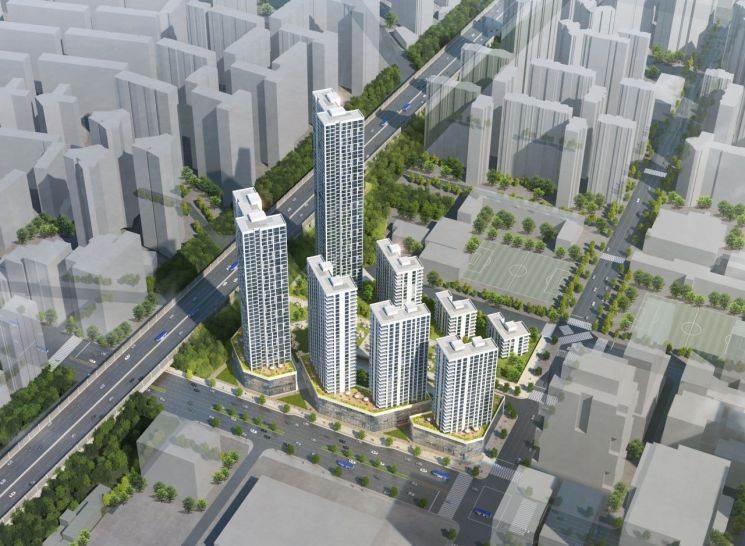
Finally, since the site is located at the intersection of the Gyeongbu Expressway and Seocho-daero, Seoul plans to encourage innovative landmark building designs during future architectural planning to form a symbolic landscape as the gateway to Seoul.
With the confirmation of the Jinhung Apartment rapid integrated planning proposal, Seoul expects the maintenance plan drafting process to proceed quickly within the year. Additionally, by applying simplified rapid integrated planning procedures, the project period is expected to be significantly shortened through integrated reviews by the Urban Planning Committee's delegated subcommittee and the project implementation plan.
However, conflicts with commercial unit owners remain a major hurdle. Last month, commercial property owners filed for a provisional injunction to suspend the general meeting's effectiveness, claiming that the association deprived commercial unit owners of apartment allocation rights and reduced commercial area contrary to agreements made during the promotion committee phase. The Central District Court has accepted this injunction.
Jo Nam-jun, Director of the Seoul City Urban Planning Bureau, said, "The Gangnam urban plan created in the 1970s, which lacks green and leisure spaces, is at a point where 'restructuring' is necessary. Through this project, by connecting the previously disconnected Gangnam business and commercial axis and expanding urban green spaces, Seocho Jinhung Apartment will transform into an urban complex residential district where residents can enjoy 'Jikjurak' (jobs, residence, commerce)."
Meanwhile, with the release of the Jinhung Apartment rapid integrated planning proposal, reconstruction projects in Seocho-dong around Gangnam Station are nearing completion. Seocho Lotte Castle Classic, located between Jinhung Apartment and Seocho Elementary School, is a complex rebuilt from Samik Apartment in 2006. Directly above, Seocho Prugio Summit is a reconstruction of Samho 1st Apartment completed in 2017. Below Gangnam Station, Seocho Woosung 1st, 2nd, and 3rd Apartments were transformed into Raemian Leaders One (1,317 households), Raemian Seocho STG S (593 households), and Raemian Seocho STG (421 households) respectively between 2016 and 2020, and Seocho Mujigae Apartment was reconstructed into Seocho Grand Xi in 2021. Shindong-a 1st Apartment is nearing relocation.
Additionally, the 36-year-old Sampung Apartment, completed in 1988, is also in the process of selecting a trust company for reconstruction. The promotion committee plans to hold a trust company briefing session for owners on the 22nd and 23rd.
© The Asia Business Daily(www.asiae.co.kr). All rights reserved.



















