Unlike Facebook, blogs, and Instagram,
casually sharing daily life in informal speech... "Still just lurking"
'Hongka Cola' Hong Jun-pyo creates account but remains 'silent'
"Think of politicians' dignity and please do some 'Supal (Thread follow)'"
Kim Jaeseop, the People Power Party's Dobong-gap district committee chairman, is one of the most active politicians using Threads recently. He wrote, "Since I belong to the People Power Party, I barely manage to hold my ground by constantly making Sswaengnim (people who are good at Threads) laugh."
In a phone interview with Asia Economy, Chairman Kim said, "When politicians use social network services (SNS), each message tends to be interpreted too politically, so even if they want to share light daily or small stories, there were few channels until now," adding, "Threads are a bit more casual, so you can convey much lighter stories, and since they are not necessarily interpreted politically, you can make jokes lightly, which is fun."
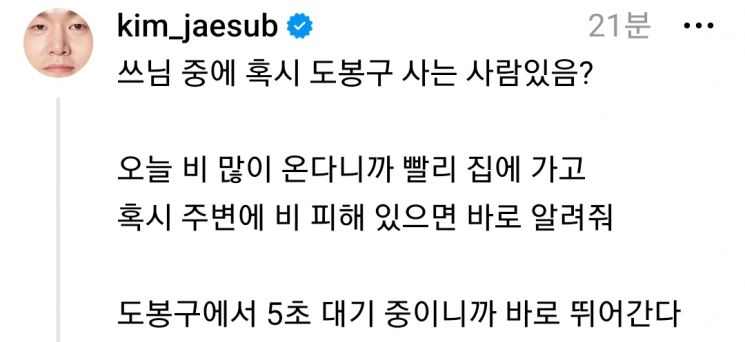 Screenshot of thread by Gib Jaeseop, Chairman of the Dobong Gap Party Committee of the People Power Party
Banmo, Sseunim, Sseupalwan... Politicians Armed with Familiarity
The Yeouido political circle has jumped on the Threads craze. Politicians who started Threads early in 'Banmo' (informal speech mode) are expanding communication with users by using expressions frequently used on Threads such as 'Sseunim (monk, Thread-nim)', 'Sseupal (Thread follow)', and 'Sseupalwan (Thread follow complete)'.
According to the political circle on the 15th, Threads is a social networking service (SNS) launched by Meta, the parent company of Facebook and Instagram, and surpassed 100 million global users just four days after its release on the 6th. In Korea, the number of Thread application installers exceeded 1 million on the 11th.
In the domestic political circle, the biggest feature of Threads is its differentiation from existing SNS. Threads only allow short posts within 500 characters, making it difficult to find long posts like on Facebook or blogs. On Instagram, attaching a photo is mandatory when writing a post, but on Threads, it is not required.
Additionally, 'familiarity' is also an advantage. Politicians, including members of the National Assembly, have often written their views on Facebook, but due to stiff expressions, they have reinforced the image of 'Eomgeunjin' (a neologism combining the first letters of strict, stern, and serious). However, on Threads, most use informal speech, allowing them to approach voters more familiarly. A staff member from a lawmaker's office said, "Since Facebook or blogs mainly have long posts, they wrote content introducing current issues or policies, but if such posts appear on Threads, it would be boring and no one would read them. It seems good to use Threads to convey simple thoughts or information."
Assemblyman Yoo Kyungjoon Posts 'Report to Gangnam-gu Office Water Management Division in Case of Flooding' on Threads... Long Posts on Facebook
In fact, lawmakers use Facebook and Threads for different purposes. Yoo Kyungjoon, a People Power Party lawmaker representing Seoul Gangnam (Samseong, Daechi, Dogok), posted necessary phone numbers for local residents on Threads in case of flood damage. Along with this, he wrote, "In case of road flooding or damage, report to 119 or Gangnam-gu Office Water Management Division." This was to share information for Gangnam residents who often experience flooding during heavy rains in the metropolitan area. On the other hand, on Facebook and Instagram, he posted photos attending the 'Daechi Intersection Drainage Improvement Project Residents' Briefing' along with a long post hoping there would be no flood damage. This clearly distinguishes Threads from other SNS.
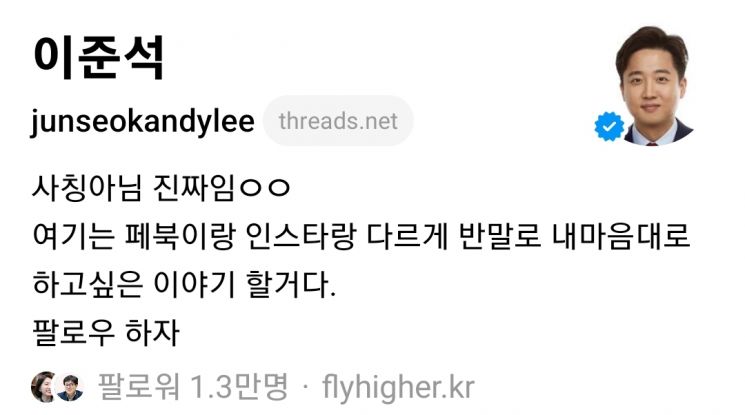
Former People Power Party leader Lee Junseok is also actively using Threads. In his introduction, Lee said, "Here, unlike Facebook and Instagram, I will speak informally and say whatever I want," adding, "Let's follow." In his posts, he used informal speech with phrases like "Grilling gogi (meat). Taking questions," "Morning Gyeongchun Line after a long time," and "I'm not sleeping yet." The response is positive. As of 4:30 PM on the 13th, Lee's Thread followers exceeded 13,000, attracting attention.
Gyeonggi Province Governor Kim Dongyeon actively uses 'Banmo' (informal speech). Governor Kim wrote, "How about a night study game? If you ask questions informally, I will reply while leaving work. Leave comments." When followers posted comments like "Hope you have a good night," and "Do you remember the photo we took last year?" he replied with "Good night," and "It's difficult. Where is it?" Among others, Governor Kim posted, "It's raining heavily in Gyeonggi today. Everyone, take an umbrella," and "The post I uploaded yesterday was caught by staff, and I almost had my phone confiscated for two weeks," narrowing the distance with followers.
Democratic Party lawmaker Heo Young posted a photo of her cat looking outside in front of a window.
"Watching silently for two days"... Oh Sehoon and Hong Junpyo Created Thread Accounts but Remain Silent
However, among politicians who created accounts, there are voices of concern about managing them. Seoul Mayor Oh Sehoon, Daegu Mayor Hong Junpyo, and People Power Party lawmaker Tae Youngho have created Threads accounts but have not posted anything yet.
Democratic Party floor leader Park Kwangon only posted, "It took me three days to think about my first Thread. I'm still thinking about it," and left it at that. Basic Income Party lawmaker Yong Hyein also wrote, "I've been lurking for two days, but I still wonder how to use Threads." A staff member from a lawmaker's office said, "I don't really know what it is, but I created an account anyway," adding, "We need to think more about how to proceed."
People Power Party lawmaker Heo Eunah, who created a Threads account early on, views this situation positively. Heo shared a video featuring former leader Lee Junseok and former deputy spokesperson Kwak Seungyong to announce the start of Threads but operates Threads mixing informal and formal speech. Heo said, "When I used formal speech, there was a request not to make it heavy, so I tried informal speech in comments," adding, "I'm enjoying watching what kind of reactions there will be."
There are also many politicians who are observing Threads cautiously. The voice-based SNS 'Clubhouse' was popular a few years ago but quickly faded. A staff member from a lawmaker's office said, "At first, loud voices lead the atmosphere, but we shouldn't repeat the dark history of Clubhouse," adding, "Just because informal speech is the trend, people who suddenly act serious won't be cheered by the public for speaking informally."
© The Asia Business Daily(www.asiae.co.kr). All rights reserved.
!["I'd Rather Live as a Glamorous Fake Than as a Poor Real Me"...A Grotesque Success Story Shaking the Korean Psyche [Slate]](https://cwcontent.asiae.co.kr/asiaresize/183/2026021902243444107_1771435474.jpg)


















