Slow Recovery in Exports and Domestic Demand... Economic Rebound Uncertain
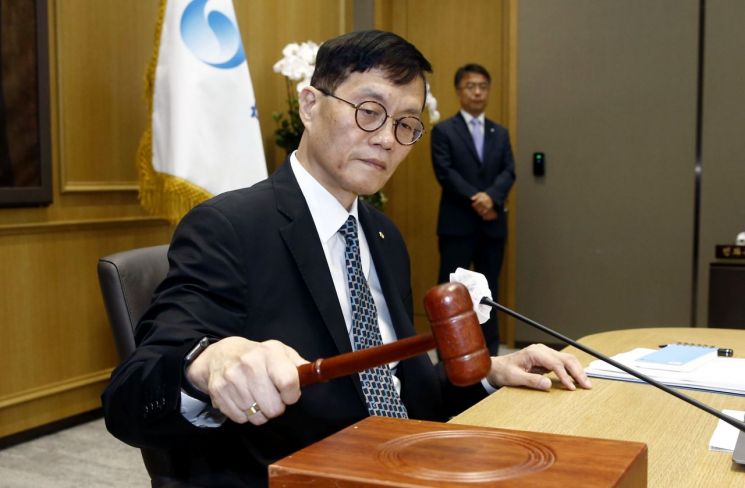
Amid economic and financial instability, the Bank of Korea kept its benchmark interest rate steady at 3.5% per annum during the Monetary Policy Committee meeting on the 13th. This marks the fourth consecutive hold following freezes in February, April, and May. The need for further rate hikes diminished due to June's consumer price inflation dropping to the 2% range, a slower-than-expected economic recovery in the second half of the year, and ongoing financial concerns such as the sharp rise in delinquency rates at Saemaeul Geumgo and instability in real estate project financing (PF).
Another major factor supporting the end of Korea's rate hikes is that the U.S. Federal Reserve's (Fed) tightening cycle is nearing its conclusion. Experts predict that the Bank of Korea's rate hike cycle has effectively ended and that the time to coordinate a rate cut to stimulate the economy is approaching.
The Bank of Korea's Monetary Policy Committee held a meeting on the day and decided to keep the benchmark interest rate at 3.50% per annum. Since August 2021, the committee had been raising rates for one and a half years but paused in February to "catch its breath," and this month marks the fourth consecutive freeze following April and May. The decision to hold rates was unanimous among committee members.
The main rationale for the hold is economic and financial instability. The Ministry of Economy and Finance lowered its forecast for this year's real gross domestic product (GDP) growth from 1.6% to 1.4% in its early-month "Second Half Economic Policy Direction." The Bank of Korea also revised its growth forecast down by 0.2 percentage points to 1.4% at the end of May, citing continued export sluggishness and a slowdown in consumer recovery. The global economic slowdown and delayed recovery in China's economy have further lowered growth expectations. Concerns remain over potential financial market tightening due to the Saemaeul Geumgo crisis and unresolved risks in real estate PF and the secondary financial sector.
The Bank of Korea's expectation that inflationary pressures are gradually easing also underpins the rate hold. June's consumer price inflation rate returned to the 2% range at 2.7%, the first time in 21 months since September 2021, alleviating inflationary burdens. Governor Lee Chang-yong emphasized, "While the domestic economy is gradually improving, inflation is expected to exceed the target level for a considerable period, and policy uncertainties remain high, so we will maintain a tightening stance focused on price stability for a substantial period."
At Month-End, Korea-U.S. Interest Rate Gap Hits Record High of 2.0 Percentage Points
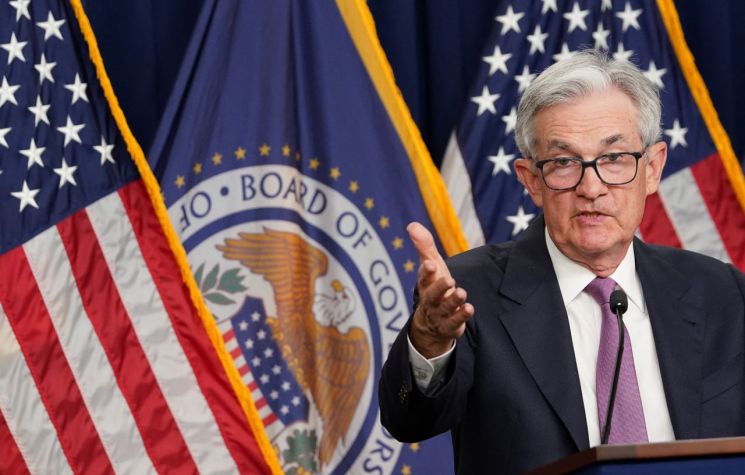
With the Bank of Korea holding its benchmark rate steady, the gap with the U.S. rate (4.75?5.00%) remains at a record high upper bound of 1.75 percentage points. If the U.S. Federal Reserve raises its policy rate by 0.25 percentage points as expected on the 26th (local time), the Korea-U.S. rate gap will widen to 2.00 percentage points. Such an unprecedented gap could increase volatility in the foreign exchange market due to potential foreign capital outflows. However, experts note that despite the historically wide rate gap, the won-dollar exchange rate has attempted to enter the 1,200 won range, showing relatively stable trends, so there is no immediate concern over sharp capital flight or won depreciation.
Professor Kang Sung-jin of Korea University’s Department of Economics said, "Although the Fed raising rates while the Bank of Korea holds rates could raise concerns about won-dollar exchange rate increases, the economy is so weak that the Bank of Korea seems to have accepted this risk to maintain the freeze. Inflation is ultimately the biggest variable in monetary policy, and unless inflation resumes an upward trend, the Bank of Korea will likely maintain the hold for a while and then follow the Fed in cutting rates once it begins to do so."
News of easing inflation in the U.S. also reduced the pressure for additional rate hikes. According to the U.S. Department of Labor on the 12th (local time), the U.S. Consumer Price Index (CPI) rose 3.0% year-on-year in June, below the market expectation of 3.1%, marking the lowest level since March 2021. The core CPI, which excludes volatile energy and food prices closely watched by the Fed, rose 4.8% year-on-year, below the market forecast of 5.0%, representing the smallest increase since October 2021.
Will the U.S. Fed’s July Hike Be the Last? Expectations for End of Tightening
With inflation surging slowing, market expectations are growing that the U.S. Fed will end its tightening cycle after the July rate hike. Professor Kim Jung-sik, Emeritus at Yonsei University’s Department of Economics, said, "The U.S. core inflation slowdown is greater than expected, making July likely the last rate hike. Given the increased possibility of the Fed gradually cutting rates next year, Korea also faces less pressure for further rate hikes."
With the Bank of Korea holding rates for four consecutive times, speculation is rising that a rate cut could come as early as the end of this year. Joo Won, head of economic research at Hyundai Research Institute, said, "China’s economic recovery is far below expectations, leading to continued export sluggishness. To stimulate the economy, the Bank of Korea is expected to lower rates starting in the fourth quarter."
Professor Yoo Hye-mi of Hanyang University’s Department of Economics and Finance noted, "The rapid decline in inflation means the current rate level is sufficiently tight. Although the Bank of Korea raised rates preemptively in August 2021 due to a surge in household debt, the current economic downturn phase differs from that time." She added, "Financial institutions are experiencing stress from rising delinquency rates at Saemaeul Geumgo, and if they tighten credit screening after clearing bad debts, companies may face difficulties in financing. This could lead to increased closures among small business owners and SMEs with poor financial conditions, impacting employment. Considering these potential risks, it will be difficult for the Bank of Korea to raise rates further."
Professor Heo Jun-young of Sogang University’s Department of Economics pointed out, "The economy is so weak that there are talks about the need to cut rates within this year, and recent weak links in the financial sector are gradually breaking, so the Bank of Korea has no choice but to lean toward rate cuts." Regarding the recent surge in household debt, he said, "We need to observe whether the increase is temporary or a trend. Given concerns about a reversed lease market crisis in the second half, it will be difficult to raise rates because of household debt."
Lee Chang-yong: "Saemaeul Geumgo Is an Individual Institution Issue... Fully Manageable"
At a press conference on the day, Governor Lee addressed the recent rise in household loans, including mortgage loans, saying, "Several Monetary Policy Committee members expressed significant concern about the increase in household debt at this meeting. This issue has no simple answer and requires sophisticated policy responses." He explained, "Household debt is closely linked to the real estate market, and abrupt short-term adjustments can cause unintended side effects, as seen in cases like real estate PF, reversed lease problems, and the Saemaeul Geumgo crisis."
He continued, "Currently, micro-level responses are needed to open funding channels for a soft landing of the real estate market in the short term, and a balanced approach to macro-level responses is necessary in the mid to long term to reduce the household debt-to-GDP ratio." While rapid increases in household loans could be addressed through interest rates or macroprudential regulations, he judged it premature to act now. The household debt-to-GDP ratio has decreased from 106% last year to about 103% this year, but ideally should be lowered to 80% in the mid to long term.
Regarding the Saemaeul Geumgo crisis, Governor Lee said, "It is not an issue of a specific industry but of individual institutions and is fully manageable." He added, "When liquidity problems arise in some sectors such as the Saemaeul Geumgo crisis, it is necessary to supply liquidity to prevent systemic risk. The Bank of Korea’s role is to support liquidity to minimize market shocks based on collateral from the Saemaeul Geumgo Central Association."
On the final rate during this tightening cycle and the timing of rate cuts, Governor Lee said, "All six Monetary Policy Committee members agreed that the possibility of an additional hike to 3.75% should remain open. We will discuss rate cuts once we are confident that consumer price inflation sufficiently converges to the 2% target."
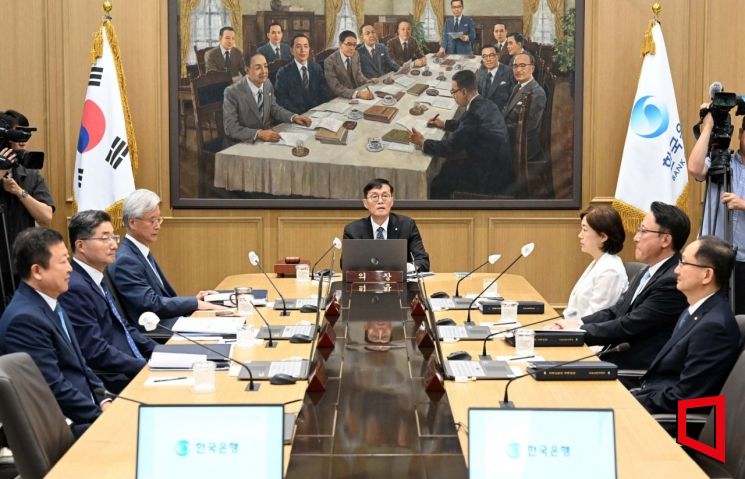 Lee Chang-yong, Governor of the Bank of Korea, is presiding over the Monetary Policy Committee meeting held on the 13th at the Bank of Korea in Jung-gu, Seoul. Photo by Joint Press Corps
© The Asia Business Daily(www.asiae.co.kr). All rights reserved.



















