Health and Medical Workers' Union General Strike, 45,000 Participants at 140 Hospitals Nationwide
100 Surgeries Postponed at National Cancer Center, Medical Field 'Chaos'
Minister of Health and Welfare Cho Kyu-hong "Firm Response According to Law and Principles"
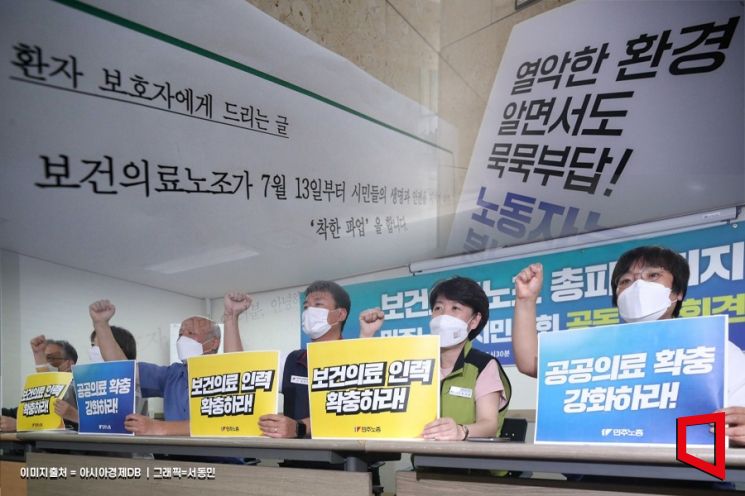
The Korean Health and Medical Workers' Union (KHMU) launched a general strike from 7 a.m. on the 13th, demanding an increase in medical personnel and other issues. With 45,000 workers from 140 medical institutions nationwide participating in the large-scale strike?the first in 19 years?confusion is intensifying among medical sites, patients, and their guardians. Hospitals participating in the strike are maintaining essential medical services such as emergency rooms, intensive care units, and delivery rooms, but delays in treatment are expected to be unavoidable. The ruling party and government prepared emergency medical measures on the same day.
Among the 45 nationwide tertiary general hospitals, 18 are participating in the strike. The so-called ‘Big 5’?Seoul Asan Medical Center, Samsung Medical Center, Seoul National University Hospital, Severance Hospital, and Seoul St. Mary’s Hospital?are not participating. However, among metropolitan area tertiary hospitals, Kyung Hee University Hospital, Korea University Anam Hospital, Korea University Guro Hospital, Ewha Womans University Mokdong Hospital, Hanyang University Hospital, Korea University Ansan Hospital, Ajou University Hospital, and Hallym University Sacred Heart Hospital (Pyeongchon) are participating.
Additionally, among regional tertiary general hospitals, Wonju Severance Christian Hospital (Gangwon), Dankook University Hospital (Chungnam), Chungnam National University Hospital (Daejeon), Wonkwang University Hospital and Jeonbuk National University Hospital (Jeonbuk), Chonnam National University Hospital and Chosun University Hospital (Gwangju), Yeungnam University Hospital (Daegu), Pusan National University Hospital (Busan), and Yangsan Pusan National University Hospital (Gyeongnam) are participating. Twenty-six regional medical center branches are also joining the strike, raising concerns about regional medical service gaps.
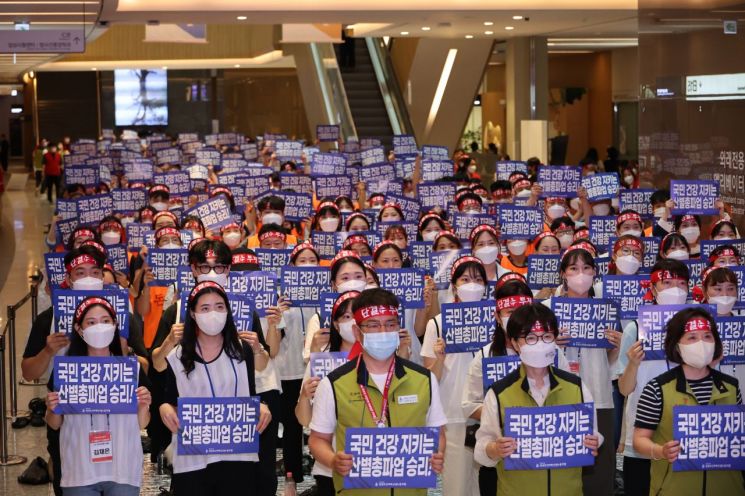
The National Cancer Center had already postponed all 100 scheduled surgeries on the 13th and 14th, when the KHMU general strike was anticipated. Due to a shortage of personnel and limited available beds, it was judged that hospitalization after surgery would be difficult. Pusan National University Hospital and Yangsan Pusan National University Hospital discharged or transferred inpatients, causing significant inconvenience to patients. A representative from a metropolitan university hospital said, "We do not plan to cancel surgeries or reduce inpatients immediately," but added, "We will monitor the strike situation and respond accordingly." The National Medical Center issued a statement under Director Joo Young-soo’s name titled ‘A Message to Patients and Guardians,’ apologizing for the disruption in medical services caused by the KHMU strike.
The National Medical Center had previously posted a notice on its website asking for understanding regarding possible delays in rapid appointment services due to the strike. Director Joo stated, "Essential medical departments such as emergency rooms, intensive care units, outpatient clinics, and operating rooms will operate normally," but added, "Due to staff shortages, delays in treatment may occur, and as the director of the National Medical Center, I sincerely apologize for any inconvenience this may cause."
The KHMU declared the strike to be ‘indefinite,’ but in practice, it is focusing its efforts on the two days of the 13th and 14th. On the first day of the strike, they gathered in front of the Dongwha Duty-Free Shop in Gwanghwamun, Seoul, to hold a ‘sector-wide general strike rally,’ and on the 14th, they plan to hold major strike rallies in four locations: Seoul, Busan, Gwangju, and Sejong. This general strike by the KHMU is the first in 19 years since the strike demanding the full introduction of the five-day workweek in 2004. Previously, in September 2021, a general strike was announced but was withdrawn just before it began due to a dramatic agreement between the union and the government.
The union has demanded ▲ full expansion of integrated nursing care services to resolve expensive nursing fees ▲ institutionalization of a nurse-to-patient ratio of 1:5 and establishment of appropriate staffing standards for patient safety ▲ expansion of physician personnel to eradicate unlicensed illegal medical practice ▲ expansion of public healthcare responsible for essential medical services ▲ support for recovery hospitals to normalize COVID-19 dedicated hospitals ▲ fair compensation for COVID-19 heroes ▲ and implementation of the September 2 labor-government agreement. The union states that they had no choice but to strike because treatment improvements were not properly implemented and public healthcare is in crisis. Na Soon-ja, chairperson of the KHMU, claimed, "This general strike is a strike to protect citizens’ safety."
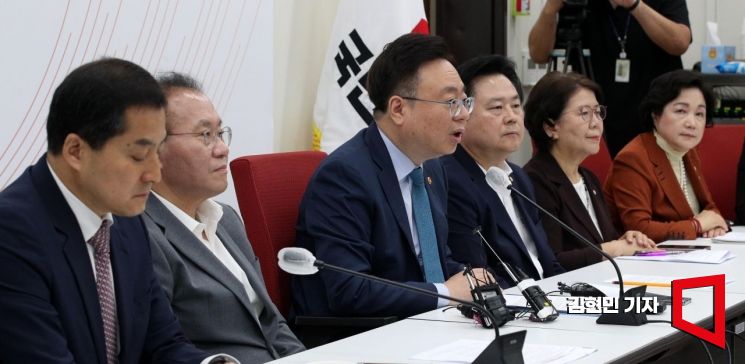 Minister of Health and Welfare Cho Kyu-hong is briefing on the results of the health and medical issues review meeting held at the National Assembly on the 13th. Photo by Hyunmin Kim kimhyun81@
On the other hand, the government criticized the general strike as a ‘political strike.’ Cho Kyu-hong, Minister of Health and Welfare, said after a ‘Health and Medical Issues Review Meeting’ held at the National Assembly on the morning of the 13th, "It is not appropriate to force the government’s policy formulation and announcement to coincide with the Korean Confederation of Trade Unions’ strike schedule." He added, "The union should not join the KCTU’s strike plan but rather present field opinions to prepare reasonable institutional improvements." He emphasized, "While we guarantee the union’s lawful exercise of rights, if their legitimate dispute actions cause significant harm to the lives and health of the public, we will respond firmly according to law and principles."
The People Power Party and the government prepared emergency medical measures to ensure that essential medical services such as emergency rooms and operating rooms are not interrupted during the KHMU general strike. First, they established a cooperative system with local governments, hospital associations, and medical institutions, and through emergency situation review meetings with the heads of tertiary general hospitals participating in the strike, they decided to support the transfer of unavoidable patients to nearby hospitals. They also proposed reorganizing work shifts and deploying substitute personnel at individual hospitals.
© The Asia Business Daily(www.asiae.co.kr). All rights reserved.



















