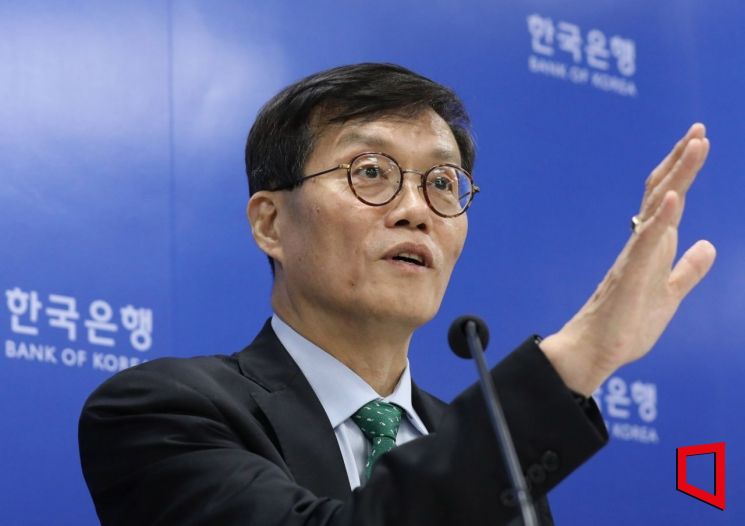
On the 13th, the Bank of Korea's Monetary Policy Committee once again kept the base interest rate at an annual 3.5%. This marks the fourth consecutive freeze following February, April, and May. The consumer price inflation rate in June dropped to the 2% range, clearly indicating a slowdown in inflation, and the pace of economic recovery in the second half of the year is expected to be slower than anticipated, reducing the need for further rate hikes. Additionally, the sharp rise in delinquency rates at Saemaeul Geumgo and ongoing financial instability in real estate project financing (PF) also supported the decision to hold the base rate steady.
The Bank of Korea's Monetary Policy Committee held a monetary policy direction meeting that day and decided to keep the base interest rate at 3.50% per annum. Since August 2021, the committee had paused its rate hike trajectory for one and a half years starting in February, taking a breather, and this month marked the fourth consecutive freeze following April and May.
The main reasons for the freeze are economic and financial instability. The Ministry of Economy and Finance lowered this year's real gross domestic product (GDP) growth forecast by 0.2 percentage points from 1.6% to 1.4% in its 'Second Half Economic Policy Direction' released earlier this month. The Bank of Korea also revised its growth forecast down by 0.2 percentage points to 1.4% at the end of May, citing continued export sluggishness and a slowdown in consumer recovery.
As the global economic slowdown continues and China's economic recovery is delayed more than expected, growth expectations continue to be lowered. Concerns remain over financial market tightening due to the Saemaeul Geumgo crisis, and instability in real estate PF and the secondary financial sector has yet to be resolved.
The Bank of Korea's expectation that inflationary pressures are gradually easing also underpinned the decision to hold rates steady. The consumer price inflation rate in June was 2.7%, returning to the 2% range for the first time in 21 months since September 2021, alleviating inflationary burdens.
The Korea-US Interest Rate Gap Hits a Record High of 2.0%P at Month-End... Eyes on Possible Rate Cuts
With the Bank of Korea freezing the base rate, the interest rate gap with the United States (4.75~5.00%) remains at a record high upper bound of 1.75 percentage points. If the U.S. Federal Reserve (Fed) raises its policy rate (base rate) by another 0.25 percentage points as expected on the 26th (local time), the Korea-US interest rate gap will widen to 2.00 percentage points.
Since such a reversal magnitude is unprecedented, the possibility of increased volatility in the foreign exchange market due to foreign capital outflows cannot be completely ruled out. However, experts note that despite the Korea-US interest rate gap widening to an all-time high, the won-dollar exchange rate has attempted to enter the 1,200 won range, showing relatively stable trends, so there is no need to worry excessively about sudden capital outflows or a sharp depreciation of the won.
With the Bank of Korea's four consecutive rate freezes, there are also speculations that the timing for a rate cut may be approaching as early as the end of this year. Joo Won, head of economic research at Hyundai Research Institute, said, "China's economic recovery speed is far below expectations, leading to continued sluggish exports and domestic demand," and predicted, "The Bank of Korea will lower rates starting in the fourth quarter to stimulate the economy."
Professor Yoo Hyemi of Hanyang University's Department of Economics and Finance said, "The rapid decline in inflation means the current interest rate level is sufficiently tight," adding, "Although the Bank of Korea preemptively raised rates in August 2021 due to a surge in household debt, the current situation is different as we are in an economic recession."
Professor Yoo explained, "Financial institutions are accumulating stress, such as rising delinquency rates at Saemaeul Geumgo, and if these institutions clean up bad debts and tighten credit screening, it could become difficult for companies to secure funding," adding, "Closures are increasing mainly among small business owners and small and medium-sized enterprises with poor financial conditions, which could affect employment. Considering these potential risks, it is best for the Bank of Korea to maintain the freeze rather than hasten a rate cut, and the earliest timing for a cut would be the first quarter of next year."
© The Asia Business Daily(www.asiae.co.kr). All rights reserved.

















