Youth Series Policy Proposed by Kim Ki-hyun of the Ruling Party
Opposition's Lee Jae-myung Meets Military Personnel
Expert: "Even 3% Madness Can Make a Difference"
Both ruling and opposition parties are flooding policies targeting the 2030 youth demographic. They are vying for the votes of the 2030 generation, who have emerged as the casting voters in next year's National Assembly general election. In last year's presidential election, the People Power Party (PPP) effectively targeted the 20s male demographic known as 'Idaenam' by promoting policies such as the 1000-won university cafeteria meal, extension of the TOEIC score validity period, and exemption from student loan interest, aiming to capture the youth vote. Meanwhile, the Democratic Party has been pushing closely aligned policies for military personnel and university students one after another.
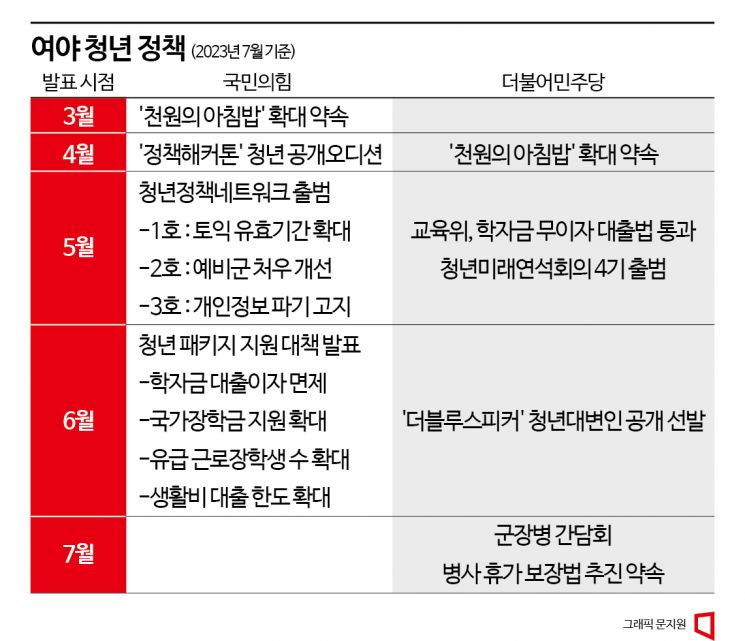
According to political circles on the 13th, the People Power Party has been actively implementing youth policies since Kim Gi-hyeon took office as party leader in March this year. Right after being elected at the March 8 party convention, Kim personally visited a university implementing the '1000-won breakfast' program, a 1000-won university meal, and promised active support from the government and ruling party.
Ruling Party's Full-Scale Battle to Capture 'Idaenam'
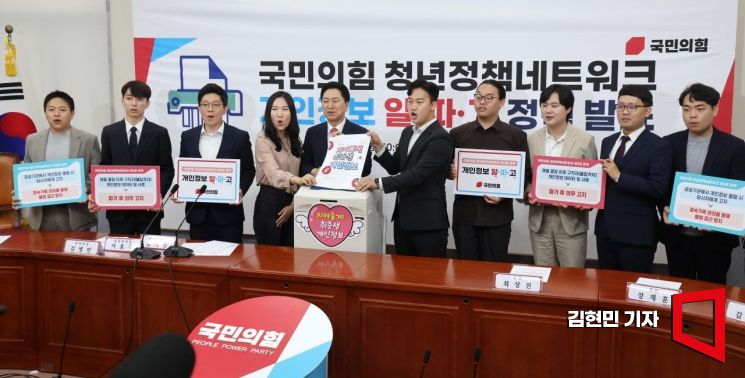 Kim Ki-hyun, leader of the People Power Party, is performing the 'Protecting Job Seekers' Personal Information' act during the announcement of the party's third youth policy, 'Personal Information Al.Pa.Go (Notification, Destruction, Notification),' held at the National Assembly on the 30th. Photo by Kim Hyun-min kimhyun81@
The People Power Party and the government decided to roughly double the '1000-won breakfast' project. In May, Kim launched the party's 'Youth Policy Network,' the only party organization chaired by the ruling party leader. At the time, Kim emphasized, "Youth issues are the most sensitive point for our party," adding, "We will move beyond armchair theorizing and design policies by considering the concerns of young people living in this era."
The Youth Policy Network decided to pursue as its first youth policy the extension of the validity period of TOEIC scores recognized by private companies during recruitment from the current 2 years to 5 years. The second policy is the 'Three Rights Guarantee for Improving Reservist Treatment.' Specifically, this includes ▲ operation of free shuttle buses for round trips to training sites ▲ revision of enforcement ordinances to prevent disadvantages such as being marked absent during training participation ▲ increase in training allowances for those who do not attend mobilization.
Last month, the third policy was also announced. Companies and public institutions must implement 'Personal Information Al.Pa.Go (Notification, Destruction, Notification)' which includes obligations to destroy and notify regarding personal information submitted by job seekers. This was a campaign pledge of President Yoon Suk-yeol during his candidacy.
Kim also personally announced a 'Youth Package Support Plan' last month, which includes ▲ exemption of 45.2 billion won in student loan interest ▲ expansion of national scholarship support worth 114 billion won ▲ increase in the number of paid work-study students (from 124,000 to 134,000) ▲ expansion of living expense loan limits (from 3.5 million won to 4 million won). He also revealed plans to release a 'Youth Promise Series' starting with this.
The People Power Party established the positions of vice-chair and chair of the Youth Division in the Policy Committee in April and appointed them through an open audition called 'Policy Hackathon Youth ON-da.'
Opposition Party Late to the Game? Even Holding Open Auditions
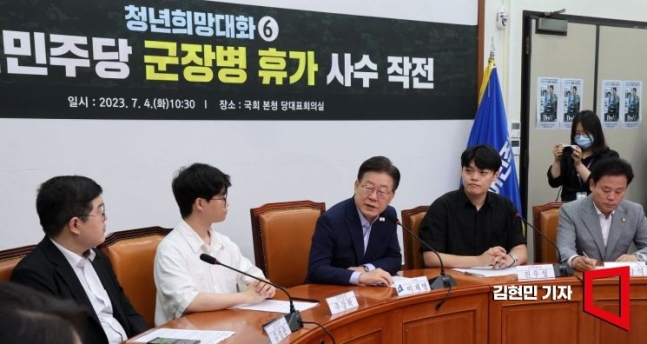
The Democratic Party also launched an immediate counterattack. In April, Kim Min-seok, the policy committee chairman, mentioned the expansion of the 1000-won breakfast program and expressed willingness to cooperate with the government and ruling party. At that time, Kim stated that the program would be expanded to all universities and said, "We will start dialogues with youth and students within this year to find 100 good youth policies."
The Democratic Party also decided on the 'Special Act on Student Loan Repayment after Employment' as party policy and passed it unilaterally at the April Education Committee plenary session. The amendment exempts interest incurred before employment when university and graduate students who took out loans have no income, amounting to about 86 billion won.
In May, the Democratic Party leadership launched the 4th term of the 'Youth Future Roundtable,' a youth policy control tower established during the ruling party era. On the 4th of this month, party leader Lee Jae-myung held a meeting titled 'Lee Jae-myung, Youth Hope Dialogue on Military Personnel Leave Inequality Issues' and announced plans to promote the 'Soldier Leave Guarantee Act,' which excludes holidays from soldiers' leave. He also pledged to resolve the issue of absence treatment during reservist training.
Earlier last month, the so-called 'The Blue Speaker' youth spokesperson was selected through a public selection for the first time in four years since 2019. This was about two months after the People Power Party elected youth division vice-chairs through open auditions.
Youth Emerging as Casting Voters in Next Year's General Election
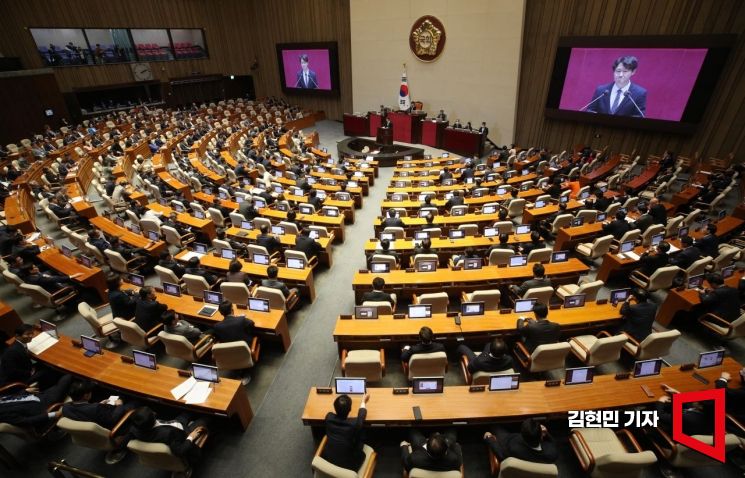 The full committee of the National Assembly (Jeonwonwi) is holding a four-day session starting on the 10th at the National Assembly in Yeouido, Seoul, to discuss the election system reform plan (amendment to the Public Official Election Act) to be applied in next year's general election, with ruling and opposition party members engaging in heated debates. This is the first time in 20 years that the full committee has convened since the discussion on the 'Agreement to Extend Dispatch for the Iraq War' in 2003. Photo by Kim Hyun-min kimhyun81@
The ruling and opposition parties' race to capture youth votes is interpreted as a move considering next year's general election. Currently, since the gap in support rates between the two major parties is not large, the centrist vote, which has a high proportion of the 2030 generation, is likely to determine the outcome of next year's general election.
Recent various opinion polls show a trend of the 2030 generation leaning toward the ruling party. The 2030 generation, interested in coin investment and fairness issues, appears to have turned away from the opposition due to the coin investment scandal involving independent lawmaker Kim Nam-guk, who left the Democratic Party. According to the June fourth week party support rate survey released by Gallup Korea on the 23rd of last month (wireless phone RDD sample frame, nationwide 1,000 men and women aged 18 and over, sampling error ±3.1 percentage points, 95% confidence level, detailed information available on the Central Election Poll Deliberation Commission website), the People Power Party recorded 35%, and the Democratic Party 31%. Among those in their 20s, the People Power Party recorded 23%, up 7 percentage points from the previous week's 16%, slightly ahead of the Democratic Party's 21%. The Democratic Party's support rate sharply dropped 12 percentage points from 33% during the same period.
In the National Barometer Survey (NBS) conducted by Embrain Public, K-stat Research, Korea Research, and Hankook Research from the 19th to 21st and announced on the 22nd (100% mobile phone virtual numbers, sampling error ±3.1 percentage points, 95% confidence level), the People Power Party's support rate among those in their 20s rose 7 percentage points from two weeks ago to 27%, while the Democratic Party's support rate fell 2 percentage points to 17%. Among those in their 30s, the People Power Party recorded 30%, ahead of the Democratic Party's 27%.
Experts diagnose that the youth policies of both parties could shake the outcome of next year's general election. Lee Kwang-jae, secretary-general of the Manifesto Implementation Headquarters, said, "This can be seen as an election strategy rather than an immediate change in support rates," adding, "Even a 3% impact on support rates during elections can change the election results." He continued, "Policies can change election outcomes," but added, "Whether the policies introduced will be maintained after the election will affect voters' trust in the long term."
Political commentator Lee Jong-hoon also said, "The People Power Party seems to be trying to bring back the 'Idaenam' who have recently defected," and "The competitive throwing of youth policies by both parties is ultimately to capture the centrist vote that will influence the final election outcome." He warned, "From the public's perspective, releasing policies that will be discarded after the election may appear irresponsible."
© The Asia Business Daily(www.asiae.co.kr). All rights reserved.
![Clutching a Stolen Dior Bag, Saying "I Hate Being Poor but Real"... The Grotesque Con of a "Human Knockoff" [Slate]](https://cwcontent.asiae.co.kr/asiaresize/183/2026021902243444107_1771435474.jpg)


















