Genetipharma announced on the 12th that it has submitted the clinical trial application (IND) for the Phase 2 clinical trial of ‘Chrisdesalazine,’ a drug under development for the treatment of degenerative neurodegenerative diseases, targeting Alzheimer’s dementia, to the Ministry of Food and Drug Safety.
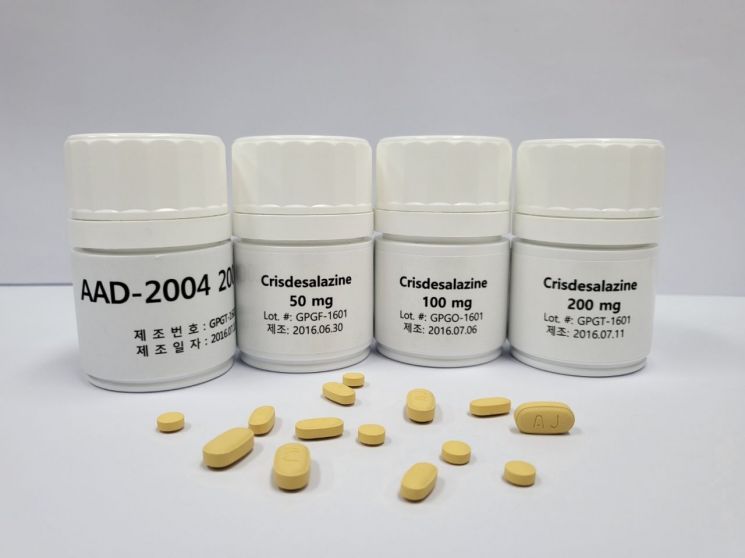 'Chrisdesalazine,' being developed by GNT Pharma as a treatment for degenerative brain diseases [Photo provided by GNT Pharma]
This Phase 2 clinical trial will be conducted on 144 patients with moderate Alzheimer’s disease who have cognitive impairment and tested positive on brain amyloid positron emission tomography (PET) imaging. Professor Choi Sung-hye of Inha University Hospital’s Department of Neurology will serve as the principal investigator, and about 10 domestic and international dementia clinical institutions will participate. The trial will be conducted in a double-blind manner, with patients taking either a placebo or Chrisdesalazine 100 mg or 200 mg once daily for 26 weeks.
The primary efficacy endpoint of the clinical trial is set as the proportion of patients who show improvement in the Alzheimer’s Disease Assessment Scale-Cognitive Subscale (ADAS-cog) score at week 26. Secondary efficacy evaluations will assess changes in cognitive function, activities of daily living, neuropsychiatric behavior, and geriatric depression scale scores at weeks 13 and 26, determining the drug efficacy of Chrisdesalazine compared to placebo.
Chrisdesalazine is a synthetic new drug discovered as a dementia treatment with support from the Brain Frontier Project Group of the Ministry of Science and ICT. It has both strong antioxidant effects that remove reactive oxygen species and anti-inflammatory effects that inhibit mPGES-1, blocking the production of the inflammatory mediator PGE2. In non-clinical trials, it reduced all biomarkers of Alzheimer’s dementia, including amyloid beta (Aβ), tauopathy (Tau), and neuronal cell death (N), and was shown to improve cognitive function when administered during early, middle, and late stages of the disease. Safety was also confirmed in a Phase 1 clinical trial conducted on 72 healthy adults, including elderly subjects.
Notably, for companion dogs, a treatment for cognitive dysfunction syndrome similar to Alzheimer’s dementia called ‘Jedacure’ has been on the market since 2021. It was confirmed that companion dogs with cognitive dysfunction syndrome showed significant improvement in cognitive function and social activity after taking Jedacure for more than 4 weeks. Post-marketing surveillance also confirmed cognitive dysfunction improvement effects in dogs with cognitive dysfunction syndrome who took the drug for 6 months, with no notable side effects reported.
Byungjoo Kwak, CEO of Genetipharma, stated, “We confirmed a significant improvement in cognitive dysfunction and a slowing of disease progression in companion dogs suffering from severe cognitive dysfunction syndrome,” adding, “The goal of this Phase 2 clinical trial is to verify the efficacy of Chrisdesalazine in improving cognitive impairment and treating the disease in patients with moderate-stage Alzheimer’s disease who have cognitive dysfunction.”
© The Asia Business Daily(www.asiae.co.kr). All rights reserved.
![Clutching a Stolen Dior Bag, Saying "I Hate Being Poor but Real"... The Grotesque Con of a "Human Knockoff" [Slate]](https://cwcontent.asiae.co.kr/asiaresize/183/2026021902243444107_1771435474.jpg)
















