The nationwide general strike by the Korean Health and Medical Workers' Union (KHMU) is just one day away, heightening tensions in the medical field. While disruptions to surgeries and hospital admissions at some hospitals have become a reality, the strike has also sparked heated debates over its pros and cons. The government has taken measures to prevent medical service gaps caused by the strike, but a dramatic last-minute resolution like the one in 2021 seems unlikely at this point.
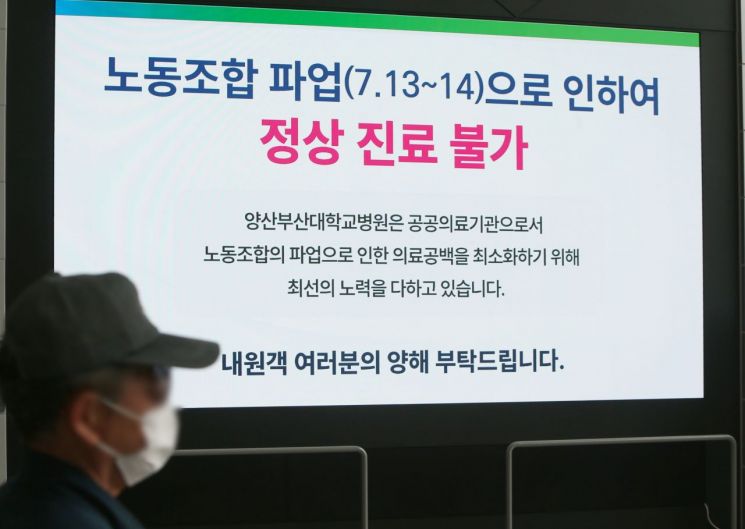 The electronic billboard at Yangsan Pusan National University Hospital displays a message informing that normal medical services are unavailable due to a labor union strike.
 [Image source=Yonhap News]
According to KHMU on the 12th, the union will hold a simultaneous general strike eve event nationwide at 6 p.m., including at Ewha Womans University Seoul Hospital, marking the countdown to the strike. About 800 union members from the Ewha Medical Center branch, along with KHMU Chairperson Na Soon-ja, are expected to participate in the eve event held at Ewha Hospital. The event will proceed with Chairperson Na’s opening speech, a video screening outlining the seven major demands of the sector-wide general strike, a report on negotiation progress and organizing efforts, and an explanation of the strike schedule.
The union expects approximately 65,000 members from 127 branches (145 workplaces) nationwide to participate in this strike. The workplaces involved include 29 private university hospital branches, 12 national university hospital branches, 12 special-purpose public hospital branches, 26 Korean Red Cross branches, and 26 local medical center branches. Although the so-called 'Big 5' large hospitals in Seoul will not participate, national university hospitals, private university tertiary hospitals, and public medical centers have announced their participation. The union has decided to maintain essential medical personnel in emergency rooms, operating rooms, intensive care units, and delivery rooms. However, since 65% of KHMU members are nurses, disruptions to outpatient care, diagnostics and testing, and hospital admissions are inevitable at medical institutions participating in the strike.
Some hospitals have already taken measures such as suspending surgeries and admissions. The National Cancer Center has canceled all surgeries scheduled for the 13th and 14th due to the strike. This is because there is a shortage of nursing and caregiving staff needed to care for surgical patients who require hospitalization. Additionally, Busan National University Hospital and Yangsan Busan National University Hospital are reducing the number of inpatients in general wards by discharging or transferring patients, except for critically ill patients, mothers, and infants, in preparation for the strike. Hospitals participating in the strike are closely monitoring the situation. A representative from a metropolitan area university hospital stated, "We currently have no plans to cancel surgeries or reduce inpatient numbers, but we will respond as the strike situation unfolds."
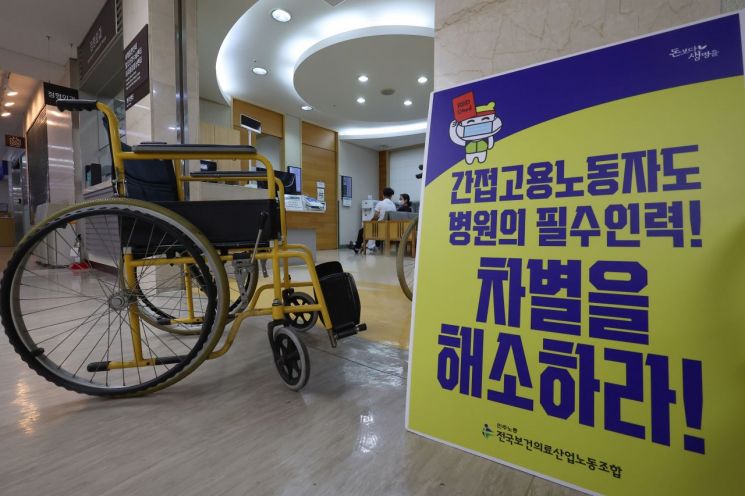 On the 11th, a sign of the Health and Medical Workers' Union was placed at a hospital in Seoul. [Image source=Yonhap News]
The general strike by KHMU has also sparked heated debates over support and opposition. The Good Public Hospital Movement Headquarters issued a statement saying, "Most citizens, disappointed by the current government policies that turn their backs on the urgent need to strengthen public healthcare, will naturally support the KHMU strike, which boldly stands against the government's policy issues." They declared their support, urging the government not to ignore the legitimate demands of healthcare workers and to actively pursue the realization of public healthcare and securing adequate healthcare personnel. Conversely, the '14 Health and Welfare Medical Solidarity,' a coalition of 14 healthcare-related professional organizations, held a press conference this morning to express their stance on the KHMU general strike. A coalition representative said, "Since there are concerns about medical service gaps, we plan to express our opinions and discuss ways to minimize public inconvenience."
A dramatic resolution between the union and the government also appears difficult. In 2021, just hours before the general strike, the 'September 2 Government-Union Agreement' was dramatically reached, preventing chaos in the medical field. However, this time, the gap between the union and government positions is not easily bridged. On the 10th, when the Ministry of Health and Welfare sent a message stating, "You should not participate in a political strike that neglects the lives and health of the people," the union immediately fired back, saying, "Labeling this as a political strike and shutting the door to dialogue is a narrow political attitude to evade responsibility." The union demands the government prepare a concrete roadmap addressing seven issues: ▲ full expansion of integrated nursing and caregiving services to resolve high caregiving costs ▲ institutionalization of a nurse-to-patient ratio of 1:5 and establishment of appropriate staffing standards for patient safety ▲ expansion of physician workforce to eradicate unlicensed illegal medical practice ▲ expansion of public healthcare responsible for essential medical services ▲ support for recovery hospitals to normalize COVID-19 dedicated hospitals ▲ fair compensation for COVID-19 heroes ▲ implementation of the September 2 Government-Union Agreement.
© The Asia Business Daily(www.asiae.co.kr). All rights reserved.
![Clutching a Stolen Dior Bag, Saying "I Hate Being Poor but Real"... The Grotesque Con of a "Human Knockoff" [Slate]](https://cwcontent.asiae.co.kr/asiaresize/183/2026021902243444107_1771435474.jpg)

















