Government Announces 2nd Round of Job Vacancy Measures Following March
Four Additional Sectors Including Construction Designated Beyond Existing Six
Increase in Private Housing Special Supply and Expansion of Earned Income Tax Exemption
Minister Lee Jeong-sik: "Improving Working Conditions Is the Fundamental Solution"
The government announced additional measures to address the labor shortage in industrial sites. In addition to the existing six industries such as shipbuilding and root industries, four more industries?construction, shipping, fisheries, and resource circulation?will be newly designated for focused support. The plan includes expanding the special supply of private housing and increasing the non-taxable amount of earned income to provide tangible benefits, while significantly increasing workforce inflow into vacant jobs through flexible working hours and improved work environments.
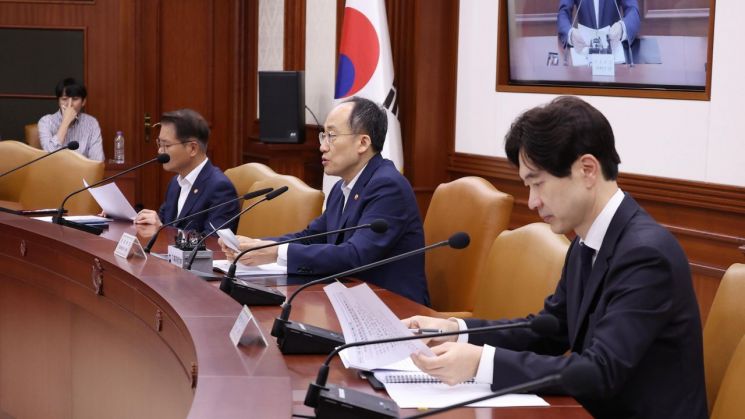 Deputy Prime Minister and Minister of Economy and Finance Choo Kyung-ho is attending the Emergency Economic Ministers' Meeting and Export Investment Measures Meeting held at the Government Seoul Office in Jongno-gu, Seoul, on the morning of the 12th, explaining the recent economic situation and agenda. [Photo by Yonhap News]
On the morning of the 12th, the government announced the "2nd Vacant Job Resolution Plan" at an emergency economic ministers' meeting held at the Government Seoul Office. This is a follow-up to the first plan released in March. Previously, the government selected six major industries?shipbuilding, root industries, logistics and transportation, health and welfare, restaurants, and agriculture?and provided customized support to resolve labor shortages. As a result, as of May, the number of vacant jobs was 214,000, a decrease of 11,000 compared to the same month last year.
In particular, the number of insured employees under employment insurance in the shipbuilding industry increased by 8,000 (8.5%) to 107,000 compared to the same month last year, and the health and welfare sector also saw an increase of 10,500 (5.4%). However, considering that many field companies still complain of labor shortages, the government has prepared additional support measures for the existing six industries and newly selected four more industries through this plan.
Poor Working Conditions...Urgent Need for Workforce Inflow in Essential Industries
The newly selected industries?construction, shipping, fisheries, and resource circulation?are essential to our society but have very poor working conditions, resulting in very low domestic workforce inflow. Jeong Gyeong-hoon, Director of Labor Market Policy at the Ministry of Employment and Labor, emphasized, "If the problem of workforce not entering these industries is not resolved, the long-term economic trend cannot be improved," adding, "Since fisheries and resource circulation are essential industries, we must ensure they operate by improving working conditions."
First, in the shipping sector, to increase real wages, the non-taxable amount of earned income for seafarers on foreign-going vessels and distant-water fishing vessels (currently 3 million KRW per month) will be expanded, and a Seafarer Development Fund will be established to strengthen welfare support. Additionally, labor-management-government consultations will be promoted in the second half of the year to shorten the boarding period on foreign-going vessels and improve paid leave days. Integrated management of seafarer personnel will be conducted to ensure smooth seafarer replenishment, and new training ships for merchant and fishing vessels will be constructed to expand practical training.
In the construction sector, where working conditions are poor, the government will expand the special supply of private housing for overseas construction workers to increase their numbers. Support will be provided for installing portable toilets during high-rise apartment construction, and safety accident prevention at sites will be strengthened using smart technology and equipment. In fisheries, to improve the safety and welfare of fishing crew members, the mandatory subscription to fishing crew insurance will be expanded to all fishing vessels, and the Fishing Vessel Safety Operation Act will be amended to establish a safety and health management system.
In the resource circulation sector, which young people particularly avoid, regional hub clusters will be established to attract talent, and modernization and automation of public waste sorting centers will be implemented. Support for modernization of outdated facilities of small environmental companies will also be strengthened. Since the resource circulation sector has a very high proportion of workers aged 50 and above (45.1%) and severe job avoidance, improving working conditions is urgent.
Expansion of Foreign Workforce... "The Purpose of Labor Reform is to Create Good Jobs"
Since it is difficult to fill vacant jobs with domestic workers alone, efforts to introduce foreign workers will be accelerated. This year, the quota for skilled workers (E-7-4) will be increased by 30,000, visa acquisition requirements will be eased, and measures to activate domestic employment of foreign students will be prepared. The government also plans to review the approval of new industries for simple foreign workers (E-9) based on analysis of industries facing labor shortages.
Support measures for the existing six industries will also be strengthened. In shipbuilding, the "Shipbuilding Industry Win-Win Agreement" including surveys on subcontracting and improvement of progress payments will be steadily implemented, and to prevent the departure of field workers, a "Shipbuilding Industry Employee Hope Deduction" project will be newly established next year as part of improving treatment. In root industries, flexible working hours will be supported to increase the inflow of idle labor such as career-interrupted women, and in health and welfare, measures to improve the treatment of care workers and secure manpower will be developed by October.
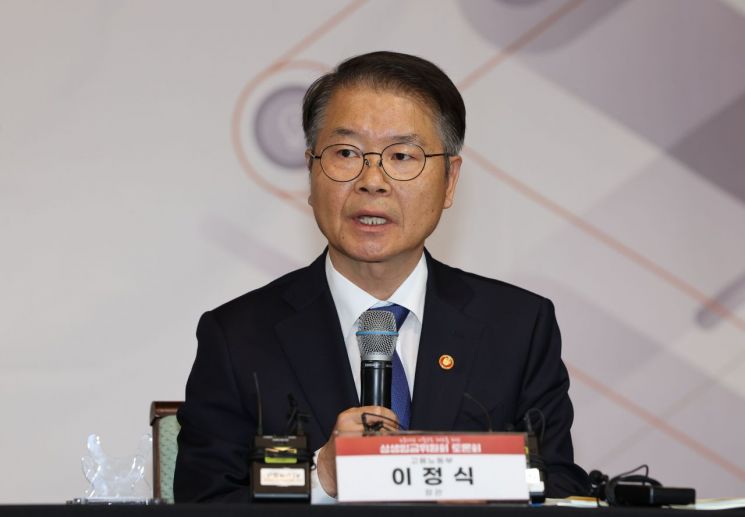
Lee Jeong-sik, Minister of Employment and Labor, emphasized, "The ultimate goal of labor reform, a core reform task of the Yoon Seok-yeol government, is to create quality jobs," adding, "Therefore, this vacant job resolution plan is part of labor reform, and at the same time, improving working conditions in small and medium enterprises through labor reform is the fundamental solution to vacant jobs." Minister Lee explained, "We will continue to steadily promote labor reform while expanding systematic workforce training and customized employment services."
© The Asia Business Daily(www.asiae.co.kr). All rights reserved.
!["The Woman Who Threw Herself into the Water Clutching a Stolen Dior Bag"...A Grotesque Success Story That Shakes the Korean Psyche [Slate]](https://cwcontent.asiae.co.kr/asiaresize/183/2026021902243444107_1771435474.jpg)

















