Mention South Korea as Republic of Korea
Taeyoungho "Suspect change from ethnic to inter-state relations"
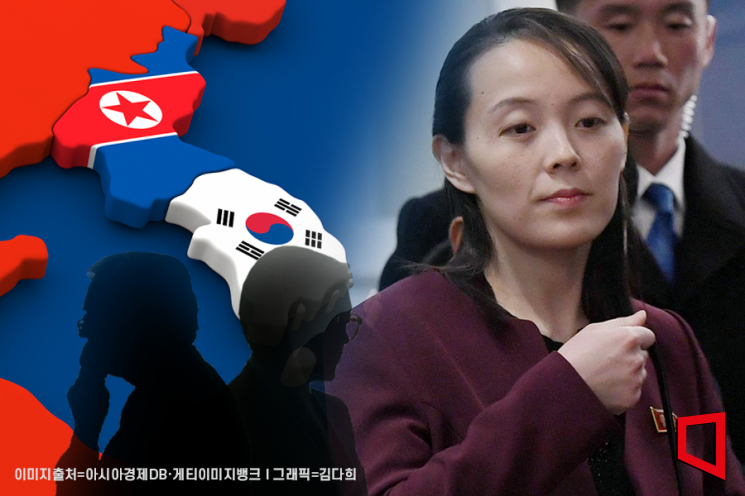
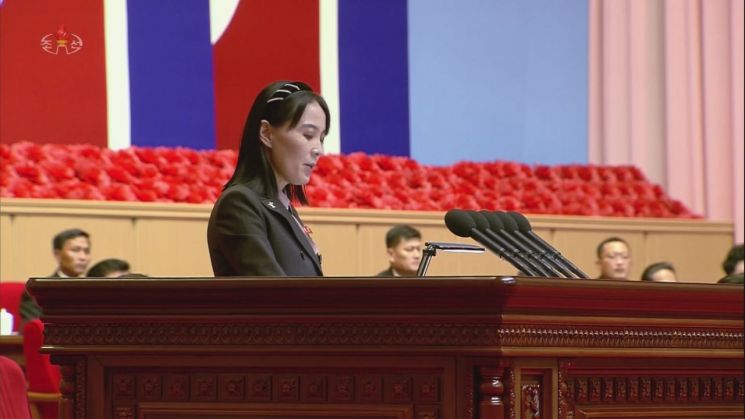
In consecutive statements released by Kim Yo-jong, the Deputy Director of the Workers' Party of Korea, she referred to our side as the "Republic of Korea" instead of "Namjoson" (South Joseon), leading to analyses that North Korea is formalizing a "two Koreas" strategy that views South Korea not as a special relationship but as a state-to-state relationship.
The amendment of the party charter at the 8th Party Congress held two years ago, which can be seen as a renunciation of "communist unification," also supports this speculation. However, some point out that it is premature to conclude this solely based on Kim Yo-jong's one-time use of the term "Republic of Korea."
On the 11th, Tae Yong-ho, a former North Korean diplomat and a member of the People Power Party, stated on his social media (SNS), "There are suspicious circumstances suggesting that North Korea is trying to change inter-Korean relations from an ethnic relationship to a state-to-state relationship," and he publicly questioned, "We should ask the Kim siblings whether they intend to change the grand principle of the ‘special inter-Korean relationship’ upheld by their grandfather and father to a ‘state-to-state relationship’ in their generation."
He added, "If North Korea intends to change inter-Korean relations from a special relationship aiming for unification to a state relationship, it would be a serious situation that fundamentally overturns the special relationship aiming for unification maintained for over 30 years since the adoption of the 1991 Basic Agreement between North and South Korea," and said, "We must also prepare legislative and institutional responses accordingly."
The reason for Tae's claim is that in two statements released over two days starting the previous day, Kim Yo-jong used the term "Republic of Korea" instead of "Namjoson." North Korea's use of the term "Republic of Korea" has been limited to extremely exceptional cases such as talks or agreements, while major media, documents, and statements have mainly used the expression "Namjoson," as inter-Korean relations have been regarded as a special relationship rather than a state-to-state relationship.
From this perspective, Kim Yo-jong's unusual use of "Republic of Korea" to refer to South Korea can be interpreted as an intention to change inter-Korean relations to a state-to-state relationship.
Experts such as Jeong Se-hyun, former Senior Vice Chairman of the National Unification Advisory Council, and Lee Jong-seok, former Minister of Unification, also interpreted North Korea's deletion of the mention of "national liberation democratic revolution" through the amendment of the party charter at the 8th Party Congress in 2021 in the same context. They suggest that North Korea is abandoning the "South Korean revolutionary unification theory" and trying to view North and South Korea as separate states.
In the 1970s, North Korea rejected the "two Koreas" theory as a "U.S. imperialist scheme." At that time, Chairman Kim Il-sung's teachings included statements such as "Japanese militarists are actively following the U.S. imperialist 'two Koreas' policy with the aim of making South Korea their commodity market and colony." However, this theory effectively collapsed with the simultaneous admission of both Koreas to the United Nations in 1991.
Through the 1991 Basic Agreement between North and South Korea, a "special relationship" was established that externally recognized two states but internally aimed for unification as one state. However, over the past 30 years, the political and economic gaps between the two Koreas have gradually widened, and the "one state" theory is increasingly losing ground.
However, some point out that it is difficult to be certain that North Korea has officially adopted the "two states" strategy based solely on Kim Yo-jong's recent statements.
Cha Doo-hyun, Senior Research Fellow at the Asan Institute for Policy Studies, wrote on his SNS, "The key is whether this is just a twist or if the term is being used repeatedly as a new expression," and emphasized, "If it is a one-time occurrence, it is just Kim Yo-jong making a sarcastic remark once," cautioning against premature judgment. The Ministry of Unification also described Kim Yo-jong's remarks as "unprecedented" but stated that it "will not make any presumptions."
© The Asia Business Daily(www.asiae.co.kr). All rights reserved.


















