President Biden
"Will Attend Hanwha Solutions Factory Groundbreaking Ceremony"
Hanwha Solutions to Invest 3.2 Trillion KRW by Next Year
Building Solar Hub, an Integrated Solar Production Complex
Producing Entire Solar Value Chain
From Basic Materials to Modules
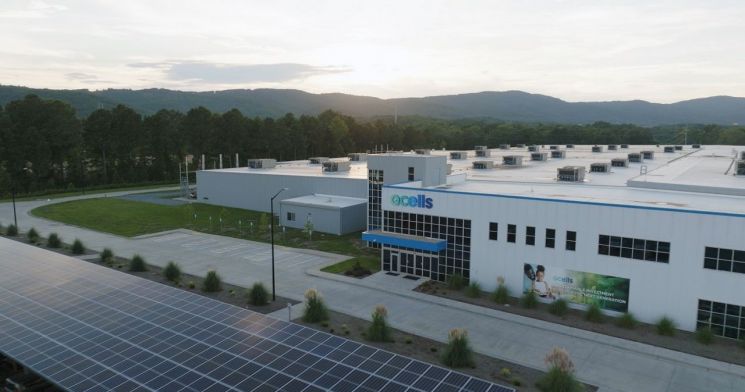
U.S. President Joe Biden has declared his intention to visit Hanwha Solutions' (Q CELLS division · Hanwha Q CELLS) solar module factory in Georgia, which has not yet broken ground. He specifically pointed to the Hanwha factory as a key base to reclaim dominance in renewable energy.
In a speech on the 6th, President Biden, while visiting the Flex LTD factory located in West Columbia, South Carolina, said, "Since taking office, I have announced production and supply facilities in over 60 locations nationwide to build a solar energy supply chain," adding, "The biggest achievement among them is Dalton, Georgia (the site of the Hanwha Q CELLS factory)." He further stated, "I will attend the groundbreaking ceremony of the (Hanwha Q CELLS) factory." Hanwha Solutions is investing about 3.2 trillion won to build the largest solar module factory in North America, called the 'Solar Hub.' The annual production capacity of solar modules will be approximately 8.4 GW, enough to supply electricity to 1.3 million U.S. households for one year.
◆From a country that only invented to a country that executes, the U.S.= The American current affairs monthly magazine The Atlantic Monthly criticized in its New Year's issue this year that "the U.S. has become a country that only invents but does not execute." The example given was solar modules. The world's first commercialized solar module was produced in 1954 at AT&T's Bell Labs. At that time, it was a 1W module priced at $286. Supplying sufficient electricity to a U.S. household then cost over $1.4 million (about 1.8 billion won). The efficiency of converting light energy into electricity was only 1%. Currently, solar modules convert more than 20% of light energy into electrical energy. Although the U.S. continued research and development to improve efficiency after inventing solar modules, large-scale production was ultimately carried out in countries like China and Germany, which provided subsidies for solar module installation.
However, as the importance of carbon neutrality and energy dominance has been emphasized, the U.S. is showing a strong will not to lose domestic production of renewable energy such as solar power. Hanwha Solutions alone is investing over 3 trillion won but is expected to receive tax credit benefits worth $875 million (about 1.09 trillion won) in the future. Due to such massive subsidies, the U.S. solar market is expected to grow from 140 GW in 2022 to 210 GW in 2024, raising expectations for increased performance from market expansion.
◆Hanwha plants the entire solar value chain in the U.S.= Hanwha Solutions' Solar Hub investment is the largest scale in the history of the U.S. solar energy industry. It is also the first time a single company has established production lines for all key solar value chains in the North American region. The solar key value chain consists of five stages: 'Polysilicon (the raw material for solar cells made mainly of silicon) → Ingot (a cylindrical block made by melting polysilicon into crystals) → Wafer (thin slices cut from ingots) → Cell (solar cell) → Module (panel assembled from solar cells) → Power generation (construction and operation).' Hanwha Solutions' Georgia factory produces four of these products in one location, excluding the raw material polysilicon. By using polysilicon produced by REC Silicon, whose shares were acquired last year, Hanwha Solutions becomes the only company in North America to have the entire solar module supply chain from basic material polysilicon to finished modules. This means it can become a rival to China, which dominates most of the solar supply chain.
Hanwha Solutions is also free from environmental pollution issues related to solar modules. The largest competitor in the U.S. market, First Solar, produces cadmium telluride solar modules, which contaminate soil and groundwater with heavy metals such as cadmium and arsenic when disposed of or landfilled. In contrast, Hanwha Solutions' polysilicon modules pose no environmental pollution concerns even upon disposal. Kang Dong-jin, a researcher at Hyundai Motor Securities, predicted, "Hanwha Solutions, which is steadily constructing solar cell production facilities in the U.S., will be the biggest beneficiary of the renewable energy industry boom driven by the IRA and other policies."
© The Asia Business Daily(www.asiae.co.kr). All rights reserved.
![Clutching a Stolen Dior Bag, Saying "I Hate Being Poor but Real"... The Grotesque Con of a "Human Knockoff" [Slate]](https://cwcontent.asiae.co.kr/asiaresize/183/2026021902243444107_1771435474.jpg)
















