Wheel Control Solely by Electrical Signals Without Mechanical Connection
Electrification-Optimized Technology Enhances Indoor Space Utilization
Steering Disabled When Discharged and High Cost of Dual Design Must Be Addressed
Lexus to Equip in 2025, Tesla Files Patent Application
One day in 2030. I entered the highway by car. When fully autonomous driving started, the steering wheel moved from the driver's seat to the passenger seat. The now unnecessary steering wheel moved to secure space in the driver's seat. In this space, the driver reads a book or eats. After spending time leisurely, I entered the city, the destination. Wanting to drive, I stopped autonomous driving, and the steering wheel returned to the driver's seat. While waiting at a signal, a situation arose where I had to make a U-turn. Gently pressing the accelerator pedal and turning the steering wheel only 90 degrees, the vehicle made a 180-degree U-turn.
This is a scene that could be seen if Steer by Wire (SbW), where the steering wheel is not directly connected to the car wheels, becomes commercialized. Automakers and parts manufacturers are rushing to develop this technology suitable for electric vehicles, which allows better use of interior space. Lexus already plans to offer SbW as an option in its first electric vehicle, and Tesla is expected to equip the new Model 3 with it. However, since it is software-based technology, vulnerability to hacking or sudden malfunctions poses obstacles to commercialization.
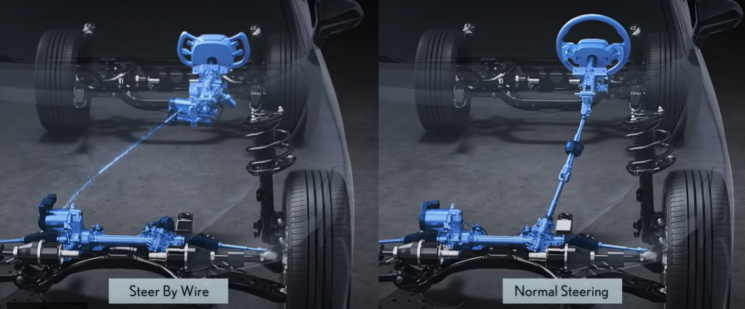 (Left) The difference between a vehicle equipped with steer-by-wire technology and a conventional vehicle. When SbW is applied, the axle is eliminated.
 [Photo by Lexus UK YouTube]
SbW is a technology that moves the steering wheel electronically. Generally, a car’s steering wheel is connected to the front wheels through a single shaft to change direction. However, SbW completely separates the steering wheel from the wheels and moves the wheels only by electrical signals.
Applying SbW allows the steering wheel position to be freely arranged. Since the steering wheel can move, there is no need to manufacture separate vehicles for countries with right-hand drive (such as the UK and Japan).
It also pairs well with electric vehicles. SbW can maximize the use of interior space, which is an advantage of electric vehicles. Most electric vehicles are built on a 'skateboard' platform. This platform’s characteristic is that the battery, drive motor, and other components are gathered in a module (a single unit made of individual parts) under the chassis. In other words, electric vehicles have fewer parts and more interior space compared to internal combustion engine vehicles with engines at the front. With the increased space, design can be more flexible, and applying SbW can eliminate parts like the shaft that connects the front wheels and steering wheel. This means the front seats, including the driver's seat, have more space than existing electric vehicles.
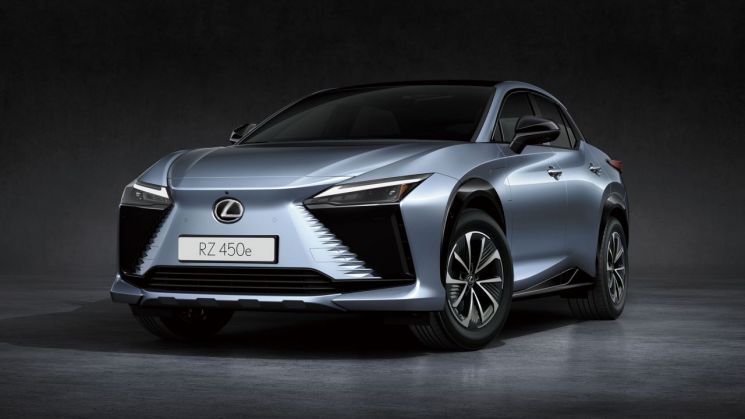
Driving convenience also improves. Vehicles equipped with One Motion Grip, an SbW developed by Japanese automaker Lexus, allow driving by turning the steering wheel only about 150 degrees left or right without needing to rotate it 2 to 3 times. The steering gear ratio can be freely adjusted according to vehicle speed. At low speeds, a small turn of the steering wheel results in a large wheel turn, while at high speeds, the gear ratio is set higher so the steering wheel moves less easily.
However, there are drawbacks. Steering may become impossible if the electric vehicle’s battery is depleted. Redundant design (creating backups of software and other systems to prepare for potential errors) is also necessary to prepare for various malfunctions, which means higher costs. Jeon Hyun-joo, senior analyst at the Korea Automotive Research Institute’s Industry Analysis Office, said, “Compared to mechanical steering, SbW is vulnerable to hacking, so cybersecurity enhancement is necessary, and concerns exist about high costs in mass production due to increased manufacturing costs from redundant design.”
Automakers have already begun commercializing SbW. Lexus will start producing the electric vehicle RZ450e equipped with this technology in the first half of next year. Yoichiro Kasai, deputy chief engineer of the RZ, said, “We are developing it with a focus on driving convenience, driving enjoyment, and driver seat design,” adding, “We are developing it so that drivers can feel like they are playing a PlayStation game, able to go in the desired direction.” Safety was also considered by installing auxiliary systems through redundant design and including a separate battery. Tesla applied for an SbW patent last month and is expected to equip it in the Model 3 in the second half of this year.
© The Asia Business Daily(www.asiae.co.kr). All rights reserved.


















