Northward Migration of Turbulent Fish Species Due to Global Warming... Changes in Marine Ecosystems
As the seas around the Korean Peninsula warm due to climate change, changes are being detected in the marine ecosystem. In the East Sea, sharks, which are warm-current species, have been spotted, and in Jeju Island, there has been an increase in sightings of the blue-ringed octopus, which inhabits subtropical seas.
On the 9th, a report was received of a shark sighting off the coast of Pohang, Gyeongbuk. According to the Pohang Coast Guard, around 1 p.m. that day, the captain of fishing boat A reported seeing a shark.
The shark found is known to be a type of blue shark. The blue shark, the fastest among sharks, is a carnivorous fish that preys on species such as sea bass, herring, and tuna, and is known for its aggressive nature, sometimes attacking humans.
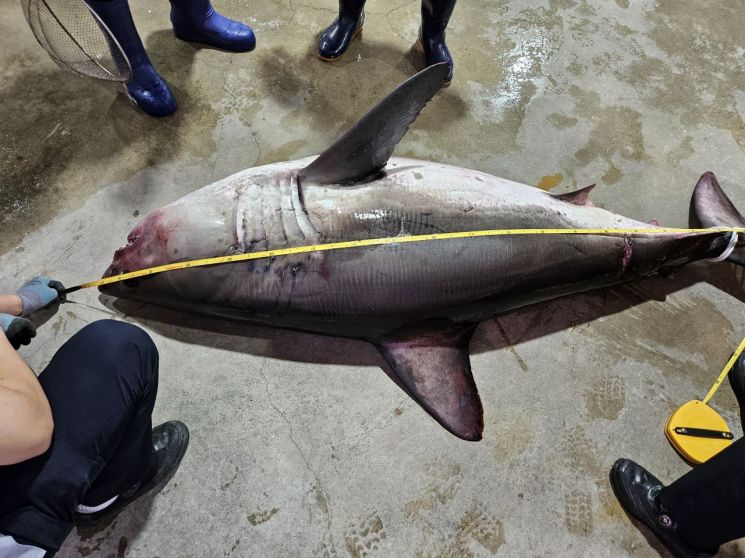 At around 4:15 a.m. on the 6th, a dead white shark caught in the net was found near 3.7 km east of Imwon Port, Samcheok City, on the fishing vessel A (24-ton class, 7 crew members). The Coast Guard urged vacationers to be cautious during the peak holiday season. The bycaught white shark measured 211 cm in length, 150 cm in girth, and weighed approximately 1 kg. Photo by Donghae Coast Guard, Yonhap News.
Both blue sharks and great white sharks are warm-current species, but cases of them moving northward are increasing. Recently, reports of shark sightings along the East Coast have been frequent. On the 23rd of last month, a 1.9-meter-long great white shark was spotted off Janghang Port in Sokcho, Gangwon Province, and on the 6th, a sevengill shark was found dead, caught in a net, off the eastern sea near Imwon Port in Samcheok, Gangwon Province.
Additionally, on the 7th, a shark presumed to be a blue shark was sighted by the coast guard during a maritime patrol about 1.2 km east of Gwangjin Port in Samcheok.
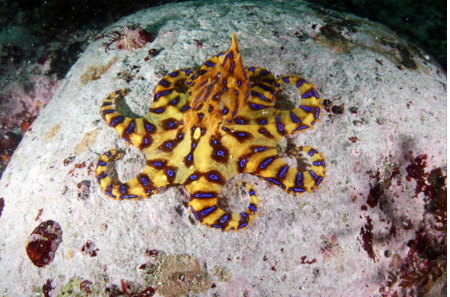
Meanwhile, in the waters around Jeju Island, the highly venomous blue-ringed octopus has been appearing frequently for several years. According to a paper published in the international journal Toxins by a research team from the National Institute of Fisheries Science in March, since the blue-ringed octopus was first discovered in Jeju in 2012, there have been a total of 26 reports in Korea.
The blue-ringed octopus is smaller than common octopuses, with an adult size around 10 cm, and displays iridescent blue patterns on its arms and back. The danger of the blue-ringed octopus lies in its tetrodotoxin (TTX), which is ten times more potent than cyanide. If touched with bare hands and bitten, exposure to the toxin can cause symptoms such as paralysis, vomiting, respiratory distress, and cardiac arrest. An adult bitten by a blue-ringed octopus can die within just 26 minutes.
The blue-ringed octopus primarily inhabits subtropical seas of the South Pacific, including Australia, Indonesia, the Philippines, and Sri Lanka, but recently it has been found not only in Jeju but also in Geoje, Busan, Yeosu, and other southern coastal areas, and since 2020, it has been discovered along the Ulsan coast in the East Sea.
The northward movement of marine species that inhabit warm seas is related to the rise in sea temperatures. As sea temperatures rise, their habitat range expands. According to the Korea Institute of Ocean Science and Technology (KIOST), the average sea surface temperature in the East Sea from March to May this year was 10 degrees Celsius, which is 1.8 degrees higher than the 30-year average from 1991 to 2020. This is the highest temperature recorded in 42 years since observations began in Korea.
KIOST stated, "This rapid rise in spring sea surface temperature in the East Sea is presumed to be caused by the reduction of sea ice in the Kara Sea and Barents Sea north of Russia in the Arctic Ocean, and atmospheric responses due to global warming, which have led to the development of strong high pressure over the upper layers of the seas around Korea and the maintenance of high temperatures." They added, "This indicates that global warming is accelerating, and it may lead to even higher sea temperatures in the East Sea this summer, so continuous monitoring and preparation are necessary."
© The Asia Business Daily(www.asiae.co.kr). All rights reserved.


















