Industrial Research Institute Report on Changes and Challenges in Automobile Export Structure
South Korean Eco-friendly Cars Imported $2.1 Billion in Q1 This Year
Surpasses Japan, Germany, and Canada as Top Importing Countries
Supply Chain Restructuring Trends Due to IRA and Critical Raw Materials Act
Support Needed for Mobility Services and Commercial Electrification
As major countries have expressed their determination to establish domestic electric vehicle supply chains and competition among companies intensifies, there is an analysis that the automotive industry, a key export sector for South Korea, may face threats. It has been pointed out that policy support is needed in areas that have been relatively overlooked so far, such as expanding sales channels to emerging markets, mobility services, and electrification of commercial vehicles.
According to the report "Changes in the Structure of Automobile Exports and Future Tasks" released on the 10th by Song Myung-gu, a senior researcher at the Korea Institute for Industrial Economics and Trade, the recent increase in South Korea's automobile exports is largely due to the rise in sales of eco-friendly vehicles. Until 2017, out of South Korea's automobile export value of $38.8 billion, internal combustion engine vehicles accounted for $35.2 billion, exceeding 90%. Even when combining hybrid, plug-in hybrid, and electric vehicles, the share was only about 9.3%.
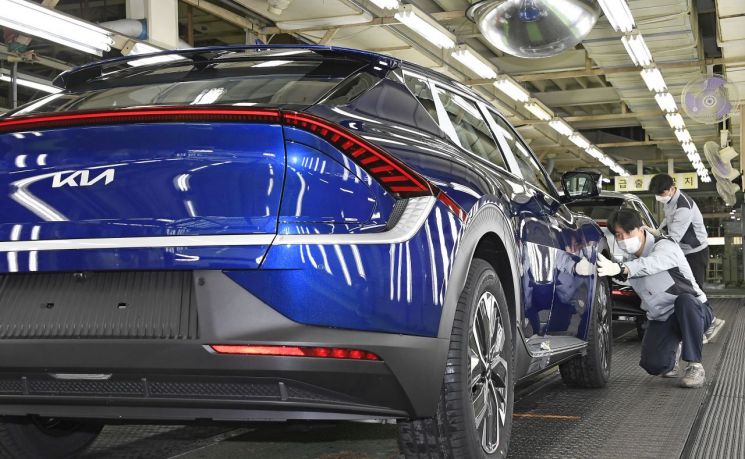
Since then, the proportion of eco-friendly vehicles has steadily increased, accounting for 31.1% last year. In the first quarter of this year, it soared to 37.1%. This means that nearly 4 out of every 10 vehicles South Korea exports are eco-friendly. Looking at the average annual growth rate of export value over the past five years, internal combustion engine vehicles have remained almost flat at 0.2%, while all eco-friendly vehicles have shown double-digit growth rates. In particular, electric vehicle exports have increased by more than 80% annually.
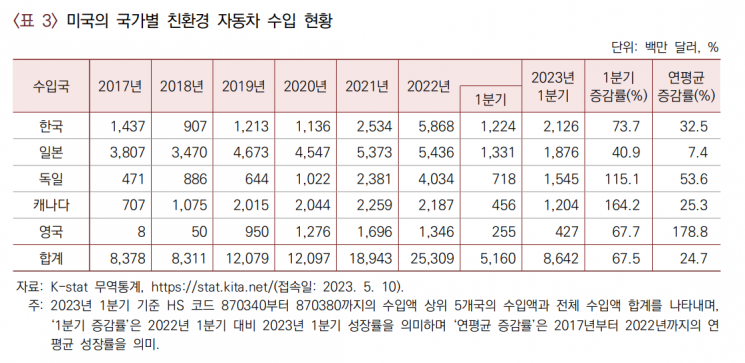
This is the result of gaining product competitiveness in the United States, which has emerged as the largest export market. Examining the trade results of eco-friendly vehicles in the U.S., South Korea was the largest source country for U.S. imports of eco-friendly vehicles in the first quarter of this year, importing $2.1 billion worth from South Korea.
Japan followed with $1.9 billion, Germany with $1.5 billion, and Canada with $1.2 billion. South Korea was ranked 4th among U.S. eco-friendly vehicle import countries in 2020, rose to 2nd place the following year, and has been 1st since last year. The report cited a local market research agency's findings, explaining that "customer satisfaction with South Korean vehicles in the U.S. has significantly increased compared to 2019 and is highly regarded in the market."
Although automobile trade with the U.S. seems to be going smoothly, the situation is not entirely reassuring. The report states, "Each major country’s strategy to reorganize supply chains centered on their own countries and intensified competition in the electric vehicle market are threat factors to our automotive industry," adding, "In particular, the U.S. Inflation Reduction Act (IRA), the European Climate Neutral Industry Act, and the Critical Raw Materials Act may bring changes to battery and electric vehicle production bases in the future, which will have considerable impact on South Korea’s electric vehicle exports."
To maintain competitiveness in the global eco-friendly vehicle market, it pointed out the need to diversify export markets, strengthen public-private cooperation systems involving the government and companies, and increase collaboration between automakers and battery manufacturers. It also emphasized the importance of maintaining close relationships with battery material producing countries such as Australia and Indonesia.
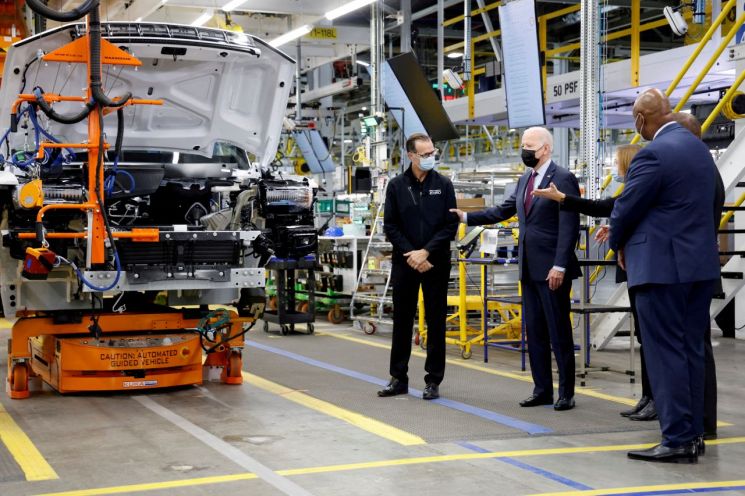 U.S. President Joe Biden is visiting and touring Factory Zero, where GM's electric pickup truck Hummer EV is produced in 2021.
 Furthermore, the institute diagnosed that policies for electrification in the commercial vehicle sector are necessary for mid- to long-term competitiveness. Although commercial vehicles account for a small proportion of total vehicles, they emit a large amount of pollutants and are considered an urgent sector for electrification to achieve carbon neutrality goals. It also stressed that public support should back mobility services and vehicle software sectors.
The report stated, "To enhance the competitiveness of the vehicle software industry, expansion of private sector investment and domestic workforce development policies should be pursued," and added, "In the mobility service sector, increasing demonstration bases and establishing institutional foundations for data utilization are required, which necessitates close cooperation between the private sector and government."
© The Asia Business Daily(www.asiae.co.kr). All rights reserved.



















