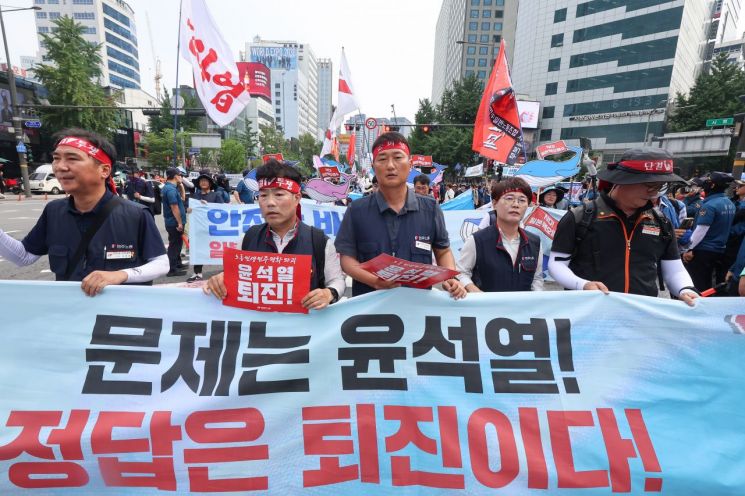
 On the afternoon of the 6th, participants marched toward the Government Seoul Office and Seoul Employment and Labor Office during the National Workers' Rally of the Korean Confederation of Trade Unions (KCTU) held around Sungnyemun in Jung-gu, Seoul.
 [Image source=Yonhap News]
As conflicts between labor and management over next year's minimum wage decision intensify, a final conclusion is expected to be reached in the latter half of next week. Due to the significant differences in positions between labor and management, it is highly likely that the mediation proposal put forth by the public interest commissioners will be adopted through a vote once again.
According to the Ministry of Employment and Labor on the 9th, the Minimum Wage Commission will hold its 12th and 13th plenary meetings at the Government Sejong Complex on the 11th and 13th, respectively.
The Ministry of Employment and Labor must finalize and announce next year's minimum wage by the 5th of next month. Considering administrative procedures and objection periods, next week is effectively the deadline.
Referring to previous cases, the minimum wage is likely to be decided late on the night of the 13th or early morning of the 14th. In situations where labor and management cannot reach an agreement, the Minimum Wage Commission has made final decisions through voting at the last moment.
Currently, labor demands a minimum wage of 12,000 won for next year, while management requests 9,700 won. The initial proposals were 12,210 won and 9,620 won respectively, but these were gradually narrowed to 12,130 won and 9,650 won in the first revision, and 12,000 won and 9,700 won in the second revision.
Both labor and management plan to present a third revision at the plenary meeting on the 11th, but the gap is unlikely to narrow significantly. Especially since conflicts between labor and the government over labor reforms continue, a fierce power struggle over the minimum wage is expected more than in previous years.
As discussions on the minimum wage reach their final stages, attention is focused on whether the "10,000 won" mark can be surpassed next year. If the increase rate exceeds 3.95%, the minimum wage will surpass 10,000 won. In recent years, the increase rates were well above 3.95%, with 5.05% in 2022 (9,160 won) and 5.0% this year (9,620 won).
Even if it does not rise to the 12,000 won demanded by labor, there is a sufficient possibility of breaking the 10,000 won barrier.
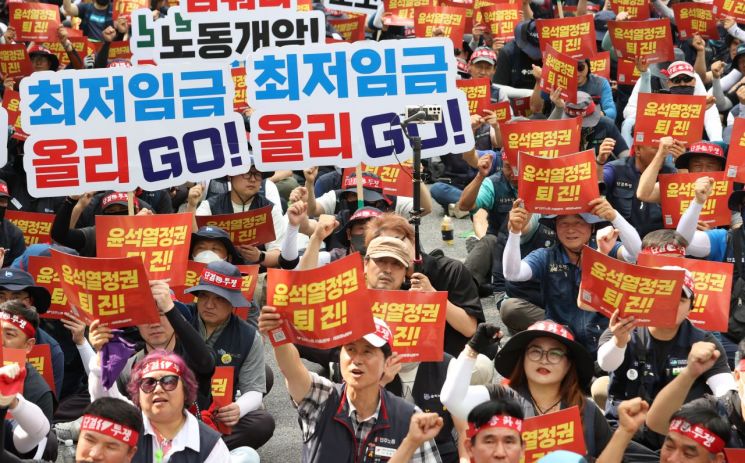 On the afternoon of the 5th, participants hold signs calling for an increase in the minimum wage at the "General Strike Victory Rally" organized by the Korean Confederation of Trade Unions in front of the National Police Agency in Seodaemun-gu, Seoul. [Image source=Yonhap News]
The key lies in the mediation proposal by the public interest commissioners. The Minimum Wage Commission consists of 27 members: 9 worker representatives, 9 employer representatives, and 9 public interest commissioners. However, since the positions of worker and employer representatives usually run parallel without agreement, the amount is decided by voting.
Last year, the amount proposed by the public interest commissioners (9,620 won) was adopted through voting. At that time, all employer representatives and some worker representatives who opposed the mediation proposal abstained or did not participate, resulting in the final decision of 9,620 won.
Therefore, the public interest commissioners, who play a mediating role, effectively hold the casting vote in the Minimum Wage Commission. Since its establishment in 1987, the Minimum Wage Commission has decided minimum wage levels by voting for 11 consecutive years from 2012 to last year, and voting was also common before that.
Especially since large unions under the Korean Confederation of Trade Unions (KCTU) are scheduled to go on a series of general strikes next week, the power struggle among the government, management, and labor is likely to continue until the final moments.
Although Kim Jun-young, former worker representative and Secretary-General of the Korean Metal Workers' Federation under the Federation of Korean Trade Unions (FKTU), was arrested after staging a "watchtower sit-in," disrupting the balance of members, it is analyzed that this is unlikely to be a decisive variable. Considering the proportion of public interest commissioners, the absence of one worker representative may not have significant meaning.
© The Asia Business Daily(www.asiae.co.kr). All rights reserved.
![Clutching a Stolen Dior Bag, Saying "I Hate Being Poor but Real"... The Grotesque Con of a "Human Knockoff" [Slate]](https://cwcontent.asiae.co.kr/asiaresize/183/2026021902243444107_1771435474.jpg)

















