"US-Japan Interest Rate Gap Widens
Yen Selling Pressure Intensifies
Yen Value Expected to Keep Falling
Until BOJ Shifts to Tightening"
Former Vice Minister of Finance of Japan, Eisuke Sakakibara, known as "Mr. Yen," warned that the yen-to-dollar exchange rate could fall to 160 yen per dollar next year, the lowest level in 32 years. He pointed out that the interest rate gap between the U.S. and Japan has widened and is expected to continue, which could lead to the yen weakening further compared to its current level.
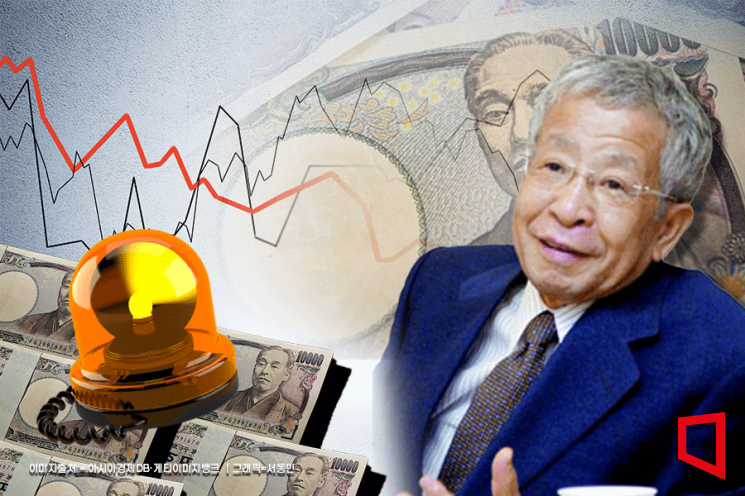
On the 7th, in an interview with Bloomberg News, former Vice Minister Sakakibara stated, "As the U.S. continues its tightening stance while Japan maintains its ultra-low interest rate policy, the yen could weaken by more than 10% from its current level."
According to his forecast, the yen-to-dollar rate will drop to the 160 yen range next year. He explained, "The divergent monetary policies of the U.S. and Japan have widened the interest rate gap between the two countries, strengthening the selling pressure on the yen," adding, "The yen's value could continue to decline until the Bank of Japan (BOJ) shifts to a tightening monetary policy."
However, he also predicted that if the Japanese economy shows signs of overheating as it currently does, the BOJ might implement tightening measures next year. This year, the Japanese stock market experienced an unexpected boom, with listed companies posting record-high earnings thanks to last year's weak yen effect. The TOPIX index, which focuses on large-cap stocks, reached its highest level since before the bubble burst in 1987. Domestic demand is also recovering due to a surge in tourists. If the economy continues to show such strength, former Vice Minister Sakakibara expects the BOJ to abandon its negative interest rate policy and the Yield Curve Control (YCC) policy, which artificially adjusts long-term interest rate fluctuations.
Regarding the BOJ's foreign exchange market intervention strategy, he suggested that "masked intervention" would be the most effective approach. Previously, the foreign exchange authorities purchased about 9 trillion yen (approximately 82 trillion won) over three occasions last year, two of which were conducted without prior market notice. He revealed that during his tenure as Vice Minister of Finance, he once ordered a surprise foreign exchange market intervention around 2 a.m.
He said, "If I were the current authority in charge, I would intervene suddenly right now, at this very moment." He added, "It is more effective to stay quiet for a while and intervene at an unexpected time."
Former Vice Minister Sakakibara served as Vice Minister of Finance during the late 1990s when Asia faced a foreign exchange crisis. During his tenure, he pursued an aggressive foreign exchange market intervention policy to depreciate the yen, earning him the nicknames "Currency Czar" and "Mr. Yen." In June last year, he accurately predicted that the yen would surpass 150 yen per dollar. Later, in October of the same year, he forecasted the yen could fall to 170 yen per dollar, but due to the BOJ's monetary policy adjustments and foreign exchange market interventions, the yen's value rose to the 120 yen range earlier this year.
Meanwhile, in the Tokyo foreign exchange market on the same day, the yen-to-dollar exchange rate was 144.07 yen at around 9:40 a.m. The yen, which had been trading in the mid-144 yen range the previous day, briefly fell to the 143 yen range during the session as both the New York and Asian stock markets declined.
© The Asia Business Daily(www.asiae.co.kr). All rights reserved.

















