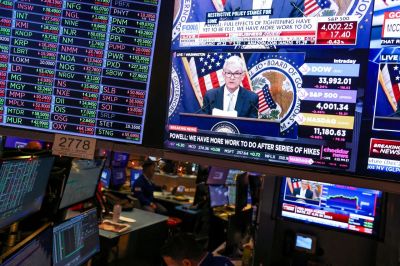
Despite more than a year of tightening by the Federal Reserve (Fed), another indicator suggesting that the U.S. labor market remains overheated has emerged. The private employment data, which doubled expectations, has sparked widespread speculation that the Fed will not only resume rate hikes starting this month but also maintain high rates for an extended period. Amid sharply rising concerns over tightening, Treasury yields surged and the stock market declined.
June Private Employment Exceeds Forecast by More Than Double
According to Automatic Data Processing (ADP), a private employment data provider, private sector employment increased by 497,000 jobs in June compared to the previous month. This figure is more than double the expert forecast of 220,000 jobs compiled by The Wall Street Journal (WSJ) and Dow Jones. It is also the largest increase since July of last year.
By sector, employment in face-to-face service industries significantly boosted private employment. The leisure and hospitality sector alone saw an increase of 232,000 jobs, with the service provision sector expanding by 373,000 jobs. The construction sector also grew by 97,000 jobs, supported by signs of market recovery. ADP’s Chief Economist Nela Richardson explained, "The face-to-face service industry showed strength in June, leading to higher-than-expected job creation." Wage growth for workers slowed slightly to 6.4% from 6.6% the previous month but remained in the 6% range.
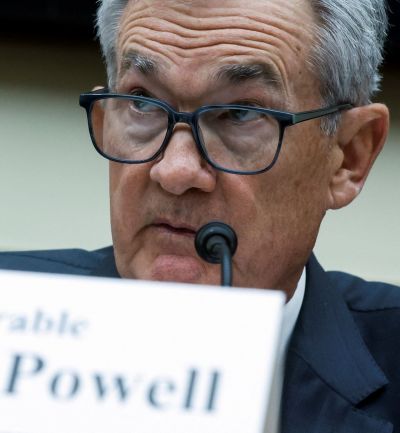
These indicators suggest, as Fed Chair Jerome Powell has expressed concern, that the overall labor market remains overheated. Powell has pointed out that achieving the inflation target of 2% requires below-trend low growth and a cooling labor market. John Lynch, Chief Investment Officer at Comerica Wealth Management, told CNBC, "The figure exceeding expectations by more than double has heightened fears that the Fed will pursue more aggressive tightening."
The weekly initial jobless claims released on the same day exceeded market expectations but remained at a low level. According to the Department of Labor, initial jobless claims for the week of June 25 to July 1 increased by 12,000 to 248,000. Continuing claims, which represent those applying for unemployment benefits for at least two weeks, decreased by 13,000 to 1.72 million, marking the lowest level since February.
U.S. companies’ layoff plans have also decreased. According to the Challenger, Gray & Christmas (CG&C) layoff report, planned layoffs in June totaled 40,709, down 49% from the previous month, the lowest since October 2022. However, the Job Openings and Labor Turnover Survey (JOLTs) reported 9.8 million private sector job openings in May, down 496,000 from the previous month.
Rate Hikes Gain Momentum...Will Fed Raise Rates Consecutively in July and September?
Since March last year, the Fed has raised the U.S. benchmark interest rate ten consecutive times, bringing it to 5.0?5.25%. At the June FOMC, the Fed decided to pause, marking its first breather. However, with the labor market overheating?an essential factor for curbing inflation?showing little sign of cooling, market expectations for tightening have intensified.
It is widely expected that rate hikes will resume at the July 25?26 FOMC meeting. According to the Chicago Mercantile Exchange (CME) FedWatch tool, the federal funds (FF) rate futures market currently prices in about a 95% chance of a 0.25% rate increase (a "baby step") in July. Moreover, as Chair Powell has indicated, consecutive hikes in July and September cannot be ruled out. Terry Sandven, Chief Equity Strategist at U.S. Bank Wealth Management, noted in an investor memo, "Strong employment data has increased the likelihood that the Fed will raise rates in both July and September."
The minutes of the June FOMC, released the previous day, clearly conveyed a tightening message that additional rate hikes are expected within the year. It was also confirmed that some hawkish members advocated for hikes during the final decision to pause. Dallas Fed President Lorie Logan confirmed in a speech that she was among those minority voices calling for a rate increase. She stated, "More restrictive policy will be needed going forward," but agreed with the final pause decision, saying, "Skipping a meeting and moving gradually may be appropriate."
Investors are now awaiting the Department of Labor’s June nonfarm payroll report, to be released the next day. If the report, following the private employment data, also exceeds expectations with strong numbers, tightening expectations are likely to intensify further. ADP’s private employment data is typically released one day before the Labor Department’s employment report and is interpreted as an indicator of overall employment conditions, though it does not always align with the Labor Department’s trends. Currently, Wall Street estimates that June nonfarm payrolls increased by 240,000 compared to the previous month, down from 339,000 in May. The unemployment rate is expected to fall from 3.7% to 3.6%.
Soaring Treasury Yields...2-Year Yield Hits Highest Level in 16 Years
Following the stronger-than-expected employment data, Treasury yields surged sharply. In particular, the 2-year U.S. Treasury yield, which is sensitive to monetary policy, hit its highest level in 16 years immediately after the private employment data was released. Treasury yields and prices move inversely.
Currently, in the New York bond market, both the 10-year and 2-year yields have surpassed resistance levels of 4% and 5%, respectively. The 2-year yield even spiked to 5.12% intraday, surpassing the previous high of 5.121% recorded on June 15, 2007, marking a 16-year peak. The benchmark 10-year yield exceeding 4% is also the first occurrence since March.
The New York stock market fell across the board. As of 11:40 a.m. that day at the New York Stock Exchange (NYSE), the Dow Jones Industrial Average was down 1.41% from the previous close. The large-cap S&P 500 index fell 1.23%, and the tech-heavy Nasdaq index dropped 1.34%. The Volatility Index (VIX), known as Wall Street’s fear gauge, rose more than 2.5% from the previous close, trading around 17.7.
© The Asia Business Daily(www.asiae.co.kr). All rights reserved.
![Clutching a Stolen Dior Bag, Saying "I Hate Being Poor but Real"... The Grotesque Con of a "Human Knockoff" [Slate]](https://cwcontent.asiae.co.kr/asiaresize/183/2026021902243444107_1771435474.jpg)












