Samsung Electronics Q2 Preliminary Earnings Announcement
Improved Deficit Amid Semiconductor Performance Slump
Q3 Semiconductor and Mobile Market Recovery Expected
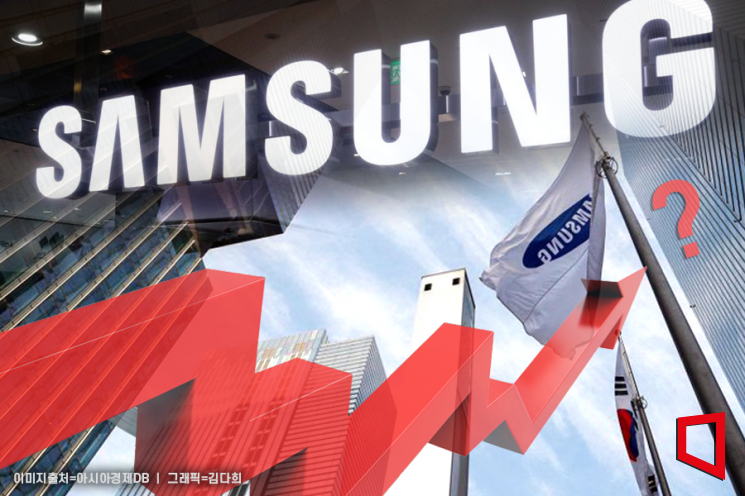
Samsung Electronics announced second-quarter earnings similar to the first quarter of this year, which had recorded an 'earnings shock.' Considering that the company had even prepared for a 'loss,' this performance can be regarded as a solid achievement. Despite sluggish semiconductor market conditions and weak global smartphone demand, Samsung maintained earnings at a level comparable to the first quarter, raising expectations for improved performance in the second half of the year. The effect of memory semiconductor production cuts is expected to fully materialize in the third quarter, opening the possibility for Samsung Electronics' earnings improvement.
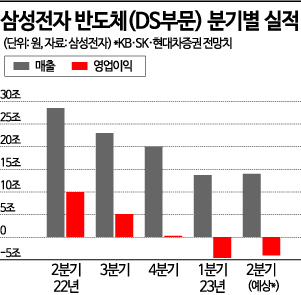
◆ Eased Memory Deficit, Taking a Breather=Analysts suggest that Samsung Electronics' ability to limit losses in its semiconductor (DS) division made it possible to achieve an operating profit of 600 billion KRW in the second quarter, despite expectations of a deficit.
The industry believes that Samsung Electronics significantly reduced its memory semiconductor deficit, bringing the total semiconductor operating loss down to the 3 to 4 trillion KRW range. In the first quarter, Samsung's semiconductor deficit reached 4.58 trillion KRW. There is growing consensus that Samsung's second-quarter DRAM bit growth (shipment increase rate converted to bit units) likely rose by about 20% compared to the first quarter.
The improving semiconductor market conditions entering the second half of the year are a positive factor. Due to production cuts in the memory industry, including Samsung Electronics, memory semiconductor inventory is expected to decrease from the third quarter, and the price decline has significantly narrowed, opening the possibility for price increases. Donghee Han, a researcher at SK Securities, forecasted the second half outlook, stating, "Samsung Electronics' inventory asset valuation losses could rapidly shrink," and "the pace of earnings improvement will begin to outpace the market recovery speed."
The semiconductor industry is already anticipating a reduction in the price decline of memory semiconductors. Market research firm TrendForce expects the average selling prices (ASP) of DRAM and NAND flash in the third quarter to fall by only up to 5% and 8%, respectively, compared to the second quarter. This is a significant reduction from the previously expected 18% and 15% drops in the second quarter. Samsung Electronics' plan to ramp up production of high-value memory products such as the latest High Bandwidth Memory (HBM) and Double Data Rate (DDR)5 DRAM in the second half is also expected to contribute positively to earnings.
◆ Smartphones and Home Appliances Underperform Compared to Q1= The DX (Device Experience) division, which includes consumer electronics and smartphones, is estimated to have seen limited recovery in global set (finished product) demand in the second quarter. The MX (Mobile Experience) business unit, which serves as the cash cow for the DX division, is analyzed to have posted weaker results in the second quarter compared to the first. This is due to the traditional off-season in the second quarter when the effect of new smartphone launches diminishes, coupled with continued weak smartphone demand.
Minhee Lee, a researcher at BNK Investment & Securities, said, "The impact of declining smartphone demand is expected to continue into the second quarter," adding, "Smartphone shipments in the second quarter are projected to decrease by 8% compared to the first quarter, and average selling prices are expected to fall by 15%, making it uncertain whether a double-digit operating profit margin can be maintained."
There is also disappointment that the demand increase effect from China's reopening (resumption of economic activities), anticipated at the beginning of the year, did not materialize in the first half. In the first quarter, the Galaxy S23 series' success helped the MX and Network business units generate 3.94 trillion KRW in profit, covering 86% of the DS division's operating loss, but such performance was not achieved in the second quarter.
However, expectations remain high that the DX division's performance will improve in the second half due to the peak season effect and production of new customer products. The MX and Network business units' results are likely to improve starting in the third quarter, when the launch effect of the new Galaxy Z Fold5 model becomes fully realized. Samsung Display is also positioned to benefit from new product production effects, such as the U.S. Apple iPhone 15 series, following the third quarter peak season.
© The Asia Business Daily(www.asiae.co.kr). All rights reserved.
![Clutching a Stolen Dior Bag, Saying "I Hate Being Poor but Real"... The Grotesque Con of a "Human Knockoff" [Slate]](https://cwcontent.asiae.co.kr/asiaresize/183/2026021902243444107_1771435474.jpg)

















