Officials from the U.S. Federal Reserve (Fed) have made it clear that they are prepared for additional interest rate hikes within the year. It has been confirmed that even at the June Federal Open Market Committee (FOMC) meeting, where the rate was unanimously held steady, some hawkish members expressed opinions in favor of a rate increase. Given the dot plot's indication of the possibility of two hikes this year, there is widespread speculation that rates could rise again as early as this month.
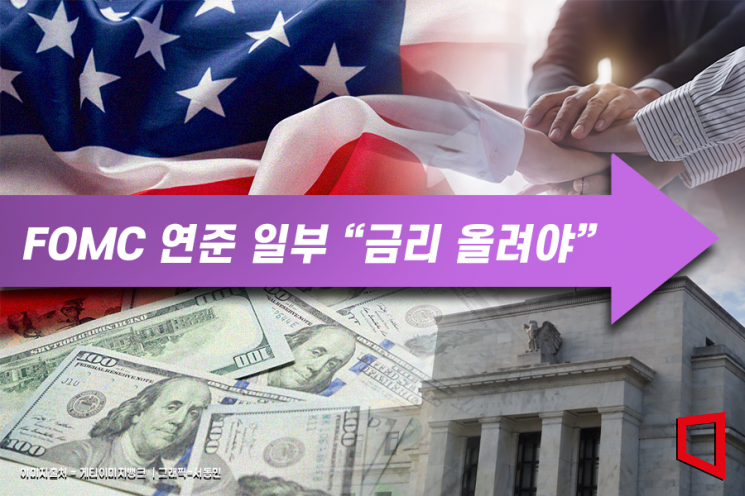
According to the minutes of the June FOMC meeting released by the Fed on the 5th (local time), participants decided to keep the target range for the federal funds rate unchanged at 5.0?5.25%, stating that this would allow more time to assess economic progress toward the Fed's goals of maximum employment and price stability.
The minutes explained the rationale behind the decision, noting that "almost all participants judged it appropriate or acceptable to hold rates steady in June, considering how quickly the Fed raised rates last year and that it takes time for such moves to affect economic conditions." However, some attendees also indicated that they "could prefer or support a 0.25 percentage point increase," pointing out that "momentum in economic activity was stronger than previously expected and there were few clear signs that inflation was moving toward the 2% target."
This passage confirms that while the majority opinion was to pause to assess the impact of ten consecutive rate hikes on the economy, a minority of hawkish (monetary tightening-favoring) voices advocated continuing tightening. Nonetheless, participants agreed that "uncertainty about the economic and inflation outlook remains high, and additional information would be useful in considering appropriate monetary policy." Ultimately, given the need to observe the effects of over a year of cumulative tightening on the economy, the decision was made to hold rates steady in June.
In addition to cumulative monetary policy effects, the unanimous decision to hold rates was influenced by the fact that credit conditions tightened further following the Silicon Valley Bank (SVB) collapse and the ensuing banking sector crisis. The minutes noted that "participants paid attention to the possibility that the cumulative high-intensity tightening could have a greater economic impact than expected and that the tightening of credit conditions in the banking sector could be more significant than anticipated." They also assessed that "the economy is facing headwinds from credit tightening, including from high interest rates, which could affect economic activity, employment, and inflation, though the extent of these effects is uncertain."
However, instead of raising rates, participants aimed to send a clear signal to the market through the dot plot that the fight against inflation is not over. Previously, at last month's FOMC, the Fed held rates steady but raised the year-end rate forecast on the dot plot from 5.1% (median) to 5.6%. This suggests the possibility of two baby steps (0.25 percentage point increases) in the remaining four meetings this year.
The dot plot shows a more hawkish tone. Of the 18 FOMC members, all but two foresee additional hikes by year-end. Among them, 12 expect to raise rates two or more times. Recently, Fed Chair Jerome Powell attended the European Central Bank (ECB) forum and did not rule out consecutive hikes through July and September. This differs somewhat from market expectations that the Fed will alternate between hikes and pauses to gauge the impact.
Additionally, participants viewed the likelihood of a short-term recession as very high. However, the minutes noted that recent economic indicators, such as consumer spending, have shown resilience stronger than expected, which has delayed the timing of the recession forecast. Opinions converged on the possibility that even if a recession occurs, it would be mild and brief.
Currently, market consensus favors a resumption of rate hikes this month. According to the Chicago Mercantile Exchange (CME) FedWatch tool, the federal funds (FF) futures market is pricing in nearly an 89% chance of a baby step increase in July.
Investors are focusing on the employment data to be released later this week. The employment report scheduled for the 7th is crucial. Wall Street estimates that nonfarm payrolls increased by 240,000 in June compared to the previous month. The unemployment rate for June is expected to be 3.6%. Prior to that, on the 6th, the ADP private sector report and the Job Openings and Labor Turnover Survey (JOLTs) will also be released.
© The Asia Business Daily(www.asiae.co.kr). All rights reserved.

















