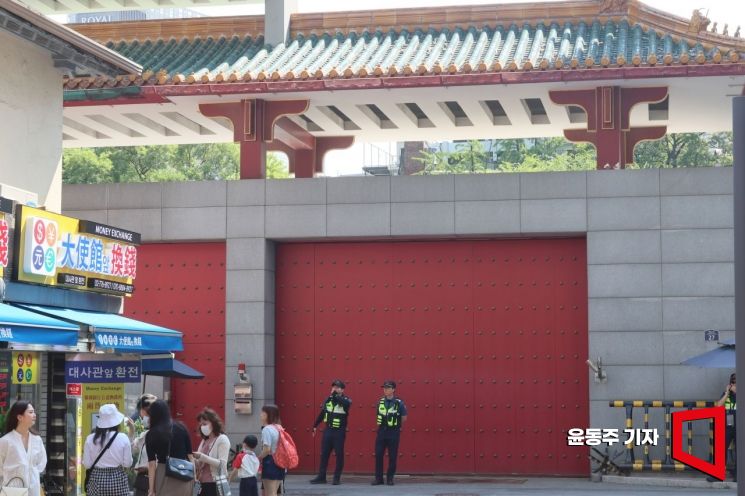
The Embassy of China in Korea (hereinafter referred to as the Embassy) criticized Japan's plan to discharge contaminated water from its nuclear power plant, stating that Japan, which received help from the world during the Fukushima earthquake 12 years ago, is now trying to impose radiation risks on all humanity.
On the 5th, the Embassy issued a statement regarding the International Atomic Energy Agency (IAEA)'s report on Japan's contaminated water discharge, saying, "This (IAEA) report did not fully reflect the opinions of all experts involved in the evaluation process, and the related conclusions did not receive unanimous approval from all experts," and added, "China expresses regret over the IAEA's hasty release of the report."
It continued, "China believes that the IAEA report cannot serve as a ‘talisman’ or ‘pass’ for Japan’s ocean discharge of contaminated water," and stated, "Due to limitations in its authority, the IAEA did not review the legitimacy and legality of Japan’s ocean discharge plan, failed to evaluate the long-term effectiveness of Japan’s purification equipment, and did not definitively verify the truthfulness and accuracy of data related to Japan’s contaminated water."
Earlier, the IAEA concluded in its report that "Japan’s plan to discharge treated water (contaminated water) stored at the Fukushima Daiichi Nuclear Power Plant into the ocean complies with international safety standards," and added, "The radiological impact of the treated water discharge on humans and the environment is expected to be negligible," effectively supporting Japan’s position.
The Embassy noted, "China paid attention to IAEA Director General Rafael Grossi’s statement that ‘The IAEA conducted reviews and assessments at the request of the Japanese government and does not guarantee Japan’s ocean discharge of nuclear contaminated water,’" and claimed, "Japan, ignoring international concerns and opposition due to cost issues, has decided to discharge nuclear contaminated water into the ocean, turning the Pacific Ocean into a ‘sewer.’"
It also added, "Regardless of the report’s content, the fact remains that Japan will continuously discharge over one million tons of Fukushima nuclear contaminated water into the Pacific Ocean over the next 30 years," and said, "What impact will the long-term accumulation and concentration of radioactive nuclides have on the marine ecological environment, food safety, and human health? The IAEA report does not provide answers to these questions."
In particular, the Embassy stated, "Japan received global support 12 years ago during the Fukushima nuclear accident, but 12 years later, Japan has decided to impose the risks of radioactive contamination on all humanity," and criticized, "China once again urges Japan to halt its plan to discharge nuclear contaminated water into the ocean and to ensure its treatment in a scientific, safe, and transparent manner."
The Embassy emphasized, "If Japan proceeds with the ocean discharge, it must take responsibility for all consequences," and urged, "China calls on Japan to cooperate with the IAEA to promptly establish a long-term global monitoring system involving all stakeholders, including Japan’s neighboring countries."
© The Asia Business Daily(www.asiae.co.kr). All rights reserved.

















