Professor Hyunwook Lee's research team from the Department of Energy Chemical Engineering at UNIST discovered the main factors affecting the lifespan of sodium-ion batteries through the 'Prussian Blue series' materials.
Sodium-ion batteries are attracting attention as next-generation batteries that can replace low-cost lithium-ion batteries due to their lower production costs and similar battery systems compared to lithium-ion batteries.
The 'Prussian Blue series' materials are a group of blue dye substances used since the 18th century, including Prussian Blue itself, which is used as a dye for blue jeans. They also have the function of spontaneously adsorbing ions and have been used as antidotes for radioactive cesium poisoning.
Recently, 'Prussian White,' an anode material for sodium-ion batteries unveiled by the Chinese battery company CATL, is one of the materials in this series.
The research team synthesized Prussian Blue series anode materials with different characteristics using the representative method of synthesizing battery anode materials called the 'aqueous solution-based co-precipitation method.' In particular, they analyzed how the amount of water molecules in the Prussian Blue series anode materials after synthesis affects the battery's characteristics.
Prussian Blue series materials can be applied to both the commercialized electrolyte system based on organic solvents, called the 'organic electrolyte system,' and the next-generation electrolyte system based on water, called the 'aqueous electrolyte system.'
 Changes in the Properties of Prussian Blue Series Materials According to the Amount of Water Molecules.
Considering these characteristics, the research team conducted experiments to investigate how water molecules affect the battery characteristics in both electrolyte systems.
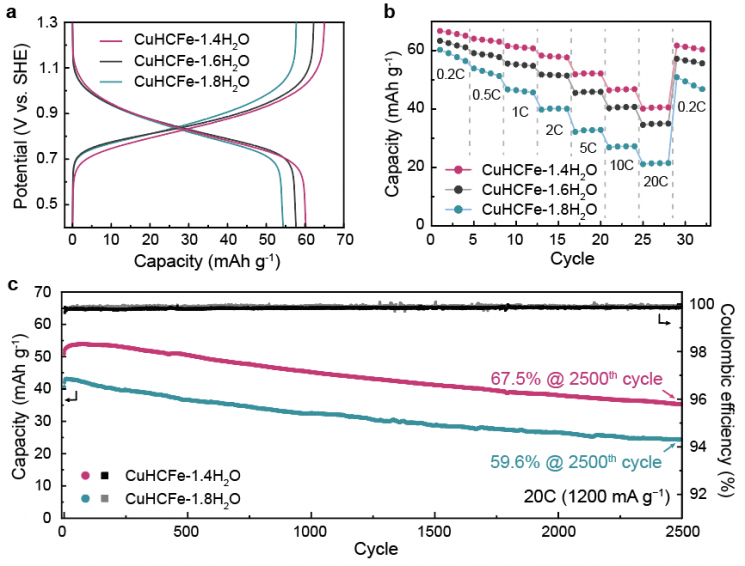
As a result, anode materials with fewer water molecules showed higher energy efficiency and longer lifespan.
The research team confirmed that when the number of water molecules decreases by about 24%, the battery capacity improves by 9.7%, and the battery lifespan is maintained up to 67.5% even after 2,500 charge-discharge cycles. In contrast, anode materials with a higher number of water molecules showed a lifespan of 59.6% under the same experimental conditions, demonstrating the difference.
Additionally, when the same amount of water molecules (24%) was reduced, it was found that sodium ions in the aqueous electrolyte system were activated more than four times, resulting in the battery speed improving by about twice.
First author Areum Choi, a researcher in the Department of Energy Chemical Engineering, explained, “Prussian Blue series materials are gaining attention as anodes for sodium secondary batteries, increasing interest in which factors affect anode characteristics. We confirmed the battery characteristics of these materials based on differences in water molecule content, and it seems possible to apply these characteristics to other applications as well.”
Professor Hyunwook Lee of the Department of Energy Chemical Engineering added, “Research on capacity-related factors such as Prussian Blue and Prussian White is still insufficient. It is necessary to uncover the hidden factors in these materials to develop high-performance sodium secondary batteries.”
This research was conducted with support from the UNIST Future Leading Specialized Project, the Ministry of Science and ICT, and the Korea Research Foundation's Mid-career Linked New Follow-up Project. It was published online on May 29 in the international academic journal in the energy and materials field, Journal of Materials Chemistry A.
© The Asia Business Daily(www.asiae.co.kr). All rights reserved.

















