The prosecution requested the confiscation of tens of billions of won in criminal proceeds obtained through the operation of illegal gambling sites, but the court ruling that recognized only a confiscation of 1 million won was finalized.
The ruling was made based on the legal principle that confiscation can only be applied to specifically identified criminal proceeds.
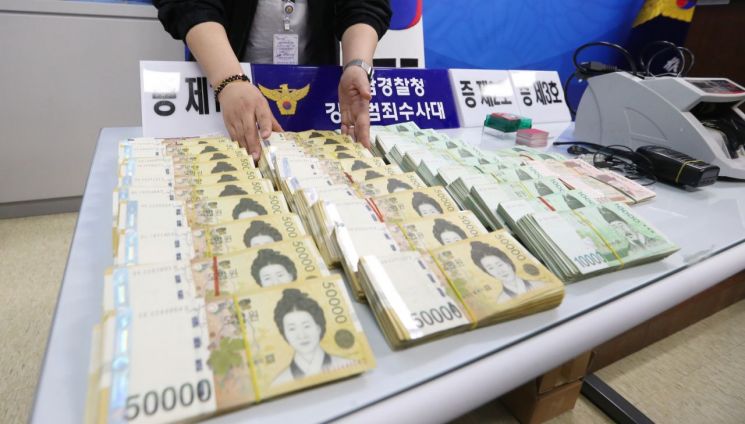
According to the legal community on the 5th, the Supreme Court's 3rd Division (Presiding Justice Lee Heung-gu) upheld the original judgment sentencing Mr. A, who was indicted for violating the National Sports Promotion Act and operating gambling, to 1 year and 10 months in prison and ordering a confiscation of 1 million won.
From February 2013 to September 2014, Mr. A conspired with his nephew Mr. B and Mr. B's acquaintance Mr. C to operate an illegal sports gambling site issuing quasi-sports Toto. Mr. A opened the site in Cambodia and was responsible for program development and overseas server management, while Mr. B and Mr. C opened a call center office in Korea, received gambling funds from customers who registered as members, charged game money, paid game money to customers who correctly predicted game results, and then exchanged it and transferred it to their accounts.
Customers who registered as members on the sites they operated placed bets ranging from 5,000 won to 500,000 won in game money on sports games such as soccer, baseball, and basketball held domestically or overseas, and if they predicted the results correctly, they received game money multiplied by a predetermined payout rate.
After Mr. B and Mr. C, who were active domestically, were arrested, Mr. A opened and operated another illegal gambling site from September 2014 to February 2015.
According to the prosecution's investigation, Mr. A issued quasi-sports Toto worth approximately 2.287 billion won and 810 million won through two illegal gambling sites, respectively.
The first trial court found all of Mr. A's charges guilty and sentenced him to 3 years in prison with a confiscation order of about 3.1 billion won.
Mr. A's prior criminal record for gambling operation or violation of the Game Industry Promotion Act and the fact that he continued the crime even after Mr. B and Mr. C were arrested were considered unfavorable sentencing factors. Mr. A claimed he voluntarily returned to the country to surrender, but the court found it hard to believe given that he offered 3 billion won to the Cambodian police for release when arrested in January 2022 and denied all crimes during the investigation.
However, the court took into account Mr. A's full confession and remorse during the trial, his second-degree physical disability due to sequelae of a traffic accident, and the fact that he married a Cambodian woman in 2021 and had to support his wife and young son.
During the second trial, the prosecution discovered additional criminal facts about Mr. A and applied for a change of indictment, which the court approved. The charge was that from April to December 2015, he opened a private sports Toto gambling site and received about 1.75 billion won in deposits.
The prosecution sought confiscation of about 4.847 billion won, adding the criminal proceeds from the additional charges to the 3.1 billion won confiscation amount recognized in the first trial.
However, the second trial court accepted Mr. A's claim of "legal misunderstanding or factual error regarding confiscation" and reduced the confiscation amount to 1 million won while sentencing him to 1 year and 10 months in prison. The court reasoned that it was difficult to regard all the quasi-sports Toto sales proceeds or money transferred by customers to accounts as Mr. A's criminal proceeds. Also, since different accomplices operated the three sites, and there was insufficient evidence on how profits were shared with them, it was difficult to specify Mr. A's criminal proceeds.
The court first cited existing Supreme Court precedents on confiscation and seizure.
The Supreme Court has maintained the position that "whether confiscation or seizure applies or the amount recognized is not a matter of the elements of the crime, so strict proof is not required, but it must be recognized based on evidence, and if the criminal proceeds subject to confiscation cannot be specified, confiscation cannot be imposed."
Also, in a 2007 case involving accomplices in issuing quasi-sports promotion rights violating the National Sports Promotion Act, the Supreme Court stated, "Property obtained by a person punished under Article 47, Paragraph 2 of the National Sports Promotion Act through quasi-activities is subject to confiscation under Article 51, Paragraphs 1 and 3 of the Act. Since the purpose of confiscation is to deprive unjust profits and prevent their retention, when multiple persons jointly engage in quasi-activities and gain profits, the distributed amount, i.e., the actual attributable profit, must be confiscated individually, and if the distributed amount cannot be determined, the amount equally divided must be confiscated."
Furthermore, in 2012, the Supreme Court ruled that "if there are amounts exchanged to game users, the criminal proceeds are the sales amount minus the amount exchanged to the game users."
The second trial court judged that it was not possible to regard the total private sports Toto sales proceeds issued by Mr. A or all money deposited into accounts of Mr. A or his accomplices as criminal proceeds, as the prosecution claimed.
The court stated, "The prosecution seeks confiscation of the entire amount of about 4.847 billion won (2.287 billion won + 810 million won + 1.75 billion won) stated in each charge. However, even according to the indictment, the amount is either the amount issued for quasi-sports promotion rights or the amount deposited by gambling site members. It cannot be concluded that the entire amount belongs to the defendant as criminal proceeds."
Also, the court pointed out, "The indictment itself describes the revenue structure of the gambling site where money is deposited by members, charged as game money or cyber money, and exchanged to those who predicted results correctly. There is no evidence that the calculation regarding charging and exchanging related to the defendant's criminal proceeds was appropriately done." Among the money Mr. A and his group received from selling private sports Toto, the amount exchanged to customers who predicted results correctly should be deducted from criminal proceeds, but no such calculation was made.
Furthermore, the court noted, "The conspirators in the first charge are Mr. B and Mr. C, and the conspirators in the third charge are 'persons unknown, etc.' The defendant claims that Mr. D and others are the main culprits, and there are witness statements supporting this. The profits of the conspirators and the details of profit distribution are also unclear."
The court also found it wrong that the prosecution did not consider the fact that other accomplices had already been tried and ordered confiscation when calculating Mr. A's confiscation amount.
The court stated, "In the case involving Mr. B and Mr. C, confiscation orders of 20 million won from Mr. B and 15 million won from Mr. C were pronounced and finalized. At least the confiscation amounts for Mr. B and Mr. C should have been considered when calculating the defendant's confiscation amount, but the amounts sought by the prosecution and the confiscation amount pronounced in the original judgment seem to have not taken this into account."
It added, "Even if the defendant is a superior to Mr. B and Mr. C, it cannot be concluded that the defendant earned more profits than Mr. B and Mr. C to calculate the confiscation amount."
The court concluded, "The prosecution appears to have calculated the amount sought for confiscation based on account transfer details, but considering the above circumstances, not all account transfer details can be regarded as the defendant's profits."
Ultimately, the court rejected all of the prosecution's confiscation claims regarding the profits Mr. A earned from issuing quasi-sports promotion rights and only recognized confiscation related to the referral fees Mr. A received for involving Mr. B and Mr. C in the crime.
The court stated, "The defendant consistently admitted from the investigation agency to the court that he received 1,000 US dollars (about 1 million won) as referral fees for Mr. B and Mr. C's involvement in the crime," and "Therefore, it is recognized that the defendant obtained the above 1,000 US dollars from this crime. Specifically, considering the favorable exchange rate for the defendant, it is regarded as a profit of 1 million won."
Regarding sentencing reasons, the court said, "The defendant appears to have gained considerable profits from this case," but "it is difficult to clearly specify the amount of profits."
Regarding Mr. A's role in the crime, the court judged, "According to statements from related persons, the defendant seems to have played a significant role in operating the gambling site," but "there is insufficient evidence to conclude that the defendant was the mastermind overseeing all gambling sites."
Regarding Mr. A's claim of voluntary surrender, the court found, "According to the forensic report of the defendant's mobile phone submitted at the appellate court, the defendant called the consulate after the arrest, so it is difficult to regard it as voluntary surrender." The court also did not accept the first trial court's unfavorable sentencing factor that Mr. A attempted to offer a large sum to the Cambodian police for release, stating, "It is also hard to believe that the defendant offered a large amount to the Cambodian police for release."
The Supreme Court also dismissed the prosecution's appeal, stating, "Reviewing the reasons for the original judgment in light of relevant laws and records, there is no error affecting the judgment such as misunderstanding the law on confiscation under Article 51, Paragraph 3 of the National Sports Promotion Act."
Additionally, regarding Mr. A's appeal claiming illegality because voluntary surrender mitigation was not applied in the second trial, the Supreme Court dismissed it, stating, "Even if voluntary surrender is recognized, the court may arbitrarily reduce or exempt the sentence, so the failure to apply voluntary surrender mitigation in the original judgment cannot be deemed illegal."
© The Asia Business Daily(www.asiae.co.kr). All rights reserved.
![Clutching a Stolen Dior Bag, Saying "I Hate Being Poor but Real"... The Grotesque Con of a "Human Knockoff" [Slate]](https://cwcontent.asiae.co.kr/asiaresize/183/2026021902243444107_1771435474.jpg)
















