"Sales Down 20%, Regular Customers Hard to See"
4 Out of 10 Self-Employed Consider Closing Within 3 Years
"This year, I thought sales would recover, but they actually dropped further. Only rent, wages, interest rates, and food ingredient prices have increased. The landlord is demanding a 30% rent increase now that the COVID-19 situation has eased. I am seriously considering closing down."
At around 12:30 p.m. on the 4th near Hongdae Entrance Station on Seoul Subway Line 2, a Western-style restaurant seemed crowded with people out for lunch. However, the customers soon left like a receding tide, and a quiet atmosphere settled over the restaurant. The restaurant owner, Mr. Kim (56, male), expressed his frustration, saying, "Before the COVID-19 crisis, the place was always full regardless of meal times. Not only dine-in customers but also delivery orders have sharply declined this year."
The situation at a nearby snack bar was not much different. Even during peak meal times, only half of the 10 tables were occupied. The owner, Mr. Yoo (52, male), wearing a gloomy expression, said, "Sales have dropped by nearly 20% compared to last year. It's hard even to see the faces of regular customers." He added, "Meanwhile, utility bills, food ingredient costs, and employee wages keep rising. It became impossible to endure, so I cut the staff in half and raised prices by about 5% for the first time in five years." He continued, "Fortunately, the landlord understood our situation, but if the rent had increased as well, I would have seriously considered closing down."
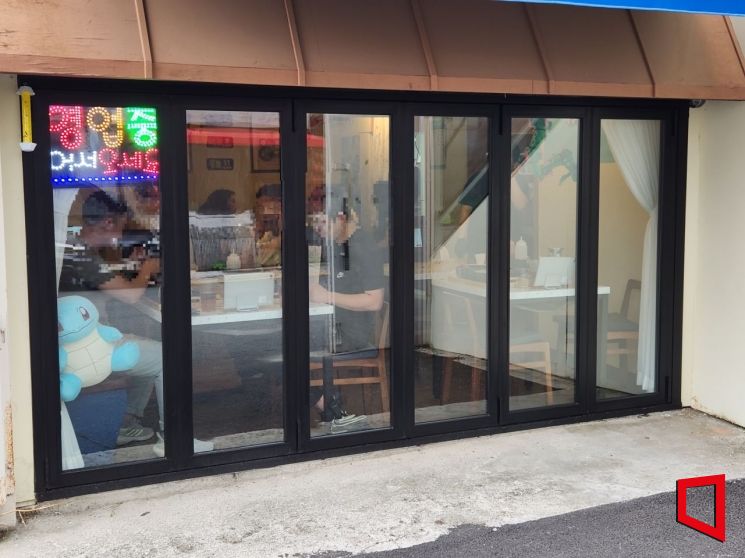 Around 12:30 PM on the 4th, citizens were having lunch at a restaurant near Hongdae Entrance Station on Seoul Subway Line 2.
 Photo by Taewon Choi skking@
Small business owners who dreamed of sales recovery as the COVID-19 situation eased are wearing worried faces. More than 60% of small business owners reported a decrease in sales in the first half of the year compared to the previous year, and about 40% said they are considering closing within the next three years. According to a survey conducted on the 2nd by the Federation of Korean Industries, commissioned to Monoresearch, targeting 500 small business owners in the restaurant, wholesale and retail, and other service sectors, 63.4% of small business owners answered that their sales in the first half of this year decreased compared to the same period last year. On average, sales in the first half of this year dropped by 9.8% compared to the previous year. The most burdensome increases in operating costs were raw materials and ingredient costs (20.9%), labor costs (20.0%), public utility charges such as electricity and gas (18.2%), and rent (14.2%), in that order.
Adding insult to injury, concerns were raised about the sharp increase in the minimum wage. The labor sector proposed 12,210 won, which is 26.9% higher than this year's minimum wage. The business sector initially proposed 9,620 won, the same level as this year. In the second revised proposal, the labor sector submitted 12,000 won, and the business sector submitted 9,700 won, failing to significantly narrow the gap.
As small business owners stand at a crossroads of survival, the Small and Medium Business Central Association’s Labor and Workforce Committee and the Minimum Wage Special Committee held a public appeal press conference on the 3rd at the Yeongdeungpo-gu SME Central Association, urging a reasonable decision on the minimum wage. They stated, "Many small and medium-sized enterprises are facing critical situations due to economic recession caused by low growth, increases in public utility charges, and soaring production costs due to high inflation," and appealed, "For the survival of businesses and job creation, please maintain the minimum wage at the current level."
Experts have suggested policies such as revitalizing domestic demand and financial support. Professor Ha Jun-kyung of Hanyang University’s Department of Economics said, "Although the budget is limited and it won't be easy, there is a need to devise policies to stimulate domestic demand. Broad measures such as tax support or coupons can be considered." He added, "Many small business owners have endured the COVID-19 crisis with high-interest loans. Financial support such as refinancing loans for these people can be considered. Also, some are trapped in a vicious cycle of accumulating deficits the more they operate but unable to close due to debt. Support for restructuring to allow such businesses to close should also be considered."
© The Asia Business Daily(www.asiae.co.kr). All rights reserved.
![Clutching a Stolen Dior Bag, Saying "I Hate Being Poor but Real"... The Grotesque Con of a "Human Knockoff" [Slate]](https://cwcontent.asiae.co.kr/asiaresize/183/2026021902243444107_1771435474.jpg)
















