Lovebug Spread Across Seoul Devastates Bukhansan Summit
National Park: "Lovebug is a Beneficial Insect... No Chemical Control Used"
This summer, the beneficial insect 'Lovebug' (Plecia nearctica) spreading throughout Seoul has covered the summit of Bukhansan Mountain. However, considering the potential impact on the ecosystem, chemical pest control measures are not planned.
Recently, photos posted by hikers who reached the summit of Bukhansan at the end of last month have been spreading on social networking services (SNS). The sight of swarms of Lovebugs clinging all over their bodies and covering the mountain summit could even evoke feelings of disgust.
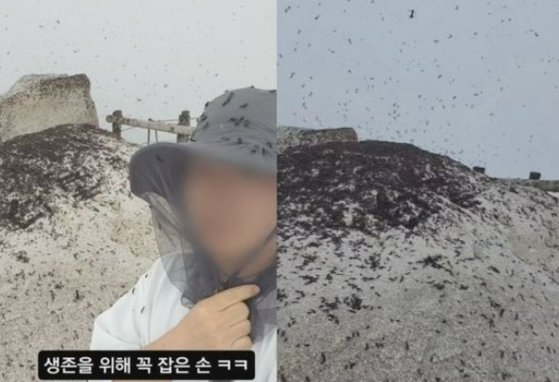
A foreign woman, Ms. A, posted a video on the 29th of last month, saying, "Yesterday, I experienced a swarm of Lovebugs on Bukhansan. This is very rare in Korea." The video shows swarms of Lovebugs crawling all over Ms. A’s body, who is wearing bright clothes, and attempts to brush them off prove futile.
Another hiker, Mr. B, shared images the next day of the summit of Bukhansan, Baegundae Rock, teeming with black swarms of Lovebugs. Mr. B said, "I’m usually not afraid of insects, but this is the largest swarm I’ve ever seen in my life," and added, "The summit of Baegundae is full of them. It’s really serious."
He gripped the mesh of his insect net hat tightly to prevent Lovebugs from entering, calling it "a hand held tightly for survival" and added, "It would be a big problem if I took this off."
Among netizens who saw the videos, reactions included, "Is this really our country?" "It’s disgusting," and "It wasn’t this bad last year, but now it’s devastated." One netizen criticized, "They could have controlled it with drones, so what were they doing until the situation got this bad?"

However, despite such criticisms and the discomfort of hikers, pest control is not expected to be carried out. On the 1st, the National Park Service shared on SNS, "We are providing information regarding the red-bodied Lovebug in the national park," and shared the response situation regarding the Lovebug.
The National Park Service stated, "We are sharing the response from the Climate and Environmental Biology Research Division of the National Institute of Biological Resources," explaining, "(The Lovebug) appeared about ten days earlier than last year due to hot and humid weather and the rainy season, and is expected to occur intensively until early July."
They added, "Chemical and biological pest control measures that affect the ecosystem within the national park will not be implemented," and explained, "The red-bodied Lovebug, called Lovebug, is a beneficial insect that does not harm humans and is expected to decrease by early July due to its short life cycle."
In fact, male Lovebugs are known to live for 3 to 5 days, and females for 5 to 7 days. Experts analyze that since they do not directly harm humans and actually help purify the environment, indiscriminate pest control could cause adverse effects.
© The Asia Business Daily(www.asiae.co.kr). All rights reserved.


















