Family Relations Registration Act Amendment Passed in Plenary Session
Amendment to Take Effect One Year After Promulgation
Notification Obligation Applies to Births After Enforcement of the Law
On the 30th, the National Assembly passed an amendment to the Family Relations Registration Act that stipulates the obligation of medical institutions to report birth information in order to prevent the occurrence of 'unreported births' where parents intentionally fail to register the birth.
The amended law includes ▲ the obligation of medical personnel to record birth information ▲ the obligation of the head of medical institutions to submit birth information to the Health Insurance Review and Assessment Service (HIRA) ▲ HIRA's obligation to notify the heads of cities, towns, and townships of birth information ▲ and the obligation of the heads of cities, towns, and townships to verify birth registration, issue a notice to register, and register births ex officio.
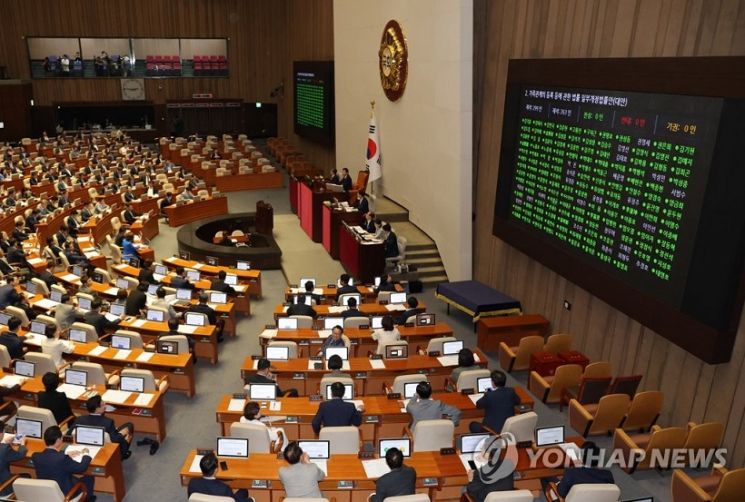 On the 30th, the National Assembly plenary session is passing the "Amendment to the Act on Family Relations Registration, etc." to introduce the "Birth Notification System."
The amended law will take effect one year after its promulgation. The provisions regulating the obligations of medical personnel and the heads of medical institutions will apply only to births occurring after the law comes into effect.
The amendment first newly establishes Article 44-3 (Notification of Birth Facts), which stipulates the obligation of medical personnel to record birth information and the obligation of the head of medical institutions to submit birth information.
Under the Medical Service Act, medical personnel affiliated with a medical institution must record the following in the medical records or midwifery records (including electronic documents) of the mother of the newborn when a birth occurs at the institution to verify the birth: ▲ the name and resident registration number of the mother of the newborn (or foreign registration number if a foreigner) ▲ the newborn's gender, number of births, and date and time of birth ▲ and other matters prescribed by Supreme Court regulations.
However, if the mother's resident registration number or foreign registration number cannot be confirmed, a number used for medical benefit qualification management in the social security information system under the Social Security Basic Act must be recorded.
The head of the medical institution must submit the birth information to HIRA using the computerized information system within 14 days from the date of birth.
Upon receiving the birth information, HIRA must promptly notify the head of the city, town, or township that has jurisdiction over the mother's address, including the birth information. If the mother's address cannot be confirmed, notification must be sent to the head of the city, town, or township that has jurisdiction over the place of birth.
Additionally, the amendment newly establishes Article 44-4 (Verification, Notice to Register, and Ex Officio Birth Registration), which stipulates the obligations of the heads of cities, towns, and townships to verify birth registration, issue a notice to register, and register births ex officio.
Specifically, the head of the city, town, or township who receives birth information from HIRA must verify whether the birth has been registered within the one-month birth registration period. If the birth has not been registered by the end of the registration period, the head must immediately issue a notice to the reporting obligor, either the father or mother (or the mother in the case of children born out of wedlock), to register the birth within seven days.
If the reporting obligor does not register the birth within the notice period or if the reporting obligor cannot be identified making notice impossible, the head of the city, town, or township must, with the approval of the supervisory court and attaching the notified data, register the birth ex officio in the registry.
The amended law also provides (Article 44-5) that the heads of cities, towns, and townships may request necessary data from heads of related agencies for processing registration tasks, and that the heads of related agencies must comply with such requests.
Finally, the amendment's supplementary provision Article 1 (Effective Date) stipulates that "this law shall come into effect one year after its promulgation."
Supplementary provision Article 2 (Application of Notification of Birth Facts) states that "the amended provisions of Article 44-3 shall apply only to births occurring after the enforcement of this law," specifying the exact timing when the obligations of medical personnel and medical institutions apply.
According to the audit results by the Board of Audit and Inspection, from 2015 to 2022, there were 2,236 children born in medical institutions who were assigned temporary newborn numbers for vaccination purposes but whose births were not registered.
The birth notification system is designed to allow official confirmation of a child's birth through the reporting of birth information by medical institutions, thereby preventing children whose births are unconfirmed from being exposed to risks such as murder, abandonment, or abuse.
The Ministry of Justice, in consultation with related ministries and agencies including the Ministry of Health and Welfare, the Court Administration, and the Ministry of the Interior and Safety, submitted an amendment to the Family Relations Registration Act to the National Assembly in March last year to guarantee the 'right of all children to be registered at birth.'
The National Assembly, after discussing the government proposal along with related bills proposed by lawmakers, passed the alternative bill in the plenary session with 266 votes in favor and 1 abstention out of 267 members present.
A Ministry of Justice official stated, "With the passage of the amendment, the 'right of children to be registered immediately after birth' is guaranteed, and it is expected to contribute more to the welfare of children by preventing omissions in birth registration. The Ministry of Justice will actively cooperate with related ministries to ensure the smooth implementation of the system and will continue to work toward creating a society where children can grow up safely and healthily."
© The Asia Business Daily(www.asiae.co.kr). All rights reserved.

















