Launching a Pilot Safety ChatGPT to Provide Safety Information Using Large-scale Language Models
Improving Accuracy through Pre-training on Manuals and Laws and Fine-tuning ? Expecting Not Only Increased Expertise and Efficiency but Also Reduced Human Errors… Plans to Collaborate with Related Organizations in the Future
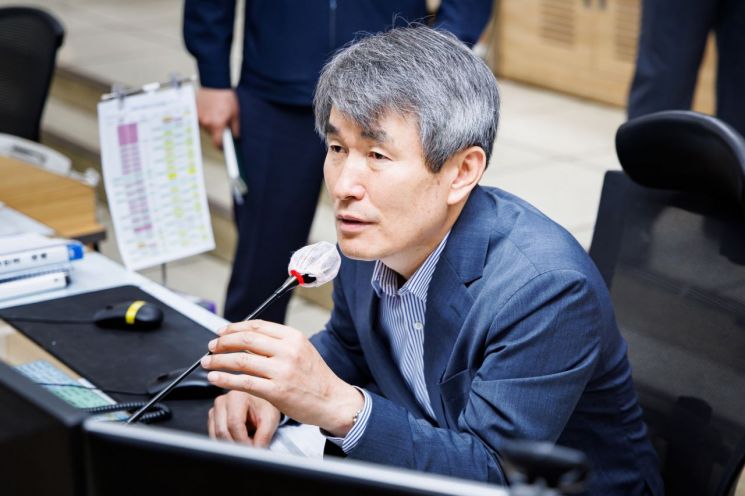
Large-scale artificial intelligence technology, which has driven innovation in various fields since ChatGPT, will be applied for the first time in domestic subways.
Seoul Metro (President Baek Ho) announced that it will pilot a safety ChatGPT utilizing the large-scale language model GPT in the subway safety sector.
A language model outputs the most appropriate content when a user inputs a sentence, and large-scale language models like ChatGPT have attracted significant attention even in academia.
In April, Seoul Metro was selected for the "Private Sector Advanced Large-scale AI Utilization Support (Demand-linked) Project" announced by the Ministry of Science and ICT and the National Information Society Agency (NIA), enabling the construction of the safety ChatGPT.
For the pilot, Seoul Metro is collaborating with Saltlux, a company possessing core technologies in AI and data science, aiming to complete the safety ChatGPT pilot by around December 15 this year and introduce it into operations starting next year.
The safety ChatGPT system will support conversations and will be linked to a search system.
Pre-training on Railway Safety-related Information → Enhancing Accuracy through Verification with Numerous Question Sets
GPT undergoes pre-training on vast amounts of information, followed by a fine-tuning process where administrators create correct answers to various questions. Then, it goes through a ranking stage to improve the appropriateness of the answers, thereby enhancing accuracy. Seoul Metro plans to build the safety ChatGPT using Saltlux’s language model.
Seoul Metro and Saltlux will pre-train the safety ChatGPT with data such as railway safety laws, safety-related regulations, work manuals, and glossaries, and proceed with fine-tuning by inputting numerous question sets. Through hundreds of question sets during fine-tuning, they aim to minimize hallucination?a structural weakness of language models where incorrect information is presented as fact?and improve answer accuracy.
Providing Accurate Information in Real Time to Enhance Work Expertise and Efficiency
# When a worker about to perform maintenance on an electric train asks the safety ChatGPT, “Please tell me the safety rules to be aware of before electric train maintenance,” the system provides an accurate answer: “Workers must receive safety training to prevent electric shock and must wear safety protective gear (such as safety helmets and safety shoes). Workers must work in pairs and communicate smoothly to prevent accidents. Also, to prevent electric shock, verify that the power is cut off and recheck whether grounding rods are installed for electric train safety.”
# When a worker about to perform welding or other fire-related tasks asks, “Please tell me the precautions when performing fire-related work in the station,” the safety ChatGPT quickly responds: “Before starting fire-related work, a prior notification form must be submitted. Workers must receive fire prevention training and wear mandatory safety protective gear (such as safety helmets, safety goggles, and heat-resistant gloves). Remove accumulated dust around the welding area and prepare fire extinguishers. Then, install spark containment covers before starting the fire-related work. After completion, clean the surrounding area thoroughly.”
As in the two examples above, the system searches relevant parts from railway safety laws, safety-related regulations, work manuals, and glossaries that serve as the basis for the answers, and after understanding the related content, provides the most accurate answers refined through the fine-tuning process.
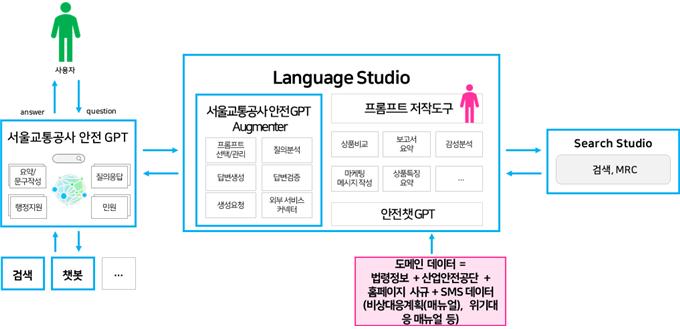
Since subways operate as systems integrating various fields such as vehicles, electricity, communication, tracks, and signaling, the volume of safety manuals in each field is vast, and safety-related laws, work guidelines, manuals, and glossaries such as the Railway Safety Act are continuously being strengthened. Through the construction of the safety ChatGPT utilizing large-scale language models, Seoul Metro will create an environment where employees can easily and quickly access various safety-related laws, work guidelines, manuals, and glossaries.
Additionally, a mobile app will be developed to allow on-site workers to directly check railway safety laws, safety-related regulations, work manuals, and glossaries in real time, enabling quick and accurate verification. Seoul Metro expects this will not only improve safety but also enable faster decision-making and more efficient work processing.
Moreover, even less experienced junior employees will be able to check safety-related questions in real time, which is expected to reduce human errors.
Strengthening Nationwide Subway Safety Management System through Linkage with Other Urban Railway Operators
The safety ChatGPT will be built to allow future linkage with other urban railway operators. Seoul Metro expects that linking safety ChatGPT will promote the sharing and cooperation of safety-related information among urban railway organizations nationwide, contributing to strengthening the nationwide subway safety management system.
Baek Ho, President of Seoul Metro, stated, “As AI technology rapidly advances, we are promoting subway safety improvement measures using AI technology, such as this pilot safety ChatGPT and the recently introduced congestion prediction system linked with CCTV and AI,” adding, “We will continue to create a subway environment that evolves to perform professional and efficient safety tasks in step with ever-advancing technology and society.”
© The Asia Business Daily(www.asiae.co.kr). All rights reserved.


















