South Korea and Japan will resume their bilateral currency swap after eight years. The agreement is valued at 10 billion dollars and involves Japan holding Korean won and lending dollars in emergencies. This marks the restoration of cooperative relations between the two countries in the economic and financial sectors.
On the 29th, Deputy Prime Minister and Minister of Economy and Finance Choo Kyung-ho and Japan’s Finance Minister Suzuki Shunichi agreed to restore the Korea-Japan currency swap, which had been suspended since 2015, at the 8th Korea-Japan Finance Ministers’ Meeting held at Japan’s Ministry of Finance. A currency swap is a mechanism where, in emergencies such as foreign exchange crises, one country deposits its currency with the other and borrows the other country’s currency or dollars at a pre-agreed exchange rate. Korea and Japan first established a currency swap worth 2 billion dollars in July 2001 and expanded it to 70 billion dollars by November 2011. However, due to deteriorating Korea-Japan relations, the currency swap agreement between the two countries ended in February 2015.
The scale of the current currency swap agreement is 10 billion dollars, the same as when it was suspended in February 2015, and the duration is three years. It is a “dollar-based” method where Korean won is exchanged for dollars held by Japan, and Japanese yen is exchanged for dollars held by Korea. By conducting the Korea-Japan currency swap in dollars, it is expected to be easier to secure dollars in emergencies, as it allows for securing dollar liquidity during crises.
The government expects that this Korea-Japan currency swap agreement will provide mutual safety measures in emergencies between the two countries and will positively contribute to regional economic and financial stability, including ASEAN+3. Deputy Prime Minister Choo said, “This Korea-Japan currency swap establishes a firm framework of solidarity and cooperation in foreign exchange and finance with countries that share universal values such as Korea, the United States, and Japan,” adding, “It means that the foreign currency liquidity safety net among advanced free-market economies is expanding to our financial and foreign exchange markets.”
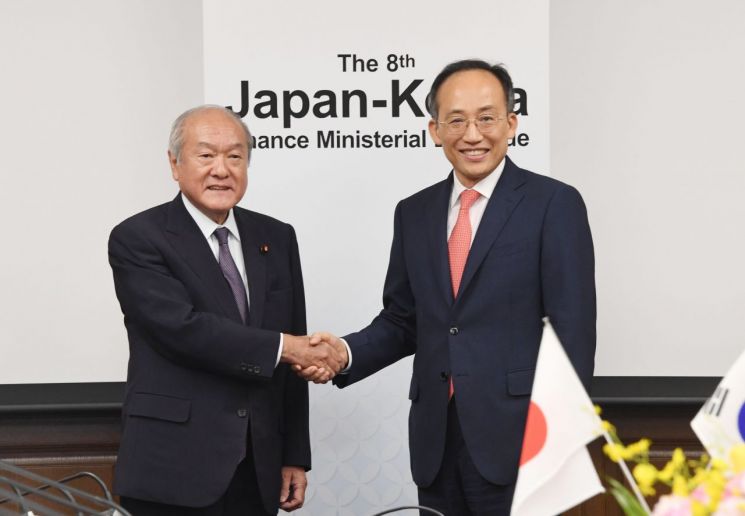 Deputy Prime Minister and Minister of Economy and Finance Choo Kyung-ho attended the "8th Korea-Japan Finance Ministers' Meeting" held at the Japanese Ministry of Finance on the 29th, shaking hands with Suzuki Shunichi, Japan's Minister of Finance, and taking a commemorative photo.
Korea and Japan Cooperate on International Stages such as G20 and G7
At the meeting, the finance ministers of both countries exchanged views on the global and regional economic situation and discussed ways to strengthen bilateral and multilateral cooperation. They expressed a positive outlook on the resilience of the global economy but noted that uncertainties persist due to intersecting downside risks such as the prolonged Russia-Ukraine war and the maintenance of tight monetary policies to combat inflation. Accordingly, they agreed to cooperate responsibly in addressing global complex crises such as geopolitical risks, supply chain fragmentation, pandemic threats, and the expansion of debt and financial volatility in developing countries.
The two countries also discussed cooperation and coordination between Korea and Japan on the international stage. First, they agreed to show responsibility and mutual solidarity as members of the international community in addressing global challenges discussed at forums such as the Group of Twenty (G20) and the Group of Seven (G7), including debt restructuring for low-income countries and the Resilient, Inclusive, and Sustainable Economies (RISE) partnership for supply chain strengthening. They also agreed to actively participate in discussions on institutional improvements such as restructuring the funding structure and introducing new financial programs to enhance the effectiveness of the Chiang Mai Initiative Multilateralization (CMIM), a regional financial safety net.
They will also expand cooperation on taxation, customs, and human exchanges. They agreed to operate a working-level consultative body between Korea and Japan’s tax authorities and to hold the Customs Directors’ Meeting, which has been suspended since 2016, in Korea in the second half of this year. They plan to discuss the implementation of sanctions against Russia and North Korea as well as issues related to e-commerce. On the occasion of the 8th Finance Ministers’ Meeting, the Export-Import Bank of Korea and the Japan Bank for International Cooperation (JBIC) signed a memorandum of understanding (MOU) for joint entry into third countries. They will support the development of infrastructure projects in third countries involving companies from both countries and promote supply chain support to strengthen economic security and industrial competitiveness.
The Korea-Japan finance ministers agreed to further strengthen communication and cooperation between their financial authorities and decided to hold the 9th Korea-Japan Finance Ministers’ Meeting in Korea in 2024.
© The Asia Business Daily(www.asiae.co.kr). All rights reserved.

















