Interview with Kim Nam-young, Executive Director of Thermal Management Development at Hyundai Wia
Since starting the business in 2018, focused on workforce expansion and R&D
This year’s success with cooling water modules installed in EV9 and Kona
Aiming for No.1 in the thermal management market by 2030
"Considering personalized air conditioning for passengers"
"When you open an electric vehicle, except for the motor, everything else consists of thermal management components. There was no company that compactly manufactured and modularized these parts. Starting with the installation of cooling water modules in the EV9 and Kona Electric, our goal is for Wia to become a leading company in the electric vehicle thermal management field by 2030."
Unlike internal combustion engine vehicles that can utilize heat generated by the engine, electric vehicles require a separate heater. Moreover, overall thermal management is essential. Batteries are vulnerable to temperature changes and must maintain an appropriate temperature. The same applies to electronic devices (electronic components) with embedded software, as well as the drive motor. Well-managed thermal control in electric vehicles improves battery efficiency, allowing them to travel farther while consuming less electricity.
Many parts manufacturers (such as Denso, Hanon Systems, Valeo, etc.) have already entered the thermal management business. Wia aims for the top position in this field by leveraging its unique strengths?namely, its ability to collaborate with Hyundai Motor Company and Kia. Namyoung Kim, Executive Director of Hyundai Wia TMS (Thermal Management Development Office), said, "Hyundai Motor and Kia are already very advanced in thermal management to the extent that competitors' research centers bring in the Ioniq 5 for study," adding, "By collaborating with these companies, we were able to learn know-how and conduct real-use condition experiments together, enabling rapid technology development."
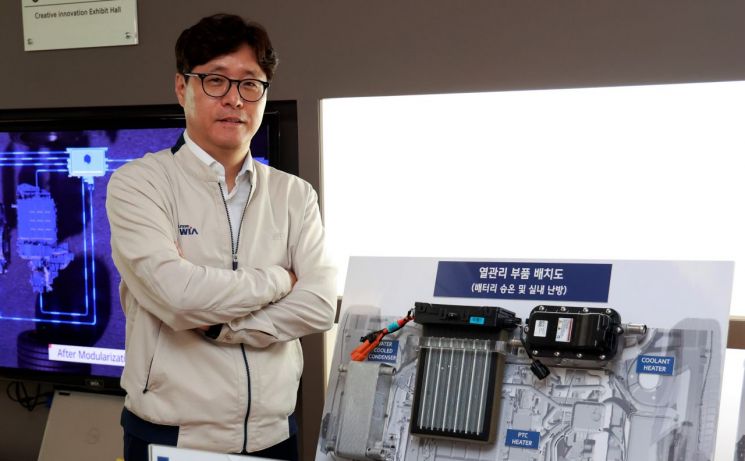 Namyoung Kim, Executive Director of TMS (Thermal Management Development Office) at Hyundai Wia, is taking a photo next to thermal management components.
 [Photo by Hyundai Wia]
For the new business, Wia increased its research personnel. The number of researchers, which was in the tens in 2020, was significantly expanded by last year. Internal engine business researchers with thermal knowledge were reassigned, and new personnel were recruited. They also conducted research on the overall thermal management system in collaboration with affiliated companies within the group.
The first fruit of this effort is the cooling water hub module. This module integrates the thermal management of electric vehicle batteries, drive units (motors, etc.), and electronic equipment components. It combines the reservoir tank that stores and replenishes cooling water, the electric water pump, and valve functions, consolidating previously separate drive component and battery cooling devices into one. This module is planned to be installed on Hyundai Motor's Kona Electric and Kia's EV9, launched this year, and subsequently on Hyundai Motor Group's dedicated electric vehicle platform, E-GMP. Executive Director Kim stated, "Compared to internal combustion engine vehicles, the number of thermal management components in electric vehicles has increased, so integrating them is the goal of parts manufacturers," adding, "We need to create the most efficient module that reduces the number of parts, maximizes performance, and lowers costs, and the cooling water module is the beginning."
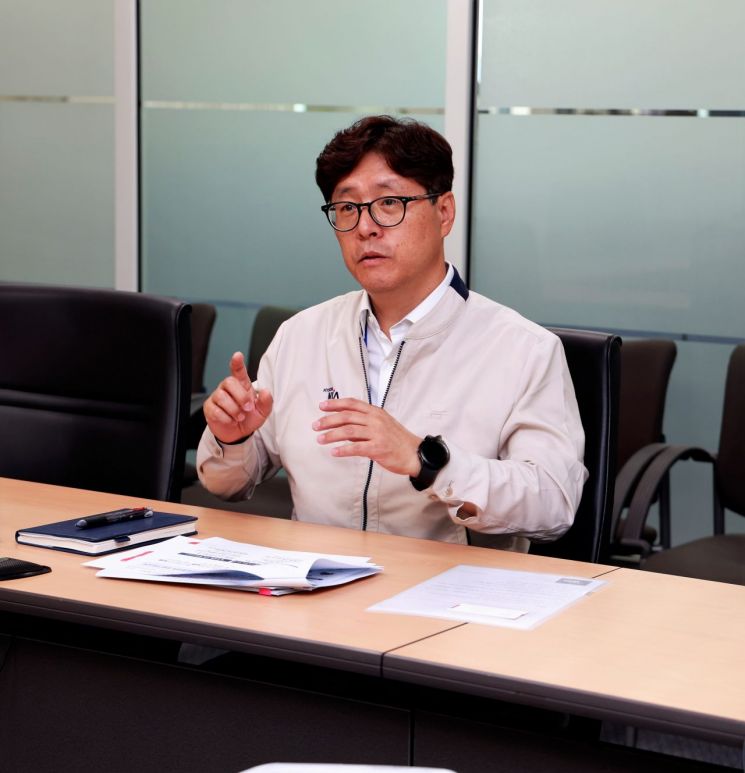 Namyoung Kim, Executive Director of TMS (Thermal Management Development Office) at Hyundai Wia, is conducting an interview with our newspaper on the 13th.
 [Photo by Hyundai Wia]
Starting with the cooling water module, Wia plans to develop an integrated thermal management system by 2025. This system will combine the HVAC system responsible for indoor heating and cooling and air quality improvement, the cooling water and refrigerant modules that cool electronic devices and batteries, the e-compressor that compresses refrigerant at high temperature and pressure, and the thermal management controller into one. By 2030, Wia aims to develop circuits and core components capable of optimal performance under various conditions and create its own proprietary logic that organically operates parts and circuits, aspiring to become a leading company in thermal management.
So, what is the ultimate thermal management vision this company dreams of? Wia envisions a future where thermal management goes beyond the electric vehicle itself to also manage the 'heat' of the passengers inside the vehicle. Executive Director Kim said, "As autonomous driving advances further, we need to consider what activities will take place inside the vehicle," adding, "We are preparing various solutions such as how to effectively deliver airflow from HVAC systems hidden behind increasingly large displays and how to provide different cooling and heating tailored to each occupant's body based on their preferences."
© The Asia Business Daily(www.asiae.co.kr). All rights reserved.
!["The Woman Who Threw Herself into the Water Clutching a Stolen Dior Bag"...A Grotesque Success Story That Shakes the Korean Psyche [Slate]](https://cwcontent.asiae.co.kr/asiaresize/183/2026021902243444107_1771435474.jpg)

















