Jung-gu, Seoul, Opens the Way for High-Density Mixed-Use Development along Dasan-ro
District Unit Plan for Sindang and Cheonggu Station Areas Approved with Revisions by Seoul City
Building Height Allowed up to 90m, Three Special Planning Zones Established Including Zoning Upgrades
Resident Briefings Scheduled for July, Final Decision and Announcement Expected in August
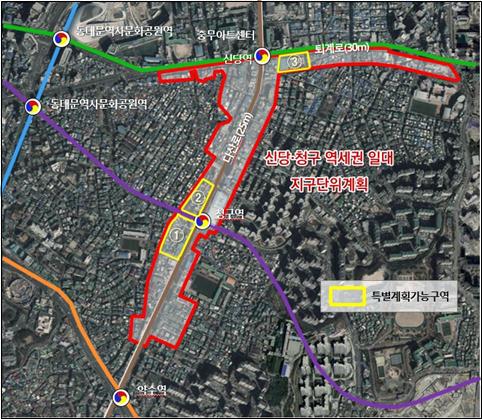
Jung-gu, Seoul (Mayor Kim Gil-seong) has designated the area around Sindang and Cheonggu stations, considered a key zone for revitalizing Dasan-ro, as a district unit planning area.
The district announced that the designation and plan decision (draft) for the Sindang and Cheonggu station area district unit plan were approved with revisions at the Seoul City Urban and Architectural Joint Committee meeting held on the 26th.
The designated area forms a T-shape around Sindang Station (Lines 2 and 6) and Cheonggu Station (Lines 5 and 6), located along Toegye-ro and Dasan-ro, covering a total area of 199,336 square meters. Toegye-ro is zoned as a line commercial area, Dasan-ro as a line quasi-residential area, and the rear areas are classified as second and third general residential zones.
The main points of the Sindang and Cheonggu station district unit plan are height relaxation and the establishment of special planning zones. The maximum building height limit along Dasan-ro has been significantly raised from the existing 50m to 70m, and along Toegye-ro from 70m to 90m.
Three new special planning zones have been designated, creating conditions for integrated development in the future that would allow a maximum height of 90m and zoning upgrades to quasi-residential areas.
This approach is expected to promote private development participation while securing public facilities desired by residents, such as parking lots, welfare facilities, and public housing.
Additionally, by expanding the Cheonggu public parking lot site, parking spaces will be increased to accommodate not only residents but also visitors to the recently emerging commercial district around Sindang-dong.
Furthermore, the plan includes reflecting road plans related to surrounding redevelopment projects, designating building setback lines, and securing open spaces within lots to improve the poor pedestrian environment in the city center.
Dasan-ro is a densely populated area where 70% of Jung-gu residents live, and population growth has become visible recently with active projects like Sindang 10 District and Sindang Moa Town.
However, the area is dominated by low-rise, aging buildings, resulting in low land-use efficiency and a deteriorated urban environment.
Jung-gu has extensively revised the district unit plan draft initially released at the end of 2021, aiming to restore the function of Dasan-ro by inducing high-density mixed-use development through regulatory relaxation, a pledge of the 8th local government administration.
The district plans to conduct a second public notice and resident briefing sessions in July to gather residents' opinions on the revised draft. The Sindang and Cheonggu station area district unit plan will be officially announced in August.
Kim Gil-seong, Mayor of Jung-gu, Seoul, said, "Despite Dasan-ro being a gateway connecting Gangbuk and Gangnam in the station area, its development has been slow for a long time." He added, "We hope that the regulatory relaxation and securing of public convenience facilities included in this district unit plan will improve residents' living conditions and help the area become a representative district of Jung-gu."
© The Asia Business Daily(www.asiae.co.kr). All rights reserved.

















