Credit Ratings Downgraded for Savings Banks and Capital Companies with High PF Burden
Mid-sized Construction and Real Estate Trust Companies Also on a Downward Trend
Expansion of Companies with Declining Credit Ratings Amid Prolonged Real Estate Market Downturn
The credit ratings of financial companies and construction firms are deteriorating one after another due to sluggishness in real estate project financing (PF) businesses. Korea Ratings, NICE Investors Service, and Korea Credit Rating, the three major domestic credit rating agencies, have all downgraded the credit ratings and outlooks of savings banks, capital companies, and small to medium-sized construction firms with a high proportion of PF loans in their regular evaluations for the first half of this year. As the real estate market downturn prolongs, it is expected that the number of companies experiencing credit rating declines will continue to increase. Analysts diagnose that we are at the beginning of a vicious cycle of 'increasing defaults → declining credit ratings → rising funding costs → falling profitability → further credit rating declines.'
Increasing Defaults → Declining Credit Ratings → Rising Funding Costs → Falling Profitability → Declining Credit Ratings
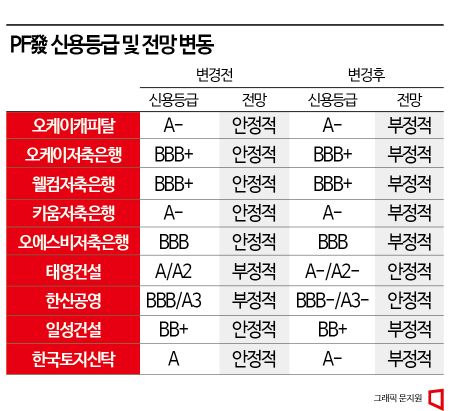
Korea Ratings and Korea Credit Rating recently changed the credit rating outlook of Welcome Savings Bank, the fourth largest in the country by loans and deposits, from 'Stable' to 'Negative' with a credit rating of BBB+. This assessment is due to the large proportion of PF (real estate financing) in total loan assets and the deterioration of profitability caused by asset defaults and rising interest rates related to PF. As of the end of March, Welcome Savings Bank's real estate financing balance (bridge loans + main PF) stood at KRW 1.4776 trillion, accounting for 27% of total loans. This exceeds twice its equity capital. Notably, the size of bridge loans that have not been converted into main PF loans amounts to KRW 835 billion.
Previously, credit rating agencies also revised the outlooks from 'Stable' to 'Negative' for OK Savings Bank (BBB+), OK Capital (A-), OK Holdings Loan (BBB), Kiwoom Savings Bank (A-), and OSB Savings Bank (BBB) for similar reasons. All three affiliates under OK Financial Group face a high risk of credit rating downgrades. The total PF loan amount of OK Financial Group affiliates is KRW 2.3493 trillion, a substantial scale, with bridge loans at KRW 1.3483 trillion, accounting for 107.4% of equity capital, indicating a high possibility of default.
Although defaults are increasing, some financial companies are defending against immediate credit deterioration through capital increases. Korea Investment Capital conducted a KRW 440 billion capital increase in March this year to prepare for PF defaults and interim dividends. NICE Investors Service analyzed that Korea Investment Capital's adjusted net capital ratio as of the end of March this year was 165.4%, significantly down from 250.8% in 2017, and slightly improved to the 170% range due to the capital increase. However, it evaluated that liquidity response capability did not improve significantly as a substantial portion of the capital increase funds was used for interim dividends. DGB Capital also recently increased its capital by KRW 50 billion to strengthen its capital buffer.
Korea Ratings stated regarding these financial companies, "Due to the real estate market downturn and high interest rates, the asset soundness and credit ratings of financial companies with a high proportion of PF loans are under increasing downward pressure. While capital increases may somewhat alleviate downward pressure on soundness and credit ratings, considering the asset composition, defaults are inevitably expected to continue expanding, so we plan to monitor closely." A financial company official said, "Depending on the PF scale and whether financial holding companies or parent companies provide financial support, credit ratings may vary, but until the real estate market recovers, a decline in credit ratings for a significant number of financial companies is inevitable."
Credit Ratings of Taeyoung Construction and Hanshin Engineering Downgraded by One Notch
Construction companies and real estate trust companies, which are directly linked to the real estate market, are also continuously facing downward pressure on their credit ratings.
Credit rating agencies recently downgraded the credit ratings of Taeyoung Construction and Hanshin Engineering by one notch each. Taeyoung Construction's corporate bond credit rating and short-term credit rating were downgraded from ‘A (Negative)/A2’ to ‘A- (Stable)/A2-’, and Hanshin Engineering's from ‘BBB+ (Negative)/A3’ to ‘BBB (Stable)/A3-’. Ilseong Construction maintained its credit rating at ‘BB+’ but changed its outlook from ‘Stable’ to ‘Negative’.
The construction industry has been experiencing sluggish sales projects since the second half of last year, with an increase in unsold and unstarted housing units. Cost burdens have expanded due to rising construction costs and interest rates, and financial conditions have worsened as companies bear the borrowings of PF projects themselves, which previously had credit enhancements such as payment guarantees. The construction companies whose credit ratings and outlooks were downgraded this time share the commonality of deteriorated financial structures, such as increased leverage ratios due to expanded working capital burdens.
Korea Ratings explained, "Taeyoung Construction had already shown a heavy financial burden due to capital reduction from the split with TY Holdings before the industrial environment worsened, and Hanshin Engineering's financial condition has continuously deteriorated due to declining profitability and land cost burdens. Currently, as the overall industry faces rising costs and financial expenses, project progress is delayed, further expanding working capital burdens, and the possibility of improving financial structure through internal cash generation is limited."
Credit rating agencies are strengthening monitoring of construction companies, so the number of construction firms facing additional credit rating downgrades is likely to increase. A credit rating agency official said, "Due to sluggish sales projects and rising construction costs, the performance and financial conditions of construction companies will gradually worsen as the real estate market deteriorates. We will closely monitor the financial conditions of construction-related companies and appropriately reflect changes in credit ratings and outlooks."
Concerns Over Chain Reaction of Credit Deterioration Amid Default Spread
Even if credit ratings or outlooks have not been adjusted immediately, there are concerns that as defaults materialize across the entire secondary financial sector, the credit ratings of financial companies, construction firms, and trust companies directly or indirectly related to PF could deteriorate in a chain reaction.
A financial company official said, "The government has supported liquidity in the PF market, preventing liquidity crunches like the Legoland incident, but as time passes and PF loans default, the number of companies with deteriorating credit ratings will increase. This could negatively impact the overall credit market as funding becomes more difficult."
© The Asia Business Daily(www.asiae.co.kr). All rights reserved.

















