Estimated 150 Survivors "Survival Rate 53-58%"
Female Sent to Gimhae Release Site Last Year Has Died
The wild breeding of the natural monument Oriental stork is progressing smoothly. According to the Cultural Heritage Administration on the 28th, the number of Oriental storks released into the wild or bred in the wild through the wild release project reached 256 as of June this year. Excluding cases of death or those not observed for over a year, it is estimated that 150 storks are alive. The Cultural Heritage Administration explained, "The survival rate is between 53 and 58%, which is a good level compared to other birds that usually have a survival rate of 30 to 50%."
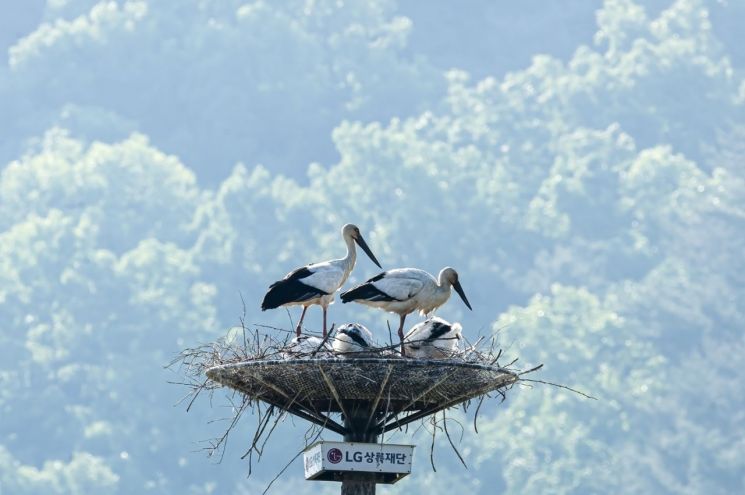
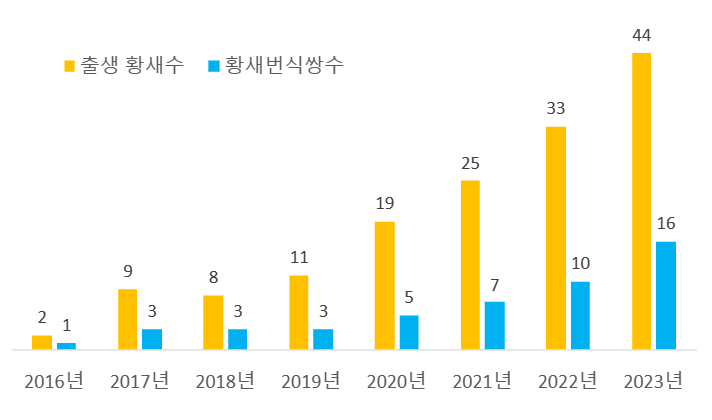
The number of successful wild breeding cases is increasing every year. In 2019, there were eleven; in 2020, nineteen; in 2021, twenty-five; and in 2022, thirty-three. This year, forty-four storks were born by June, already surpassing last year's figures. Successful breeding pairs were found not only in Chungnam regions such as Yesan and Taean but also in Jeonbuk Gochang and Gyeongnam Changnyeong. The Cultural Heritage Administration said, "There are cases of successful pairing with storks from Russia and China, which we expect will help enhance genetic diversity."
Meanwhile, among the Oriental stork couple sent to a release site in Gimhae City last year, the female was confirmed to have died earlier this month. Two eggs laid either died shortly after hatching or were not properly fertilized. The Cultural Heritage Administration stated, "We analyzed the cause of death through an autopsy but found no abnormalities," adding, "We are currently conducting tissue examinations." They further added, "We plan to inspect the facilities and environment of the Gimhae release site and release Oriental storks again in the future."
The Oriental stork, which appears in various folktales and legends, inhabits northeastern China and the Korean Peninsula. Until the 1950s, it was a common resident bird in Korea, but its population sharply declined due to poaching and environmental destruction. After a pair was found in Eumseong, Chungbuk in 1994, it disappeared. In response, the Cultural Heritage Administration has been importing Oriental storks from Russia, Germany, and other countries since 1996 to carry out breeding and restoration projects.
© The Asia Business Daily(www.asiae.co.kr). All rights reserved.


















