Jerome Powell, Chairman of the U.S. Federal Reserve (Fed), reaffirmed the policy of additional tightening due to a strong labor market. He did not rule out the possibility of consecutive interest rate hikes at the Federal Open Market Committee (FOMC) regular meetings in July and September.
On the 28th (local time), Powell attended the European Central Bank (ECB) forum held in Sintra, Portugal, and stated, "More restriction will come," adding, "The driving force behind this is a very strong labor market."
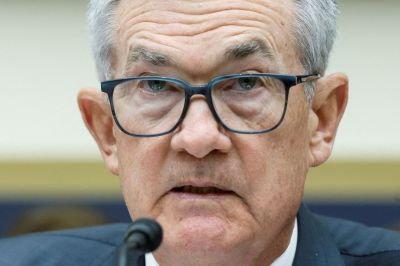
At the forum attended by major central bank governors including Christine Lagarde of the ECB, Andrew Bailey of the Bank of England (BOE), and Kazuo Ueda of the Bank of Japan (BOJ), Powell reaffirmed the Fed's dot plot outlook that two additional rate hikes are possible by the end of the year. Earlier, at the FOMC on the 14th, the Fed kept rates on hold but raised the year-end rate forecast on the dot plot from 5.1% (median) to 5.6%. This suggests that two baby steps (0.25 percentage point increases in the benchmark rate) are possible in the remaining four meetings this year.
When asked whether rate hikes could occur by skipping a meeting once again, Powell replied, "We will not rule out moving (raising rates) consecutively at meetings." This means he did not exclude the possibility of consecutive hikes in July and September. This differs from the market's expectation that the Fed will alternate between hikes and pauses to observe the effects even if it raises rates twice.
Powell also reiterated his previous statement that "the majority of FOMC members believe there will be two rate hikes this year." However, he added, "As we approach the inflation target, we will analyze data more carefully and make decisions with a lag." Having led ten consecutive rate hikes since March last year, he diagnosed that "monetary policy is restrictive but may not be sufficiently restrictive, and has not been restrictive long enough." Powell explained that the June rate hold was a decision to allow time to evaluate this.
Along with this, Powell pointed out positively that supply chains are improving and headline inflation is decreasing, which is helping to anchor inflation expectations well. However, he expressed concern that inflation in the service sector and other areas is still not showing progress. He mentioned that it will "take time" to achieve the 2% price stability target and that inflation is "lasting longer than expected." Regarding recession concerns, he said, "The possibility of a downturn is significant," adding, "It is not the most likely scenario, but it is definitely possible."
Currently, the market widely expects that the Fed, which took a breather this month, will resume rate hikes at the next July FOMC meeting. According to the Chicago Mercantile Exchange (CME) FedWatch, the federal funds (FF) rate futures market currently reflects nearly an 85% chance of a baby step in July. This rose from the 76% range the previous day after Powell's remarks were released. However, unlike the Fed's dot plot, the rate futures market still favors a scenario of one hike followed by a continued pause.
Powell was not the only one to deliver hawkish remarks that day. ECB President Lagarde bluntly stated, "We are not currently considering stopping rate hikes." She added, "It will be difficult to say with confidence that the ECB has reached the peak of rates in the near future," and predicted, "There is a very high possibility of a rate hike in July." BOE Governor Bailey also warned that "core inflation is not falling due to an overheated labor market," indicating that additional rate hikes will be inevitable if fundamental inflationary pressures persist.
On the following day, the 29th, Powell will have a dialogue with Pablo Hern?ndez de Cos, Governor of the Bank of Spain, in Madrid. The market is expected to seek more hints about the U.S. economy, inflation situation, and the direction of monetary policy from Powell's additional remarks. Later in the week, key economic indicators that could influence monetary policy, such as the final U.S. first-quarter Gross Domestic Product (GDP) and the Personal Consumption Expenditures (PCE) price index, which the Fed closely monitors, will be released. The market estimates that the core PCE for May will rise 4.6% year-on-year and 0.3% month-on-month, a slight slowdown from the previous month. However, if inflation indicators show stronger-than-expected levels, tightening pressure around the Fed could increase further.
On the day, the New York stock market opened lower across the board due to Powell's hawkish remarks and weakness in semiconductor stocks. With the possibility of consecutive rate hikes in July and September not ruled out, market caution over tightening increased. However, since Powell's remarks did not significantly deviate from the existing stance and bargain buying was confirmed mainly in big tech stocks that had been declining, the Nasdaq index later turned to a slight gain.
© The Asia Business Daily(www.asiae.co.kr). All rights reserved.

















