More than 90% of Domestic Escalators Are Made in China... Frequent Accidents
Domestic Manufacturing Base Disappeared Since 2014
"System Improvement Needed for Win-Win Cooperation Between Large and Small-Medium Enterprises"
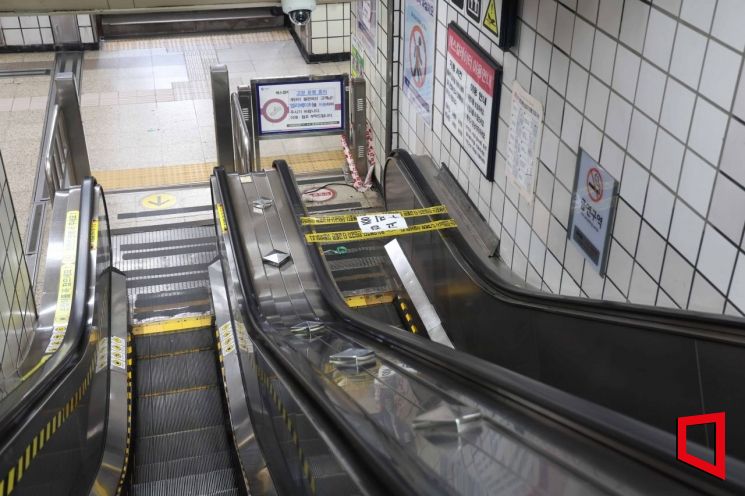 Maintenance company employees are repairing a broken escalator at Amsa Station on Seoul Metro Line 8.
Earlier this month, the up escalator at Exit 2 of Sunae Station on the Suin-Bundang Line in Bundang-gu, Seongnam-si, Gyeonggi Province, ran in reverse, injuring 14 people with moderate to severe injuries. In 2019, more than 80 people were injured in a similar reverse-running accident at Seoul National University Station. Similar incidents have occurred at Daejeon Station in 2018, Jongno 3-ga Station in 2014, and Yatap Station in 2013, resulting in dozens of injuries. Even when not causing accidents, escalators are frequently out of service due to malfunctions.
Chinese-Made Escalators Dominating the Korean Market
Chinese-made escalators are often cited as the cause of these recurring accidents every year. It is said that low-cost, low-quality Chinese parts cause frequent breakdowns. Choi Kang-jin, Senior Vice President of the Korea Elevator Association (formerly Chairman of the Korea Elevator Industry Cooperative), pointed out that the fundamental cause lies in the market structure where most escalators in Korea are made of Chinese parts rather than the parts themselves. Vice President Choi explained, "Except for some maintenance parts, there are almost no domestic escalator parts," adding, "Large corporations moved their factories overseas long ago, and most small and medium-sized enterprises import products from China."
All 2,640 escalators installed by Korail at railway stations nationwide are Chinese-made. The 1,827 escalators installed by Seoul Metro on subway lines 1 through 8 are also all Chinese products. The proportion of Chinese-made escalators operated by metropolitan transportation corporations in Busan, Incheon, Daejeon, and other cities exceeds 90%. Except for some maintenance parts such as escalator drives, control panels, and drive chains, the domestic production ratio is close to zero. Due to aggressive low-cost competition from global companies like Otis, TK Elevator, and Schindler, which have factories in China, even Hyundai Elevator moved its only domestic escalator parts factory to China in 2014. Since then, the manufacturing base has disappeared.
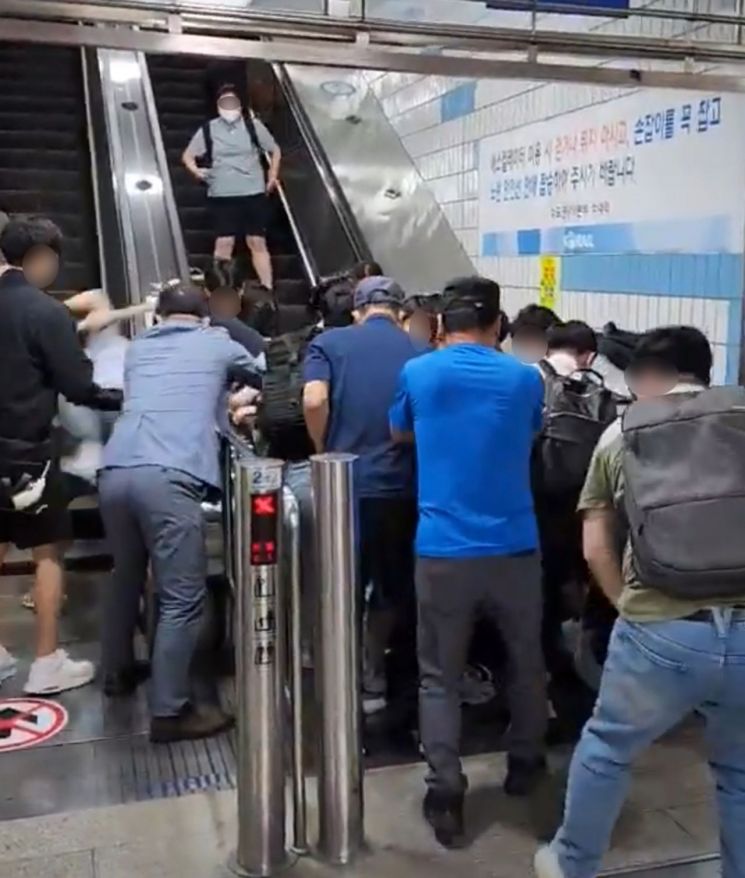 On the 8th, an accident occurred at Exit 2 of Sunae Station on the Bundang Line subway in Seongnam-si, Gyeonggi Province, where the upward escalator ran in reverse, and citizens are rescuing the injured. [Image source=Yonhap News]
Because most parts are Chinese-made, immediate supply of parts is difficult when malfunctions occur. For this reason, some escalators at KTX Gwangmyeong Station, which suffered flood damage in July last year, are still not operational. At seven Seoul subway stations flooded by typhoons and heavy rain in August last year, elevators and escalators remained out of service for over a month. This is because it takes a considerable amount of time from ordering parts to their arrival when parts break down. Moreover, many escalator parts installed in railways and subways are over 20 years old. Such parts are not stocked even in China and must be remanufactured, which takes even more time.
Even large corporations find it difficult to pre-stock parts domestically for quick response. A Hyundai Elevator official explained, "Because parts specifications vary depending on the installation area and slope of escalators inside buildings, parts must be custom-ordered and brought in afterward," adding, "Public institutions, which are the clients, likely have no room to stock parts due to budget constraints."
Hyundai Elevator, the leading company in the domestic elevator market share, has almost withdrawn from the escalator business in the public sector. This is because companies that submit the lowest bids are often selected in public construction tenders. The company says it is impossible to make a profit at the lowest bid prices. A Hyundai Elevator official said, "Unless issues such as high labor costs and the lowest-price bidding system are resolved, it will be difficult for escalator parts factories to be re-established in Korea."
Need to Improve Culture and Systems for SMEs to Enter the Market
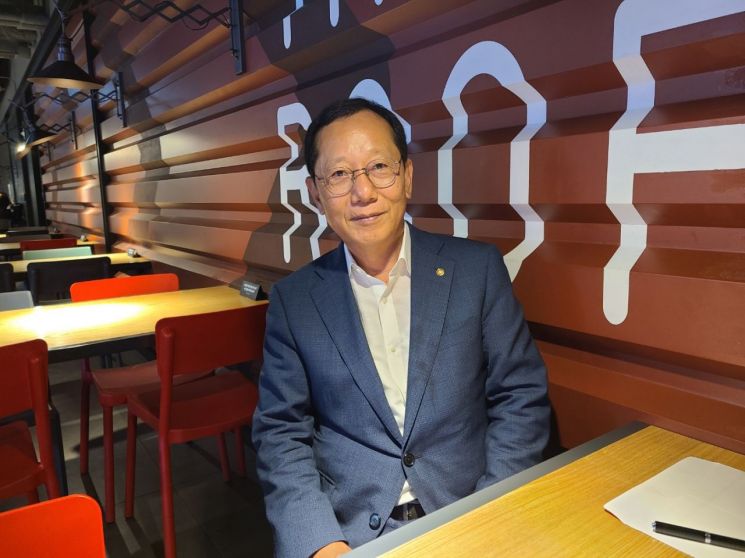 Choi Kang-jin, Senior Vice Chairman of the Korea Elevator Association (former Chairman of the Korea Elevator Industry Cooperative).
Currently, domestic small and medium-sized enterprises (SMEs) are only responsible for escalator maintenance. Is it too much to expect them to enter the manufacturing market now? According to statistics from the Korea Elevator Safety Agency, as of the end of last month, there are 39,389 escalators installed domestically (including moving walkways). Due to factors such as the increase in high-rise buildings, subway stations, and an aging population, the related market is growing. The current domestic elevator market (elevators, escalators, wheelchair lifts) is about 4 trillion won, while the global market is about 140 trillion won.
Vice President Choi said that for Korean SMEs to enter the escalator parts market, a culture where clients properly reflect product costs must first be established. He pointed out, "There is no manufacturing cost standard (legal construction cost selection criteria) for price fluctuations or design changes, so fair prices are not received," and added, "Large corporations should stop poaching SME personnel and technology and foster a cooperative atmosphere."
He also emphasized the need to implement a mandatory replacement system for aging parts. He said, "In the public sector, even if maintenance advises that parts should be replaced due to end of life, replacements are often postponed citing budget shortages," adding, "In reality, companies bear full responsibility when accidents occur." He advised that, like aircraft or military weapons, parts that have reached their design life should be replaced immediately through improved regulations.
He also pointed out that some transportation corporations assign escalator maintenance inspections conducted once a month and repair or replacement of parts when problems arise to different companies, which is problematic. He argued that the maintenance entity should be responsible for immediate repair or replacement of parts when defects are found during inspections to strengthen accountability. Separating inspection and repair leads to neglect of safety during budgeting, bidding, company selection, contracting, material preparation by the winning bidder, and construction commencement processes.
Strict certification systems also hinder SMEs. Korea amended the Elevator Safety Management Act on March 29, 2018, introducing the European elevator certification system called the 'EN Code.' The problem is that certification is much more difficult to obtain here than in Europe. Europe requires certification for only eight parts, but Korea requires certification for 22 parts, including overspeed and reverse prevention devices. Vice President Choi said, "There are more parts to certify compared to Europe," and added, "It is necessary to consider the situation of SMEs producing non-standard, small-lot, multi-variety products."
© The Asia Business Daily(www.asiae.co.kr). All rights reserved.



















