The public-private consultative body for improving the system of clinical support personnel, known as 'PA (physician assistant)' nurses, held its first meeting and began full-scale discussions. While it is significant that issues such as improving the treatment of PA nurses, who fall into a blind spot under the current Medical Service Act, have come to the surface, strong opposition from the medical community is expected to cause difficulties going forward.
The Ministry of Health and Welfare formed the 'Clinical Support Personnel Improvement Consultative Body' to resolve issues related to PA nurses and held its first meeting on the morning of the 29th. The consultative body is co-chaired by Lee Hyung-hoon, Director of Health and Medical Policy at the Ministry of Health and Welfare, and Oh Tae-yoon, Professor of Thoracic Surgery at Kangbuk Samsung Hospital. It is composed of related organizations such as the Korean Nurses Association, the Korean Hospital Association, the Korean Intern Resident Association, the Hospital Nurses Society, the Korea Patient Organization Federation, academia, and medical institutions participating in the pilot project.
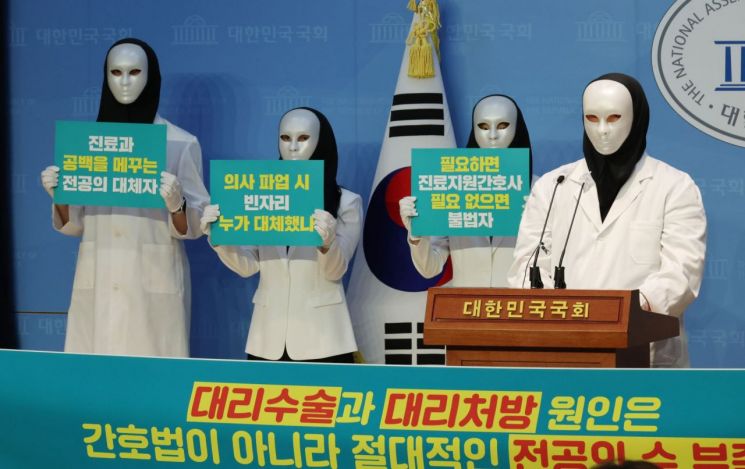 On the 10th of last month, PA nurses held a press conference at the National Assembly, appealing, "We want to perform the original duties of nurses."
 [Image source=Yonhap News]
It is estimated that there are about 10,000 PA nurses in Korea who, despite being nurses, participate in some surgeries or substitute for doctors in certain prescriptions, engaging in tasks that may be illegal under the current Medical Service Act. Although this occupation is not defined by the Medical Service Act, it is a reality that they exist in most university hospitals. Especially, the prolonged shortage of personnel and the concentration of beds in the metropolitan area have combined to increase their utilization in the field. As a result, PA nurses are expressing legal anxieties. When the nursing law controversy erupted earlier, PA nurses stated, "Nurses want to perform their duties fairly within the scope of their licenses and do not want to replace the work of residents."
Discussions related to PA nurses resurfaced in April when the Ministry of Health and Welfare announced the 'Comprehensive Support Measures for Nursing Personnel,' stating, "We plan to listen carefully to the difficulties of PA nurses and prepare improvement measures through social discussions." The ministry conducted field surveys through three policy studies from August 2021 to April this year and prepared a PA nurse management system (guideline draft), which was piloted at eight hospitals.
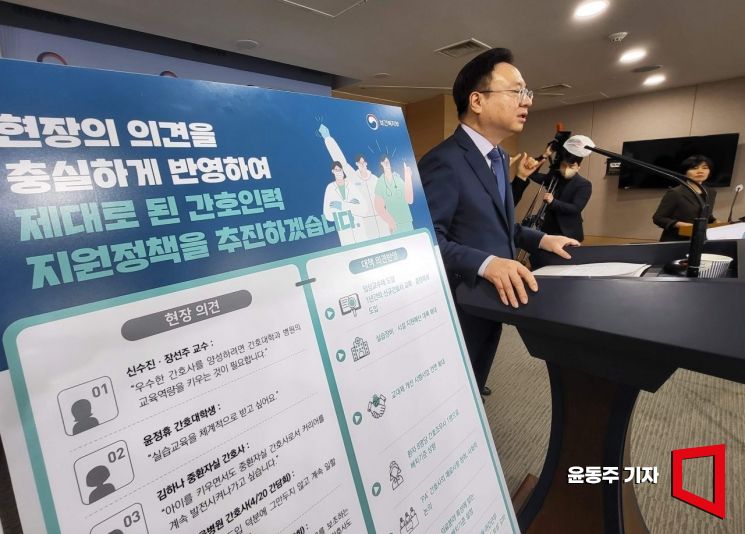 On April 25th, Cho Kyu-hong, Minister of Health and Welfare, announced a comprehensive support plan for nursing personnel at the Government Seoul Office. Photo by Yoon Dong-joo doso7@
The newly formed consultative body can be seen as a starting point for improving the PA nurse system. The body plans to discuss strengthening patient safety, improving service quality, establishing a team-based service provision system, and clarifying accountability within the current Medical Service Act framework. Additionally, to base discussions on scientific evidence and field experience, focus group interviews (FGI) will be conducted with clinical support personnel, clinical doctors, residents, and hospital directors. They also plan to hold regular meetings one to two times a month to derive concrete improvement measures. Professor Oh Tae-yoon, the private sector co-chair, said, "Clinical support personnel called PAs have been utilized since the early 2000s, which was inevitable to minimize gaps caused by shortages of medical personnel in essential critical care areas," adding, "Through broad review and discussion of this issue, improvements should be made in a way that helps enhance medical quality and patient safety."
Opposition from the medical community continues to be a variable in future discussions. The Korean Medical Association (KMA) has already refused to participate in this consultative body. The KMA argued, "Training unlicensed clinical support personnel shakes the foundation of cooperation between doctors and nurses and damages trust among medical professionals," stating, "As clinical support personnel without a separately defined license scope under the Medical Service Act, they should not be allowed to perform medical acts independently. It is appropriate for clinical nurses under the direction and supervision of doctors to perform basic clinical support tasks within their licensed scope."
The government holds the position that further delay in related discussions is impossible. Lee Hyung-hoon, the government co-chair and Director of Health and Medical Policy, emphasized, "Establishing an appropriate management system for clinical support personnel within the Medical Service Act framework is a task that can no longer be postponed to efficiently utilize health and medical personnel at the national level and provide better medical services to patients."
© The Asia Business Daily(www.asiae.co.kr). All rights reserved.


















