The prosecution and police have decided to actively pursue measures to seize and confiscate vehicles used in habitual drunk driving or serious drunk driving accidents.
On the 28th, the Supreme Prosecutors' Office and the National Police Agency announced that they have established a "Joint Prosecution-Police Drunk Driving Eradication Plan," which includes the seizure and confiscation of vehicles belonging to serious drunk driving offenders such as those causing fatal drunk driving accidents and habitual drunk drivers, and will implement it starting from the 1st of next month to curb the recent resurgence of drunk driving and related accidents.
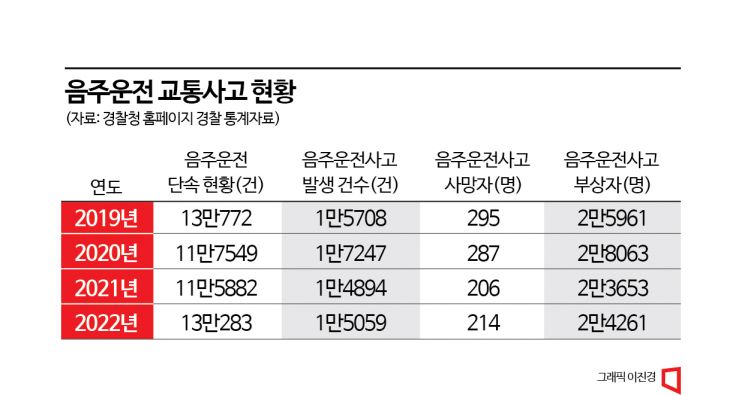
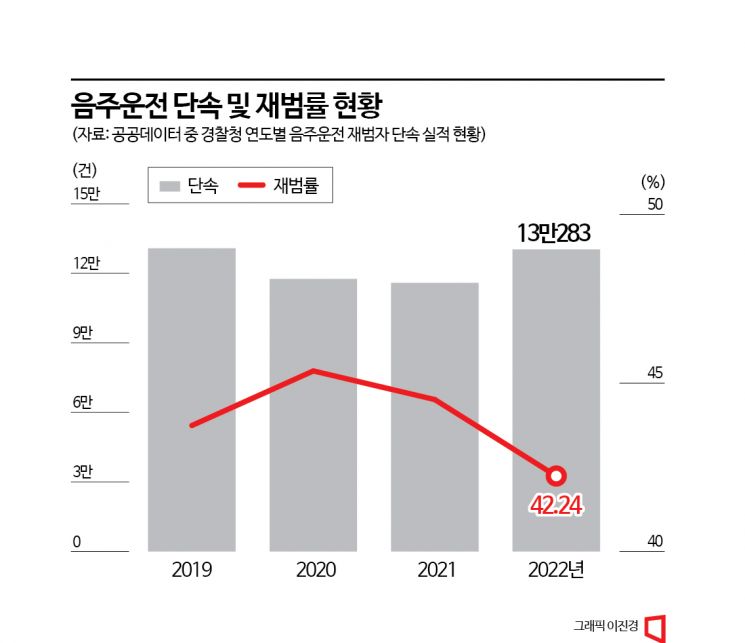
According to statistics from the National Police Agency, the number of drunk driving crackdowns, which had decreased to about 110,000 cases in 2020-2021 due to the expansion of COVID-19, recovered to about 130,000 cases last year, reaching the level before the COVID-19 pandemic in 2019.
Additionally, the recidivism rate for drunk driving has consistently remained in the 40% range, and as of 2021, Korea ranked 8th among OECD countries in the number of traffic accident fatalities per 100,000 population.
Accordingly, the prosecution and police have decided to strictly punish drunk driving offenders by establishing and implementing comprehensive measures covering all stages of criminal procedures, from crackdown to investigation and trial.
The newly established drunk driving eradication plan by the prosecution and police includes ▲ seizure and confiscation of vehicles of those causing fatal drunk driving accidents and habitual drunk drivers ▲ strict response including detention of habitual drunk driving offenders ▲ severe punishment for driver substitution and aiding and abetting ▲ strengthened crackdowns ▲ continuous cooperation between prosecution and police.
First, the prosecution and police will cooperate from the initial police investigation stage to obtain warrants from the court to seize vehicles used as tools in serious drunk driving crimes such as fatal drunk driving accidents and habitual drunk driving. They will actively pursue confiscation through requests during trials. If confiscation is not ordered by the court, they plan to actively appeal.
Confiscation is a type of punishment imposed on convicted defendants, in addition to imprisonment or fines. Korean criminal law stipulates that objects used in criminal acts can be confiscated. However, confiscation is limited if the drunk driving vehicle subject to confiscation is not owned by the driver.
Although there have been attempts to seize or request confiscation of drunk driving vehicles in the past, the lack of specific standards prevented activation, and courts have been reluctant to issue confiscation rulings.
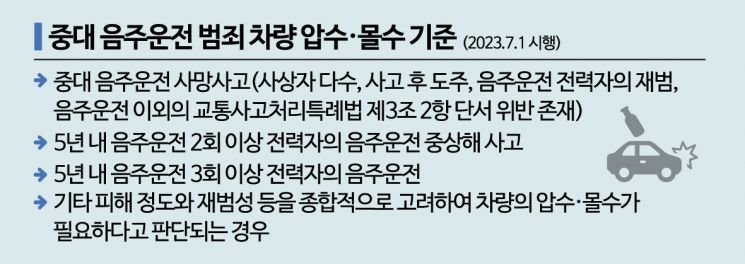
The criteria for seizure and confiscation of vehicles involved in serious drunk driving crimes established by the prosecution and police include ▲ fatal drunk driving accidents ▲ drunk driving causing serious injury by offenders with two or more drunk driving offenses within five years ▲ drunk driving by offenders with three or more drunk driving offenses within five years ▲ and other cases where seizure or confiscation is deemed necessary considering the extent of damage and recidivism risk.
Specific types of fatal drunk driving accidents include ▲ accidents with multiple casualties ▲ hit-and-run after the accident ▲ recidivism by offenders with drunk driving history ▲ violations of Article 3, Paragraph 2, Note of the Special Act on Traffic Accident Handling other than drunk driving (such as fleeing without providing aid after causing injury by professional negligence or gross negligence, abandoning victims by moving them from the accident site and fleeing, refusing breathalyzer tests, or refusing blood tests).
During the COVID-19 period, the seriousness of drunk driving somewhat diminished due to low enforcement, and as social distancing measures eased, innocent victims continue to die in drunk driving traffic accidents during daytime commuting hours and school zones.
In December last year, an elementary school student died in a drunk driving accident in a school zone in Cheongdam-dong, Seoul. In April this year, four elementary school students were killed or seriously injured after being hit by a drunk driving vehicle in a school zone in Daejeon. Additionally, in April, a woman in her 20s died in a drunk driving accident during commuting hours in Ulsan, and in May, a drunk driving accident involving a married couple occurred in Jeonju. Drunk driving accidents, including those in school zones, continue to occur regardless of day or night.
The prosecution and police believe that seizing or confiscating vehicles used by drunk driving offenders reduces the possibility of recidivism and helps prevent drunk driving accidents. Therefore, they plan to strengthen vehicle seizure and confiscation requests in serious drunk driving cases. In fact, the Daejeon District Prosecutors' Office seized the vehicle of a drunk driver involved in a school zone accident that caused casualties among four elementary school students in Daejeon.
Furthermore, the prosecution and police plan to detain habitual drunk drivers in principle through active warrant applications by the police and active warrant requests by the prosecution. During trials, the prosecution will impose strict sentences based on drunk driving history and blood alcohol concentration standards.
Moreover, as punishment standards for drunk driving are strengthened, investigations into 'driver substitution' and aiding and abetting drunk driving, which are gradually increasing, will also be intensified. The number of people prosecuted for aiding and abetting drunk driving by the prosecution increased from 334 in 2020 to 414 in 2021 and 250 in 2022, even rising during the COVID-19 pandemic. The prosecution and police plan to actively investigate not only acts that encourage or induce drunk driving but also passengers who knew about the drunk driving and did not prevent it, as well as those who provided alcohol anticipating drunk driving, as aiding and abetting drunk driving.
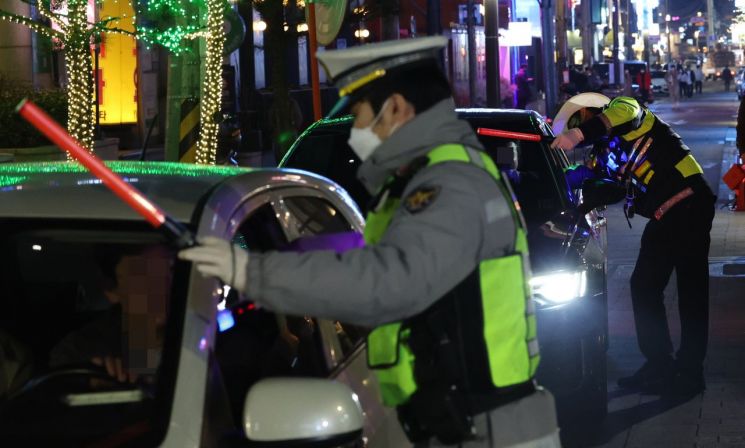
Meanwhile, the police plan to conduct nationwide intensive crackdowns during vulnerable periods for drunk driving, such as summer vacation, autumn leisure season, and year-end holidays, to raise awareness of drunk driving, which may become lax due to the return to normal life after COVID-19.
In particular, to prepare for habitual drunk driving during the July-August vacation season, nationwide simultaneous crackdowns will be conducted every Friday, when drunk driving accidents occur most frequently. At night, customized crackdowns will be conducted around entertainment districts, and during the day, in resorts and tourist spots, tailored by location and time. Additionally, drunk driving crackdowns will be strengthened around bustling areas near school zones to enhance child safety, and daytime crackdowns will be conducted to eradicate driving under hangover. Previously, the police conducted special crackdowns on drunk driving and school zone violations day and night from April 13 to May 31.
A prosecution official said, "Until now, there were no specific standards for seizure or confiscation requests of drunk driving vehicles, so each prosecutor's office or prosecutor has exercised discretion based on subjective judgments of what might be excessive. Now that clear and specific standards have been established, they can be actively utilized."
The official added, "The Supreme Prosecutors' Office and the National Police Agency will continue to make multifaceted efforts to firmly establish the public perception that 'drunk driving results in vehicle confiscation' and do their best to create a road traffic environment where citizens can travel safely and with peace of mind."
© The Asia Business Daily(www.asiae.co.kr). All rights reserved.



















