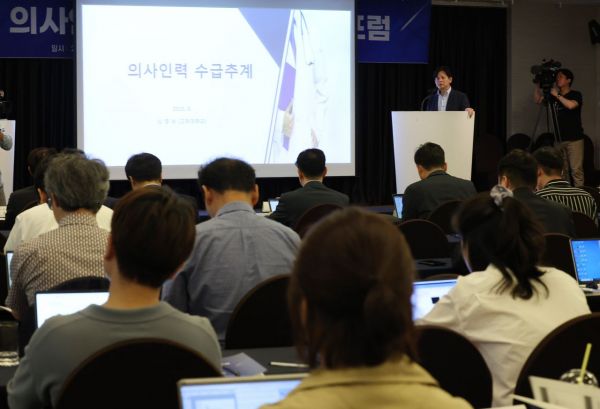
 Shin Young-seok, Research Professor at the Graduate School of Public Health, Korea University, presenting at the Physician Workforce Supply and Demand Forecast Forum.
 [Image source=Yonhap News]
Experts are divided on whether the collapse of essential medical services will worsen if the number of doctors is not increased in the future. At a forum organized by the government to estimate the scale of doctors needed for essential medical services from the 2025 admissions onward, when the government plans to expand medical school quotas, healthcare experts engaged in sharp debates. There are also calls for predictions on whether the increased number of doctors will be able to fill the gaps in essential and regional medical services if the government expands medical school quotas.
Among the eight experts who presented their views on the supply and demand outlook for doctors at the “Expert Forum on Doctor Workforce Supply and Demand Estimation” held by the Ministry of Health and Welfare on the 27th, four predicted that “if medical school quotas are not increased, there will be a shortage of doctors.” They stated that “expanding medical school quotas is necessary as a solution to the current imbalance in essential and regional medical services.”
Dr. Kwon Jeong-hyun of the Korea Development Institute (KDI) predicted, “As the population ages, medical demand will increase, but supply will decrease due to the rise in older doctors with low labor productivity, resulting in a shortage of about 22,000 essential medical doctors by 2050.” He added, “If medical school quotas are increased by 5% annually starting in 2024 to reach 4,303 by 2030, the shortage of doctors in 2050 can be addressed.” Shin Young-seok, a research professor at the Graduate School of Public Health at Korea University, cited estimates from the Korea Institute for Health and Social Affairs in 2021, forecasting a shortage of 14,334 doctors by 2030 and 27,232 by 2035.
Professor Jung Hyung-sun of the Department of Health Administration at Yonsei University said, “The gap in essential medical services is just one of many problems caused by the overall shortage of doctors.” Professor Kim Yoon of the Department of Medical Management at Seoul National University College of Medicine emphasized, “Currently, doctors’ wages are excessively high compared to the average Korean worker’s salary, and this gap is expected to widen over the next 5 to 10 years, which is a clear indication of the shortage of doctors.”
On the other hand, Woo Bong-sik, director of the Medical Policy Research Institute and a representative of the Korean Medical Association, bluntly stated, “Considering low birth rates and other factors, there is no shortage of doctors.” He further argued, “It is risky to view increasing medical school quotas as a ‘panacea’ for medical shortages. It could inadvertently lead to an increase in health insurance medical expenses.” Lee Dong-wook, emergency response committee chairman of the Gyeonggi-do Medical Association, also said, “If a large number of doctors are recruited without improving the poor working conditions in essential and regional medical services, polarization phenomena such as concentration in popular specialties will only worsen.”
Professor Jang Sung-in of the Department of Preventive Medicine at Yonsei University said, “Rather than focusing on medical demand and supply for increasing medical school quotas, the emphasis should be on workforce distribution.” Professor Oh Joo-hwan of Seoul National University College of Medicine pointed out, “If support for essential medical services among residents (trainees) is decreasing and they are gravitating toward popular specialties, increasing medical school quotas will only worsen the current distribution.” Last year, the application rates for popular specialties such as plastic surgery and dermatology were 171.8% and 163.8%, respectively, while less popular specialties like pediatrics and thoracic surgery had rates of 23.5% and 39.6%, respectively. Professor Oh also added, “The supply and demand estimates predicting a future shortage of doctors overlook the healthy aging of medical service users and the delayed retirement of medical providers.”
As opinions on expanding the doctor workforce are sharply divided, the government plans to broadly gather opinions not only through the medical issue consultative body that discusses with the Korean Medical Association but also by establishing a Health and Medical Policy Deliberation Committee involving stakeholders such as service users.
© The Asia Business Daily(www.asiae.co.kr). All rights reserved.
![Clutching a Stolen Dior Bag, Saying "I Hate Being Poor but Real"... The Grotesque Con of a "Human Knockoff" [Slate]](https://cwcontent.asiae.co.kr/asiaresize/183/2026021902243444107_1771435474.jpg)
















