Next Month, Shin Ramyun Price Down 50 Won, Saewookkang Down 100 Won
"Cost Reduction Passed on Due to Wheat Flour Price Cut"
Ottogi, Samyang Foods, Paldo Also Considering Price Cuts
Nongshim, the No. 1 ramen company in South Korea, has decided to lower the prices of Shin Ramyun and Saewookkang starting next month. Amid the government’s repeated pressure on the food industry to reduce product shipment prices based on the recent decline in raw material costs, Nongshim’s decision to cut prices for products known as the 'national ramen' and 'national snack' is expected to prompt other companies in the same industry to soon lower prices of their main products as well.
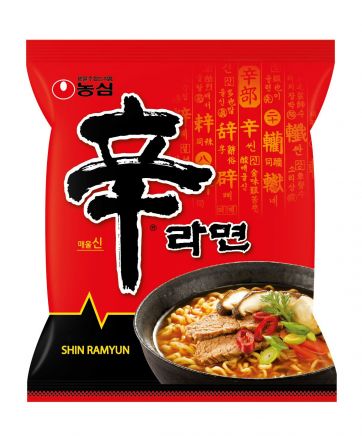
Shin Ramyun Price Cut for the First Time in 13 Years; Saewookkang Price Cut for the First Time Ever
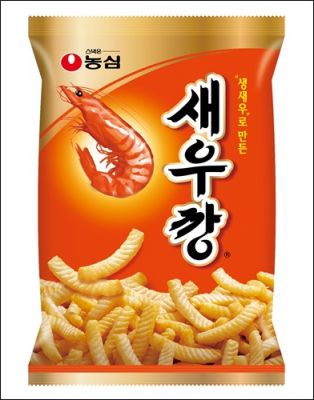
On the 27th, Nongshim announced that starting July 1, it will reduce the shipment prices of Shin Ramyun (bagged noodles) and Saewookkang by 4.5% and 6.9%, respectively. The retail price of a bag of Shin Ramyun, currently sold at 1,000 won, is expected to decrease by 50 won, and Saewookkang, priced at 1,500 won, will drop by 100 won. Nongshim explained, "The price of wheat flour supplied by domestic milling companies is scheduled to decrease by 5% starting next month, resulting in an annual cost reduction of about 8 billion won for Nongshim. We expect that this price cut will provide consumers with benefits exceeding 20 billion won annually."
Nongshim claimed that this decision signifies returning to consumers more than the increase in profits gained from the wheat flour price reduction, despite ongoing cost pressures. This is the first time in 13 years since 2010 that Nongshim has lowered the price of Shin Ramyun. At that time, raw material prices had fallen, leading to a 2.7% to 7.1% price reduction for Shin Ramyun and other main products. This is the first-ever price cut for Saewookkang.
Previously, Nongshim raised the price of Saewookkang twice last year, by 7.2% in March and 6.7% in September, citing increased raw material costs and rising exchange rates. Ramen prices were also increased by an average of 11.3% in September last year. The recent decision to partially lower prices is interpreted as a response to the government’s repeated pressure.
On the 18th, Deputy Prime Minister and Minister of Economy and Finance Choo Kyung-ho commented on the ramen price issue, saying, "Companies raised prices significantly in September and October last year, but international wheat prices have dropped by about 50% since then. I hope companies will appropriately lower prices in line with the decrease in wheat prices." In response, the ramen industry cautiously stated, "The wheat prices supplied through milling companies remain high regardless of international market prices. Not only wheat flour but also other ramen raw materials such as starch, agricultural products, and energy prices continue to rise, making it difficult to lower product prices."
Following this, on the 26th, the Ministry of Agriculture, Food and Rural Affairs held a meeting with major milling companies, urging them to reduce wheat flour prices and pressing them again. Among related industries, Nongshim was the first to decide on a price cut, just nine days after Deputy Prime Minister Choo’s remarks.
A Nongshim official explained, "Shin Ramyun (bagged noodles) and Saewookkang, which are subject to the price reduction, generate annual sales of 360 billion won domestically and have been loved as the national ramen and national snack. Although this price cut places a burden on management, we targeted products closely related to daily life so that consumers can feel a real decrease in living costs."
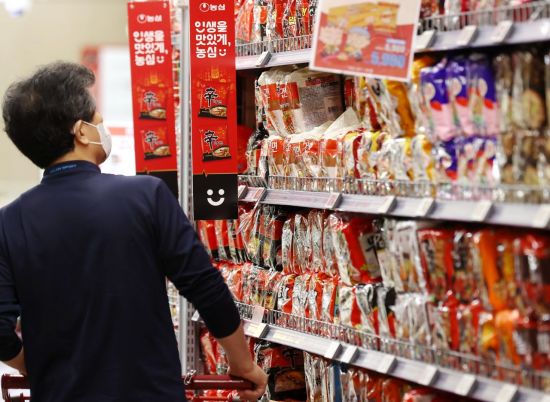 A citizen is shopping at the ramen aisle in a large supermarket in Seoul city. [Image source=Yonhap News]
Government Pressure Leads to Surrender? Food Industry Faces Possible Chain Price Cuts
Related industries are also showing signs of aligning with Nongshim’s price cut decision. Ottogi is considering lowering prices of its main ramen products next month, though the specific reduction rate has not yet been decided. Samyang Foods and Paldo are also reportedly discussing price reduction plans. Paldo and Ottogi raised prices of their main products by 9.8% and 11.0%, respectively, in September last year, while Samyang Foods increased ramen prices by an average of 9.7% in November last year.
Attention is also focused on whether milling companies, urged by the Ministry of Agriculture, Food and Rural Affairs, will reduce prices. The international wheat futures price, a raw material for flour, rose to $419 per ton in May last year due to the Russia-Ukraine war but has since declined to $243 per ton as of this month, about 58% of last May’s level. If milling companies lower flour prices, the confectionery and bakery industries using these raw materials will inevitably face pressure.
Confectionery and bakery companies also lowered product prices in 2010 following a drop in raw material costs. At that time, Lotte Confectionery reduced prices of seven snack products by 4% to 14%, Crown Haitai lowered prices of Cham Cracker and Ivy by 10% to 12%, and Paris Baguette and Tous Les Jours also cut bread prices.
However, within the food industry, there are complaints that they have no choice but to lower prices reluctantly under government pressure. An industry insider said, "While the overall costs of production and distribution have increased, only the decline in some raw material international prices is being highlighted. The atmosphere is not one of recommending price cuts but effectively forcing them, which creates significant internal burdens."
© The Asia Business Daily(www.asiae.co.kr). All rights reserved.
![Clutching a Stolen Dior Bag, Saying "I Hate Being Poor but Real"... The Grotesque Con of a "Human Knockoff" [Slate]](https://cwcontent.asiae.co.kr/asiaresize/183/2026021902243444107_1771435474.jpg)


















