As the government has decided to increase the number of medical school admissions starting from the 2025 academic year, there is growing concern about how much the quota should be increased to prevent the collapse of essential medical services. On the 27th, the Ministry of Health and Welfare held the “Physician Workforce Supply and Demand Estimation Expert Forum” at the Royal Hotel in Seoul to discuss appropriate physician workforce expansion plans based on scientific evidence. This forum was held to discuss how much to increase the physician workforce, following the agreement between the government and medical organizations on expanding the physician workforce at the 10th Medical Issues Council held on the 8th.
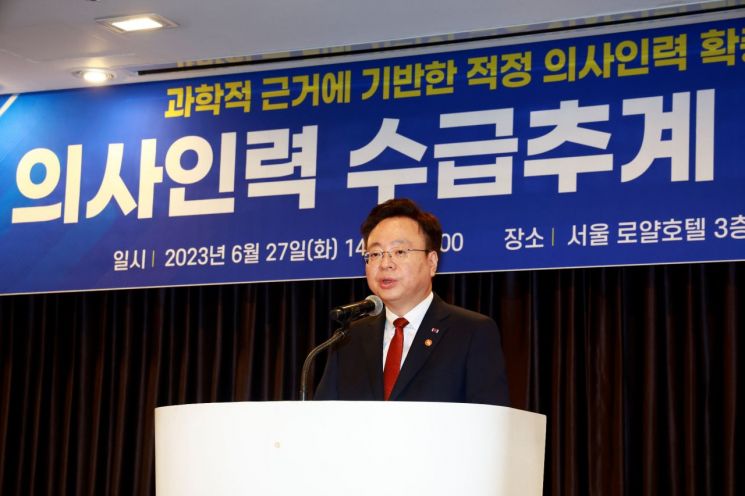 Health and Welfare Minister Cho Kyu-hong is delivering a greeting at the Expert Forum on Physician Workforce Supply and Demand Projections held at the Royal Hotel in Seoul on the 27th.
 [Photo by Ministry of Health and Welfare]
Many healthcare experts tended to agree with increasing the medical school quota, but experts from the Korea Medical Association (KMA) expressed differing views, stating, “Considering the characteristics of Korea’s declining population structure, there will not be a shortage of doctors.”
Dr. Kwon Jeong-hyun from the Korea Development Institute (KDI) projected the necessary medical demand based on population structure changes due to low birth rates and aging. Although the population is decreasing, medical demand is increasing due to aging, and by 2050, there will be a shortage of about 22,000 doctors. Dr. Kwon emphasized, “Increasing the number of doctors does not automatically improve the distribution of doctors, but in a situation where there is a shortage of doctors, the problem of imbalance in the distribution of medical personnel is likely to worsen,” adding, “While actively promoting policy support to resolve current regional and specialty imbalances, it is necessary to enhance the feasibility of policies through adjusting the scale of the physician workforce.”
Professor Shin Young-seok of Korea University forecasted, based on the 2020 “Mid- to Long-term Supply and Demand Estimation of Healthcare Personnel” and the 2021 “Specialty-specific Physician Workforce Supply and Demand Estimation Study,” that by 2035, there will be shortages of 9,654 and 27,232 doctors, respectively.
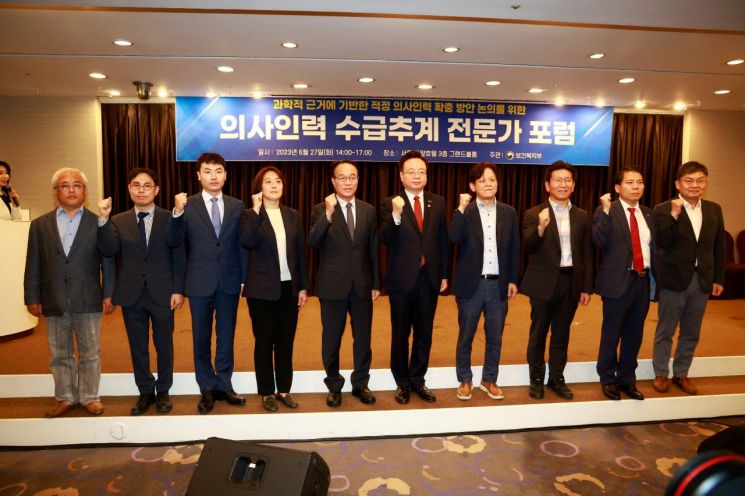 At the Expert Forum on Physician Workforce Supply and Demand Projections held on the 27th, participants including Cho Kyu-hong, Minister of Health and Welfare (6th from the left), are taking a commemorative photo.
 [Photo by Ministry of Health and Welfare]
Woo Bong-sik, Director of Medical Policy Research at the Korea Medical Association, stated that considering low birth rates and other factors, there will not be a shortage of doctors, and increasing the number of doctors would lead to an increase in health insurance medical expenses. Since it takes more than 10 years for medical personnel secured through increased medical school quotas to enter the field, he emphasized that improving the treatment of essential medical personnel should be prioritized immediately. Director Woo stated that to prevent the collapse of essential medical services, the government should prepare measures to reform ▲ the pediatric and adolescent care system ▲ the emergency medical system ▲ and the payment and compensation system rather than expanding medical school quotas.
Minister of Health and Welfare Cho Kyu-hong said at the forum, “We organized this expert forum to discuss the appropriate scale of physician workforce with statistics and health experts based on supply and demand estimates,” adding, “The government will derive the optimal scale of physician workforce expansion necessary to strengthen essential medical services based on supply and demand estimates and feedback, and will prepare multifaceted measures to support this.”
© The Asia Business Daily(www.asiae.co.kr). All rights reserved.


















