Last month, it was found that 9 out of 10 processed food items increased in price compared to a year ago. Items that rose by double digits or more accounted for 40%. Although international raw material prices such as grains and palm oil, which affect processed food prices, have been steadily declining, the level reflected in domestic consumer product prices is still minimal.
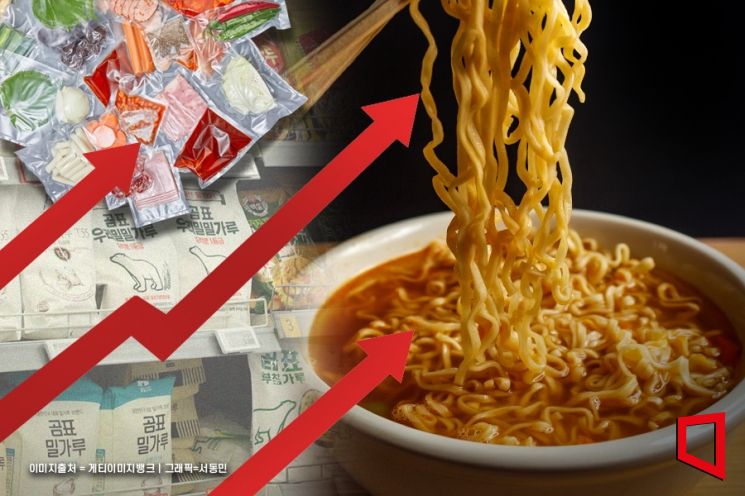
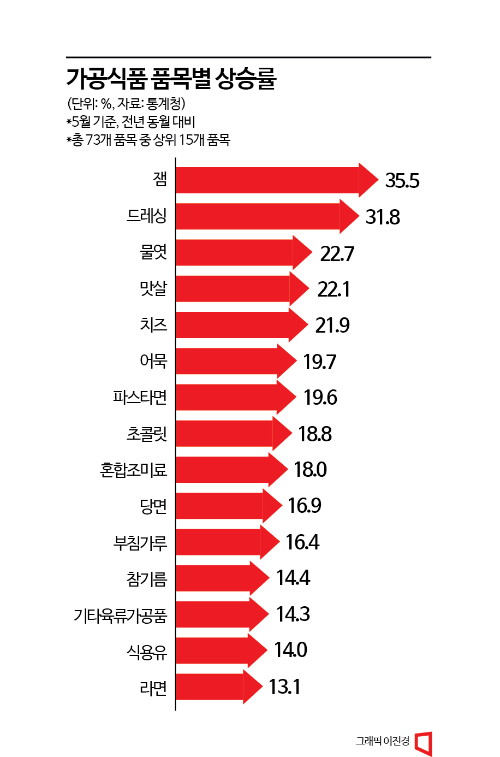
According to the National Statistical Portal of Statistics Korea on the 27th, the processed food price index in May this year rose by 7.3% compared to the same month last year. By item, out of a total of 73 items, 68 items (93.1%) increased compared to a year ago. The increase rates were high for jam (35.5%), dressing (31.8%), starch syrup (22.7%), crab sticks (22.1%), and cheese (21.9%).
Items that rose by more than 10% also increased to 29 items (39.7%), up by 7 items from the same period last year (22 items, 30.1%). Fourteen items, including pasta noodles (19.6%) and glass noodles (16.9%), had higher increase rates than ramen (13.1%), which the government recently pointed out. On the other hand, items that decreased in price were limited to five: health functional foods (-3.7%), soy sauce (-1.5%), probiotics (-1.1%), baby food (-0.9%), and beer (-0.1%).
Processed food prices are closely related to international raw material prices such as grains, palm oil, and raw milk. When the raw material prices, which are the main ingredients of products, rise, consumer product purchases tend to increase with a lag of one to two quarters. However, once processed food prices rise, they do not easily fall, which can have a long-term impact on overall price increases. In fact, in May this year, the contribution of processed food prices to the overall price index was 0.64 percentage points, greatly surpassing the contribution of petroleum products (-0.99 percentage points), which has played a catalytic role in consumer price increases.
This is why the government recently directly mentioned ramen prices and recommended price adjustments. The judgment is that if the high processed food price increase rate is not controlled, the price burden felt by ordinary people will inevitably remain high. According to the United Nations Food and Agriculture Organization (FAO), the global food price index reached a peak of 159.7 in March due to the war between Russia and Ukraine, major grain exporting countries, but steadily declined to 124.3 in May this year. However, the level reflected in actual grocery prices remains minimal.
Moreover, as the possibility of crude oil prices rising within the range of 69 to 104 won per liter increases this year, it is expected to affect the price increase of some processed foods such as dairy products and ice cream. Accordingly, the government is strengthening efforts to stabilize items closely related to citizens' lives by reviewing an investigation into price collusion of ramen through the Fair Trade Commission. However, some argue that this is excessive government intervention, and the government is expected to face greater challenges in controlling grocery prices for the time being.
© The Asia Business Daily(www.asiae.co.kr). All rights reserved.
![Clutching a Stolen Dior Bag, Saying "I Hate Being Poor but Real"... The Grotesque Con of a "Human Knockoff" [Slate]](https://cwcontent.asiae.co.kr/asiaresize/183/2026021902243444107_1771435474.jpg)

















