"Cost Burden Remains Unchanged"
The Ministry of Agriculture, Food and Rural Affairs requested a de facto reduction in flour prices on the 26th, and the milling industry responded by stating that they would consider the possibility of a price cut. However, the industry consensus is that due to ongoing cost burdens, it is uncertain whether this will actually lead to a price reduction.
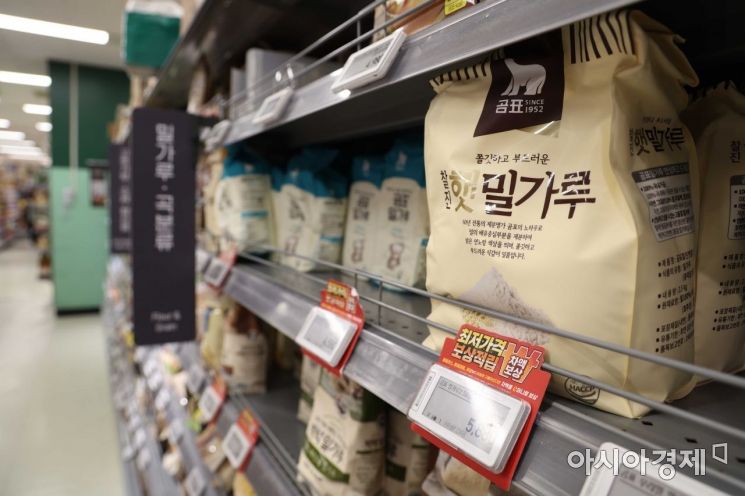
At a meeting held at the aT Center in Yangjae-dong, Seocho-gu, Seoul, seven milling companies including CJ CheilJedang and Daehan Flour Mills conveyed this stance to the Ministry of Agriculture, Food and Rural Affairs, which asked them to consider the decreased wheat import prices when setting flour prices. The milling industry said, "Although there are difficulties such as the time lag between futures prices and import prices, additional costs, and rising exchange rates, we will consider the possibility of lowering flour shipment prices in July to stabilize prices amid the decline in wheat futures prices."
International wheat futures prices rose to $419 per ton in May last year due to the Russia-Ukraine war but have since declined, remaining below $300 per ton from November last year through this month. This month, wheat futures prices dropped to $243 per ton, which is 58% of the level in May last year.
However, it is uncertain whether the milling industry will actually reduce flour prices next month. A representative from one company said, "We plan to communicate and cooperate as much as possible with the government's efforts to stabilize prices, but realistically, it is difficult to lower flour prices." Another company representative also said, "We sympathize with the government's intention to stabilize prices, but we are deeply concerned as cost burdens remain."
This month, the international wheat price fell to $243 per ton but is still higher than the average price of $201 per ton. The impact of fluctuations in wheat futures prices is reflected in import prices with a 4 to 6-month time lag. Accordingly, wheat import prices hit a record high of $496 per ton in September last year and dropped to $416 per ton this month, but this is still about 1.5 times the average price of $283 per ton. In addition, increases in labor costs, logistics costs, and energy costs are intensifying the cost burden on the milling industry.
However, CJ CheilJedang is also showing signs of a price reduction by considering a plan to discount flour prices by about 5% through increasing sales incentives to Nongshim. Not only CJ CheilJedang but other flour companies also seem likely to consider lowering prices, which could lead ramen companies including Nongshim to review product price reductions.
© The Asia Business Daily(www.asiae.co.kr). All rights reserved.

















