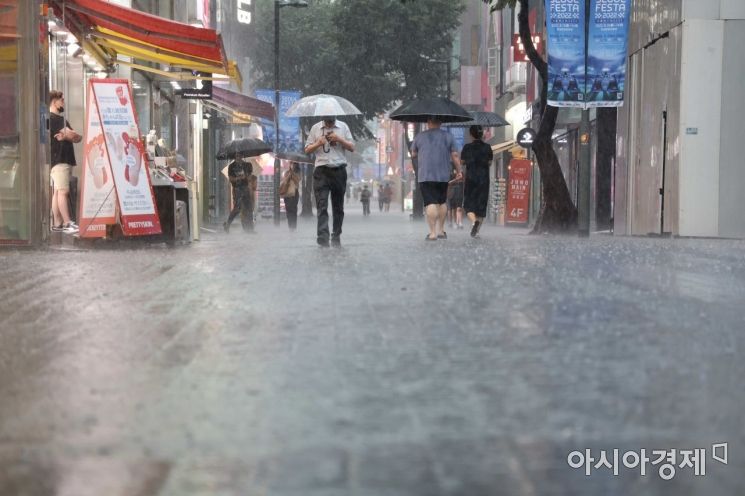
 On the 8th, when heavy rain fell mainly in the central region, citizens with umbrellas hurried their steps on the streets of Myeongdong, Seoul. / Photo by Moon Honam munonam@
The full-scale rainy season will begin on the 25th. The Seoul metropolitan area is forecasted to experience continuous rain from the 26th to the 29th.
According to the Korea Meteorological Administration, the morning low temperatures on the 25th will range from 18 to 23 degrees Celsius, and the daytime highs will be between 23 and 32 degrees Celsius.
As the North Pacific High expands and the stationary front moves northward, a low-pressure system developing over the front will influence the weather, bringing rain starting from Jeju on the night of the 24th, marking the official start of the rainy season.
By dawn on the 25th, rain will reach the southern coast of Jeollanam-do, and from the afternoon of the same day, rain will spread across the entire Honam region and Gyeongsangnam-do. By night on the 25th, rain will also fall in Chungcheong and the southern part of Gyeongsangbuk-do.
Strong, warm, and humid southern winds will bring heavy rainfall from the very first rainy season rain.
From the night of the 24th through the 25th, precipitation is expected to be 50 to 120 mm in Jeju, 30 to 80 mm in Jeollanam-do and Gyeongsangnam-do, 20 to 60 mm in Jeollabuk-do, and 5 to 20 mm in Chungcheong and southern Gyeongsangbuk-do. In the mountainous areas of Jeju and the mid-mountain region of Jeju, rainfall could exceed 150 mm, and the southern coast of Jeollanam-do and the western southern coast of Gyeongsangnam-do may see over 100 mm of rain.
In Jeju, from dawn on the 25th, rain could pour at rates exceeding 50 mm per hour, accompanied by gusty winds, thunder, and lightning. Additionally, in the southern coast of Jeollanam-do and the western southern coast of Gyeongsangnam-do, from the afternoon and night of the 25th respectively, rain accompanied by gusts, thunder, and lightning could fall at rates exceeding 30 mm per hour.
Rain is expected to begin in the Seoul metropolitan area from the early morning of the 26th. Nationwide rain is forecasted on the 26th, 27th, and 29th. On the 28th, rain is expected in the Seoul metropolitan area, Gangwon Yeongseo, Jeonnam region, and Gyeongnam region, and on the 30th, rain will likely fall in the southern regions.
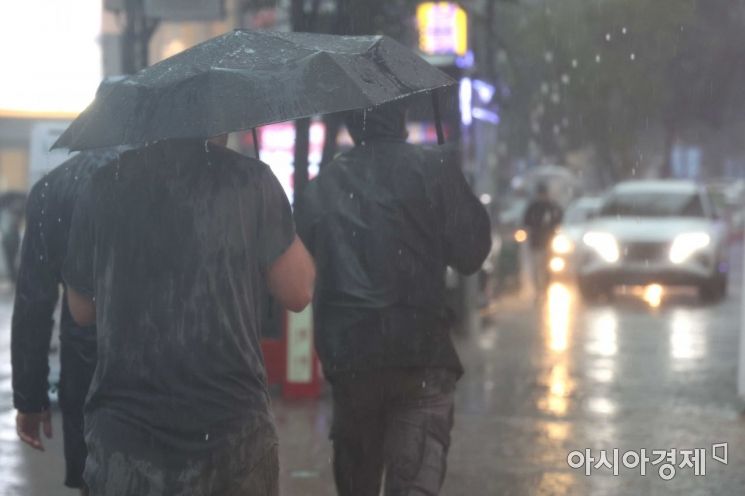 On the 8th, when heavy rain fell mainly in the central region, citizens with umbrellas hurried their steps on the streets of Myeongdong, Seoul. Photo by Moon Honam munonam@
Some areas are expected to receive around 100 mm of heavy rain in a single day, with periods of intense downpours anticipated. Preparations should be made for flooding in low-lying areas and farmland, as well as sudden rises in water levels in valleys and rivers.
It is also necessary to clean rain gutters and maintain sewage and stormwater facilities in advance.
From the night of the 24th, very strong winds blowing at 30 to 60 km/h (9 to 16 m/s) and waves reaching heights of 1.5 to 4.0 meters will occur in the southern outer sea of the West Sea and the southern outer sea of Jeju. On the 25th, these conditions will extend to the entire southern sea of the West Sea, the inner southern sea of Jeju, the southern coastal waters of Jeju, the eastern coastal waters of Jeju, the eastern outer sea of the South Sea's western part, and the inner eastern sea of the South Sea.
On the 24th, thunder and lightning with gusts will occur in the southern sea of Jeju, and on the 25th, in the seas around Jeju, the South Sea, and the West Sea. Sea fog will also persist in these waters for some time.
With the possibility of more rainfall than usual this summer, the government has taken measures to respond to flooding and other disasters.
The Korea Meteorological Administration has decided to directly send emergency disaster alerts for extreme heavy rain starting this summer to minimize damage from summer climate disasters. When very heavy rain (an hourly accumulated rainfall of 50 mm and a simultaneous 3-hour accumulated rainfall of 90 mm) is observed, disaster alerts will be sent directly to the affected areas.
After a pilot operation in Seoul and the metropolitan area this year, the plan is to expand this system nationwide next year. Yoo Hee-dong, the head of the Korea Meteorological Administration, said, “We will do our utmost to ensure that not a single casualty occurs from summer natural disasters in this era of climate crisis by directly sending disaster alerts at the most dangerous moments and locations.”
© The Asia Business Daily(www.asiae.co.kr). All rights reserved.
![Clutching a Stolen Dior Bag, Saying "I Hate Being Poor but Real"... The Grotesque Con of a "Human Knockoff" [Slate]](https://cwcontent.asiae.co.kr/asiaresize/183/2026021902243444107_1771435474.jpg)

















